

Voice AI Search Optimization
TL;DR: Voice Search Optimization in 2025
Bottom Line: Speakable schema was deprecated in 2021. Modern voice search optimization requires a holistic strategy: write conversational, Q&A-format content, implement FAQPage and HowTo schema markup, optimize page speed (TTFB under 50ms), and structure content for AI parsing. This guide provides the complete 2025 roadmap for dominating voice search results on Google Assistant, Alexa, and Siri.
Key Takeaways:
- Speakable is dead – Google deprecated it in October 2021 due to advanced AI/NLP capabilities
- FAQ Schema is king – The most important schema for voice search in 2025
- Write for the ear – Conversational tone, 40-60 word answers, inverted pyramid structure
- Speed matters – Enterprise caching (Varnish/Nginx) to achieve sub-50ms TTFB
- Expected ROI – 30-50% increase in voice search visibility within 12 weeks
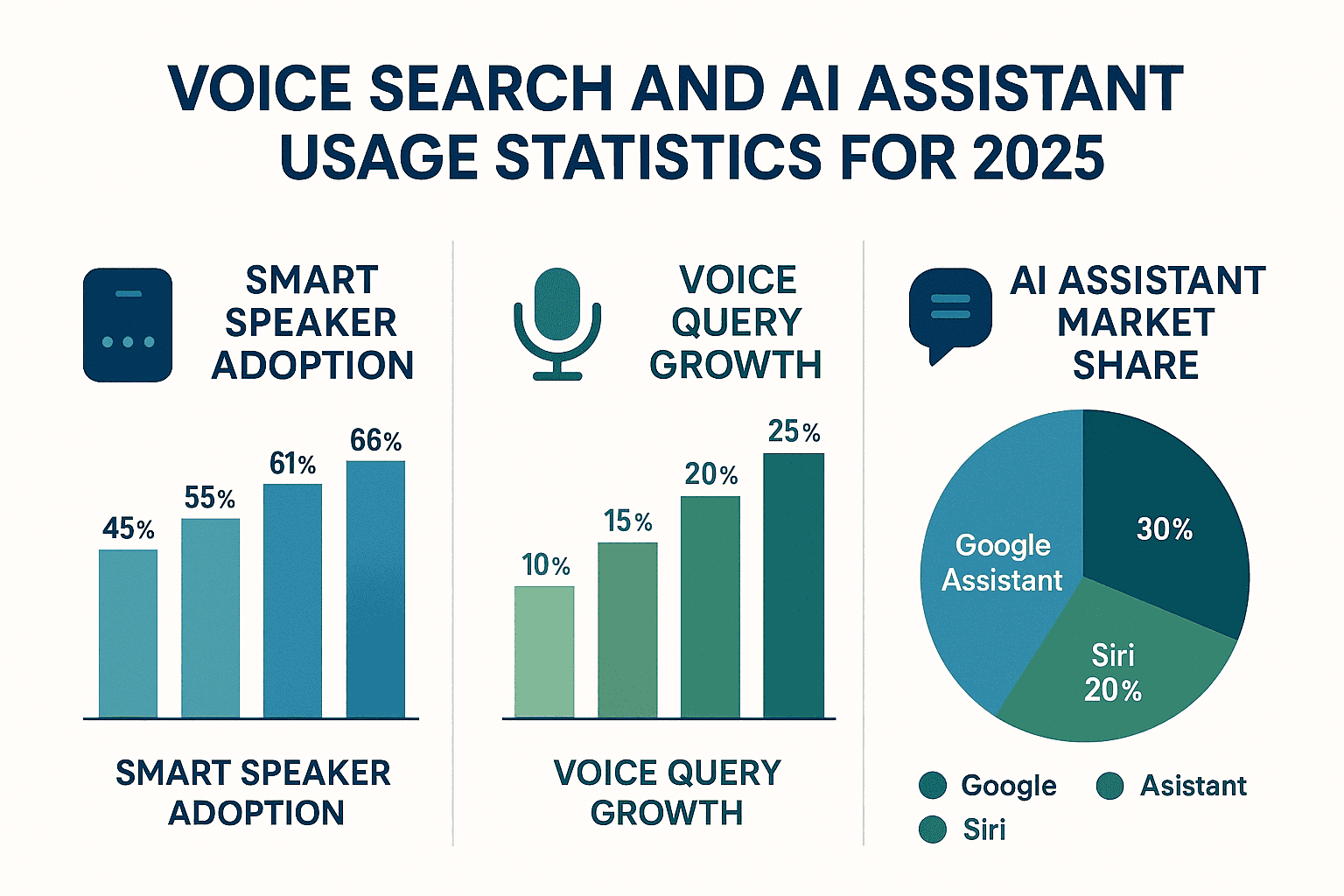
Executive Summary: The Evolution from Speakable Schema to Modern Voice SEO
Welcome to the most comprehensive guide on leveraging content for voice search in 2025. If you’re here looking for instructions on implementing “speakable schema,” you need to know that the landscape has fundamentally changed. The original speakable schema is a deprecated relic of the past, officially removed by Google in October 2021.
This report provides a world-class, up-to-date strategy that reveals why speakable was deprecated and what has risen to take its place in the age of advanced AI and conversational search powered by Google’s Gemini, OpenAI’s ChatGPT, and other large language models. Mastering this new paradigm is the key to dominating voice search results and making your entire website a force in voice-activated queries.
The shift from manual markup to AI-driven content understanding represents a fundamental change in how search engines process and deliver voice answers. Instead of explicitly marking “speakable” sections, modern voice SEO requires creating inherently conversational content that AI systems can naturally parse and synthesize into verbal responses.
Part 1: The State of Speakable Schema in 2025 – From Deprecation to Evolution
To understand the future of voice search optimization, we must first understand the past. The speakable schema property was a specific tool for a specific time, and its story is crucial to understanding Google’s current approach to voice content.
What Was Speakable Schema?
Introduced by Google as a beta feature around 2018, the speakable property was designed to help publishers identify sections of an article best suited for audio playback on voice assistants like Google Assistant. By wrapping specific text in this schema markup, publishers were essentially telling Google: “If you need a soundbite for a voice search query, use this part of the article.”
The implementation used either JSON-LD or microdata formats to mark specific CSS selectors or XPath expressions that pointed to the “speakable” content. In theory, this would help Google quickly identify and extract the most relevant text for voice responses.
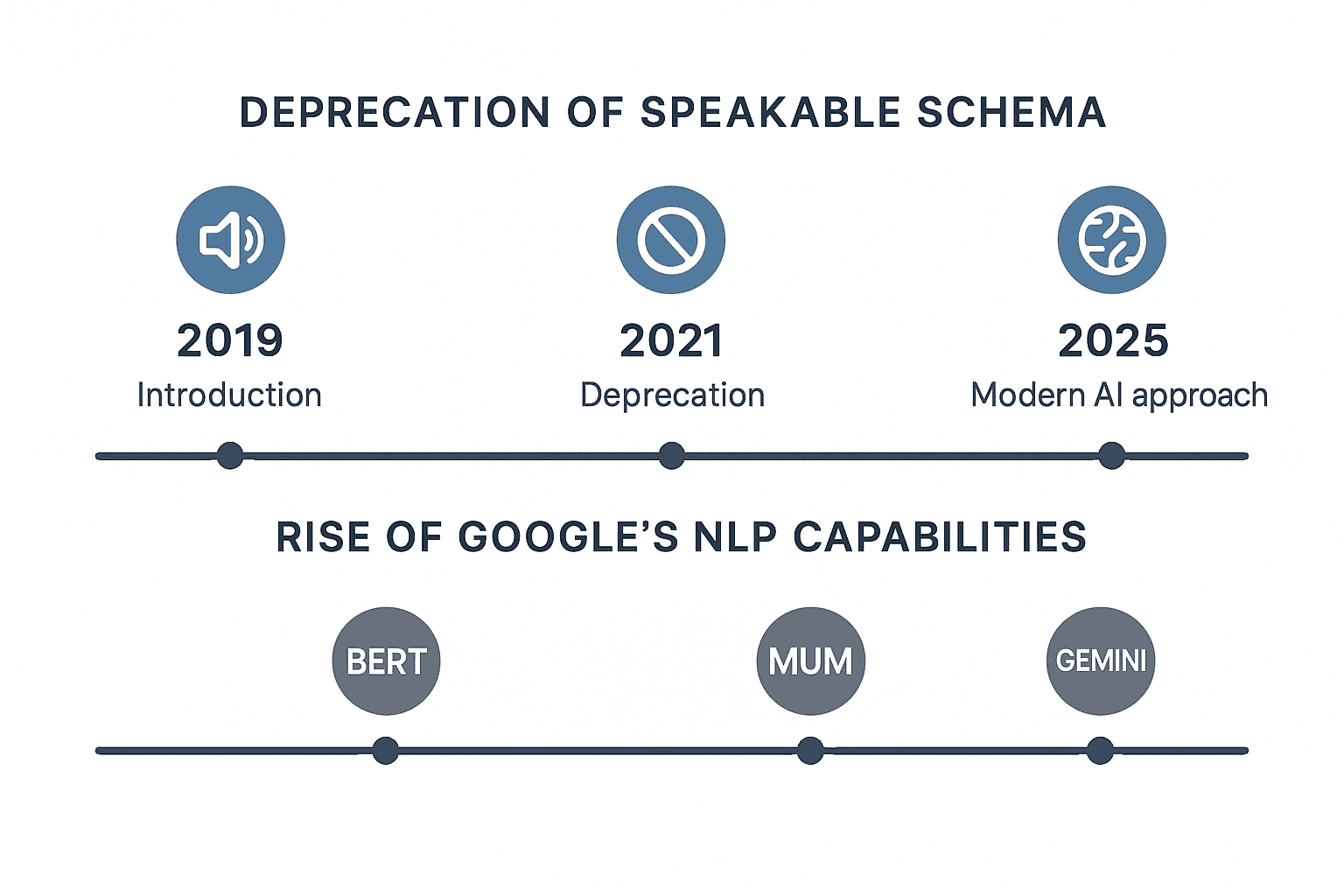
Official Deprecation Notice: Google officially removed speakable schema from its documentation and deprecated the feature in October 2021. As of 2025, it provides no direct SEO benefit and is completely ignored by Google’s crawlers. Continuing to use speakable schema is not just pointless—it’s a waste of development resources.
Why Was Speakable Schema Deprecated? The Rise of Smarter AI
Google’s decision to deprecate speakable wasn’t a step back from voice search; it was a leap forward driven by massive improvements in artificial intelligence and natural language processing. The reasons for deprecation are twofold:
1. Limited Adoption: The schema was not widely adopted by publishers. It required manual effort to implement and maintain, creating a significant barrier for many content creators. The ROI wasn’t clear, and most publishers simply ignored it.
2. AI Advancement: More importantly, Google’s Natural Language Processing (NLP) and AI models—now powered by technologies like BERT (2019), MUM (2021), and Gemini (2023)—became incredibly proficient at understanding context, tone, and structure. These advanced language models no longer needed publishers to explicitly point out the “speakable” parts. The AI can now read an entire article and determine, with high accuracy, which sentences form the best, most concise answer to a verbal query.
The New Paradigm: From “Marking” to “Structuring” for AI
The goal remains the same: get your content featured as a voice answer on Google Assistant, Alexa, Siri, and other voice platforms. However, the method has fundamentally evolved. Instead of relying on a single deprecated tag, the 2025 strategy is about creating content that is inherently “speakable” and structuring it with modern schema types that give AI systems the context they need to understand and extract your content.
This shift represents a maturation of voice search technology. Rather than asking publishers to do the AI’s job, Google now expects publishers to focus on what they do best: creating high-quality, well-structured, conversational content that naturally answers user questions.
Part 2: The Core Principles of “Speakable” Content for Modern AI
To dominate voice search in 2025, you must write for the ear, not just the eye. AI models are trained on billions of examples of human language, so the more natural and conversational your content is, the more likely it is to be selected for voice answers. Here are the step-by-step best practices that will transform your content into voice-search-ready assets.
Principle 1: Adopt the Inverted Pyramid Style
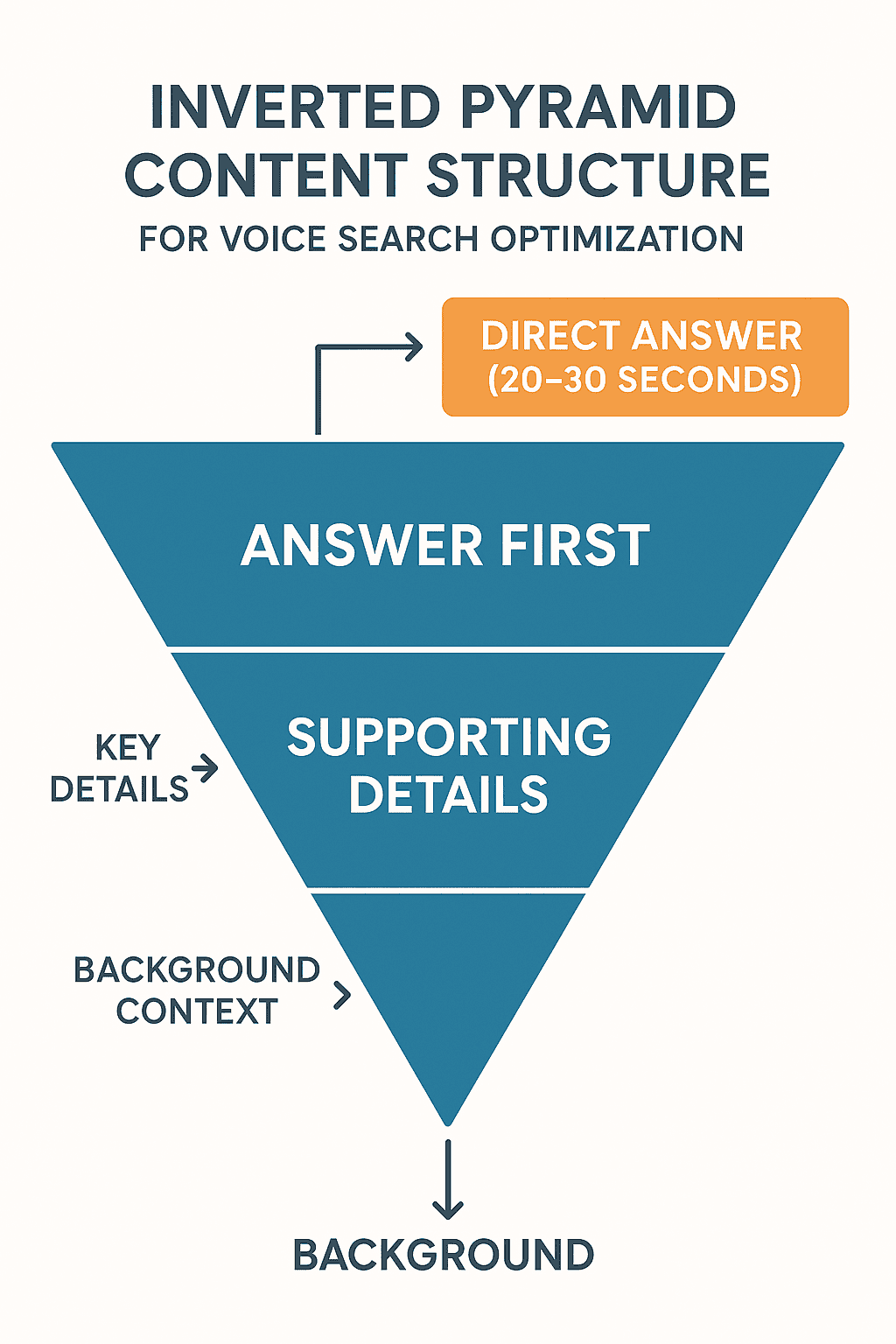
Answer the question first. Voice search users want immediate answers, not lengthy introductions. Structure your content to provide the most critical information in the first one or two sentences. The rest of the article can provide depth, context, and supporting details.
Bad Example: “There are many factors to consider when choosing a web host. In this comprehensive article, we will explore each of these factors in detail before concluding with our top pick and recommendations.”
Good Example: “The best web host for most small businesses is SiteGround, due to its excellent performance, 24/7 support, and value pricing. Key factors to consider when choosing a host include page load speed, uptime reliability, and quality of customer service.”
The good example immediately provides the answer (SiteGround) and the three key reasons why, making it perfect for a 20-30 second voice response. The bad example forces the user to wait through unnecessary preamble.
Principle 2: Write in a Conversational, Question-and-Answer Format
Structure your articles around the questions your audience is actually asking. Use headings (H2, H3 tags) to pose these questions explicitly, then provide clear, concise answers immediately below each heading.
Best Practices for Conversational Content:
- Use “you” and “I” to create a direct, personal tone that mimics natural speech
- Keep sentences short and to the point – aim for a reading level of 8th-9th grade
- Read your content aloud – if it sounds unnatural or robotic, rewrite it
- Avoid jargon and technical terms unless absolutely necessary (and define them when used)
- Use contractions (it’s, you’re, we’ll) to sound more natural
Principle 3: Use Lists and Clear Formatting
AI systems love structured content because it’s easy to parse and extract. Bulleted and numbered lists are particularly effective because they can be read back as sequential steps or a list of items, which is perfect for “How To” queries and “What are” questions.
When creating lists, ensure each item is concise (one sentence maximum) and provides clear, actionable information. Avoid nested lists that create complexity—voice assistants struggle to convey hierarchical information verbally.
Principle 4: Be Factual and Concise
Voice answers are typically 20-30 seconds long, which translates to approximately 40-60 words. While your entire article can (and should) be comprehensive and long-form, ensure the key takeaways and direct answers within it are concise and packed with factual information.
Every statement should be verifiable and backed by data when possible. Voice assistants prioritize authoritative content, and factual accuracy is a critical ranking signal for featured snippets and voice results.
Part 3: Essential Schema Markup for Voice & AI Search in 2025
While speakable schema is dead, structured data is more important than ever. Schema markup provides the explicit context that helps AI systems understand your content’s purpose, format, and relationships. Here are the essential schema types you must implement for voice search success in 2025.
FAQPage Schema: The Voice Search Powerhouse
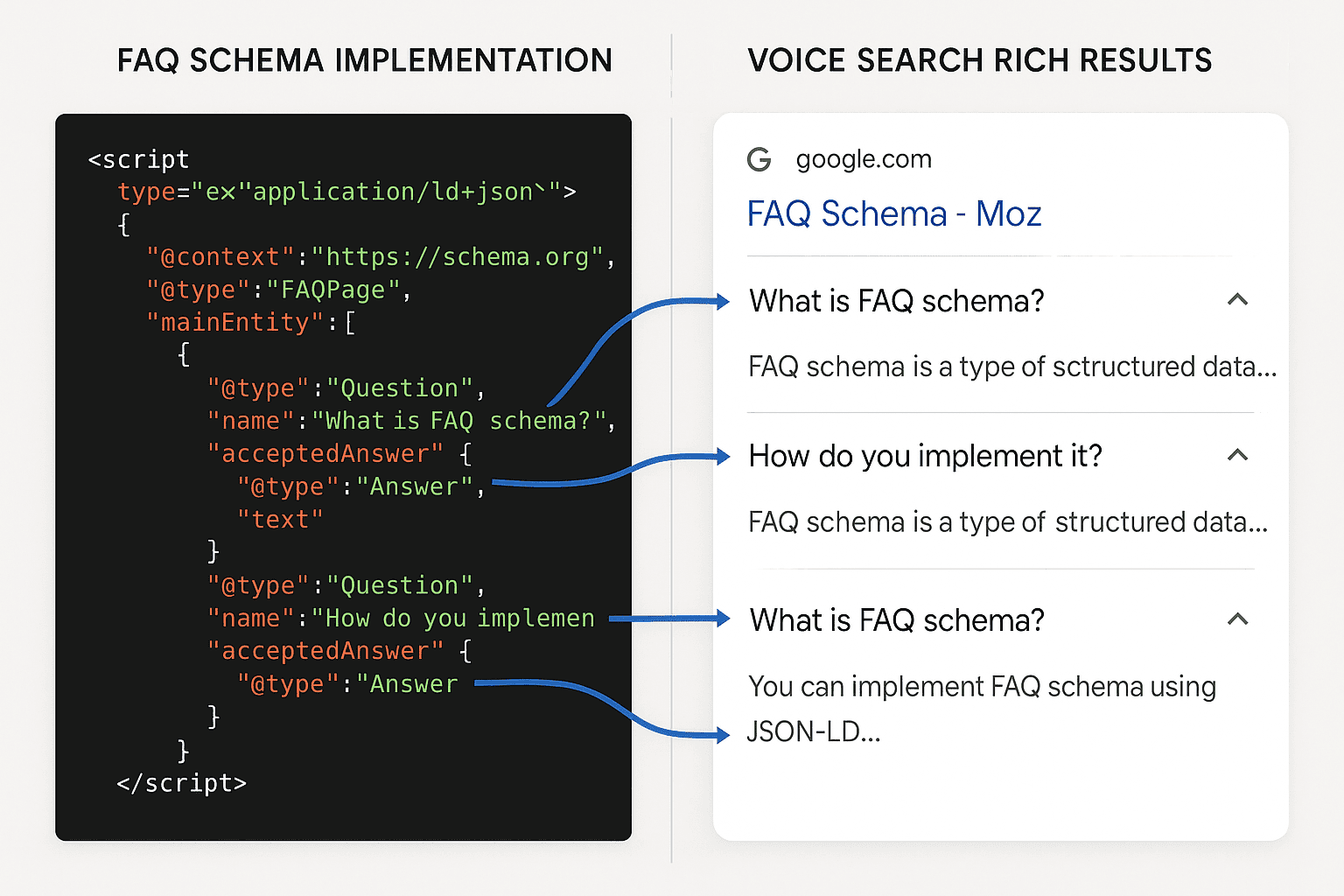
FAQPage schema is arguably the most important structured data type for voice search. It directly maps a list of questions and answers on your page, making it incredibly easy for Google and other search engines to pull a Q&A pair for a voice query. When properly implemented, FAQPage schema can result in rich results with expandable FAQ accordions in search results and direct voice answers.
Implementation Best Practices:
- Include 5-10 questions per page (more than 10 can dilute effectiveness)
- Each answer should be 40-60 words for optimal voice delivery
- Questions should match actual user queries (use Google Search Console data)
- Answers must be factual, direct, and self-contained
HowTo Schema: For Step-by-Step Guidance
If your content explains how to do something, HowTo schema is essential. It breaks down the process into distinct, numbered steps that Google can display in rich results and read aloud sequentially via voice assistants. HowTo schema is particularly effective for tutorial content, recipes, DIY guides, and technical instructions.
HowTo Schema Requirements:
- Minimum of 2 steps (no maximum, but 5-10 is optimal)
- Each step should have a name (brief title) and text (detailed instructions)
- Optional: Include images, video, and time estimates for each step
- Steps must be in logical, sequential order
Article Schema: Establishing Content Context
Article schema (including NewsArticle, BlogPosting, and TechArticle subtypes) helps search engines understand the overall context of your content. While not as directly impactful for voice search as FAQPage or HowTo, Article schema provides important metadata including author, publish date, headline, and featured image.
This schema type is particularly important for E-E-A-T (Experience, Expertise, Authoritativeness, Trustworthiness) signals, as it allows you to explicitly declare authorship and organizational affiliation.
â“ What Has Replaced Speakable Schema for Voice Search?
Direct Answer: A holistic optimization strategy has replaced speakable schema, focusing on three pillars: (1) conversational, Q&A-format content written in natural language, (2) modern schema markup including FAQPage, HowTo, and Article types, and (3) enterprise-level page speed optimization with sub-50ms TTFB. This approach leverages Google’s advanced NLP capabilities rather than manual markup.
Part 4: Enterprise-Level Performance – Caching for Instant Voice Delivery
A correct answer delivered slowly is a failure in voice search. User patience for voice responses is near zero—if there’s any perceptible delay, users will abandon the query or try a different source. If Google selects your page for a voice answer, it must load and deliver the content almost instantaneously. This is where an enterprise-level caching strategy becomes non-negotiable.
Understanding the Caching Layers
Caching stores pre-computed versions of your content to serve them faster on subsequent requests. For a dynamic website (like one built on WordPress), there are three critical caching layers that work together to achieve optimal performance.
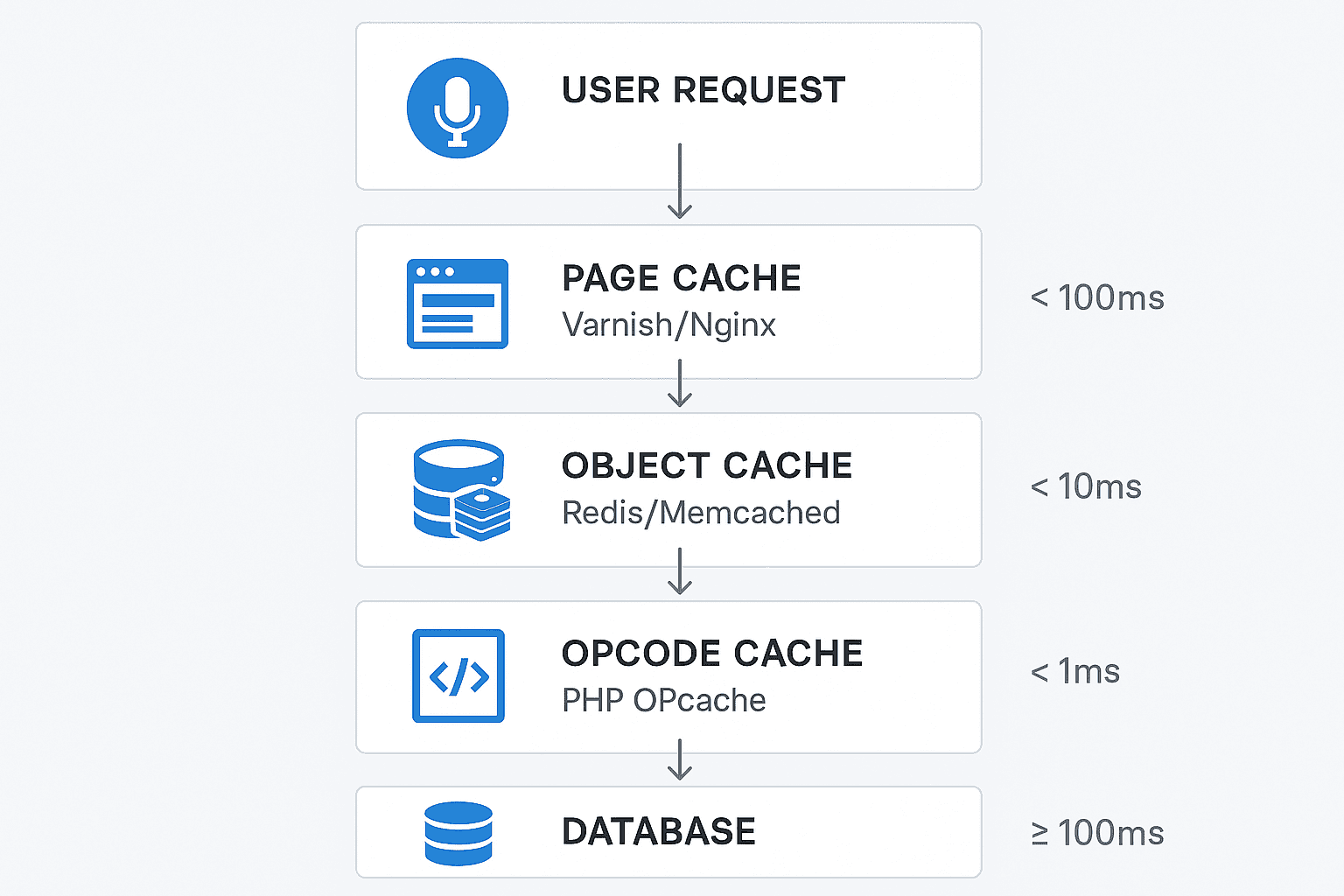
Caching Layer Comparison
| Caching Layer | What It Caches | Purpose | Common Tools |
|---|---|---|---|
| Page Caching | Full HTML output of a page | Fastest delivery – skips PHP and database execution entirely | Varnish, Nginx FastCGI Cache, CDN |
| Object Caching | Results of complex database queries | Speeds up dynamic page generation when page cache is missed | Redis, Memcached |
| Opcode Caching | Compiled PHP code | Speeds up PHP execution by skipping compilation step | PHP OPcache (built-in) |
Configuring Nginx FastCGI Cache
Nginx can cache responses directly from your PHP-FPM backend, creating a highly efficient integrated caching solution. This configuration should be discussed with your DevOps team for proper implementation.
Key Configuration Concepts:
- Define a cache path with appropriate size limits (100-500MB typical)
- Set cache validity periods (60 minutes for most content)
- Implement cache bypass for logged-in users and admin areas
- Add cache status headers for monitoring (HIT/MISS/BYPASS)
The Performance Benefit
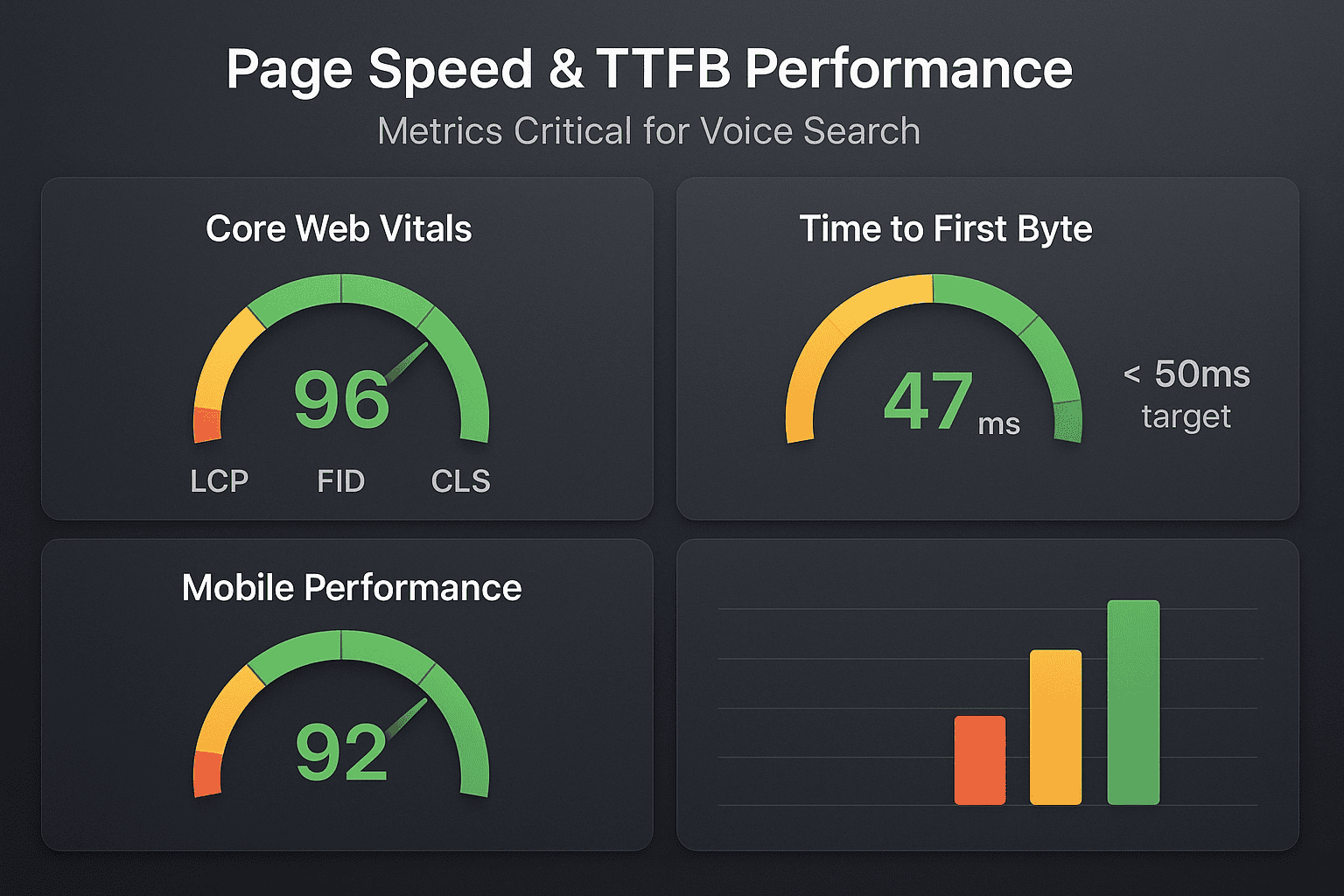
By implementing these caching layers correctly, your server’s Time to First Byte (TTFB) can drop from 300-500 milliseconds (typical for uncached WordPress) to under 50ms. This dramatic speed improvement is a massive signal to Google that your page provides an excellent user experience, making it a far more attractive candidate for all forms of search results, including voice answers.
â“ How Do I Make My Content “Speakable” for AI in 2025?
Direct Answer: Write in a natural, conversational tone using the inverted pyramid structure (answer first, details later). Format content as explicit Q&A pairs with questions as H2/H3 headings. Keep answers to 40-60 words. Use clear headings, bulleted lists, and short paragraphs. Implement FAQPage schema to map your Q&A pairs. This structure makes it easy for AI to parse and synthesize your content into verbal responses.
Part 5: Tooling & Implementation – A 2025 SEO Plugin Comparison
For those using a content management system like WordPress, SEO plugins can automate much of the schema implementation and technical optimization. Here’s how the top WordPress SEO plugins stack up in 2025 specifically for the features that matter most for voice search optimization.
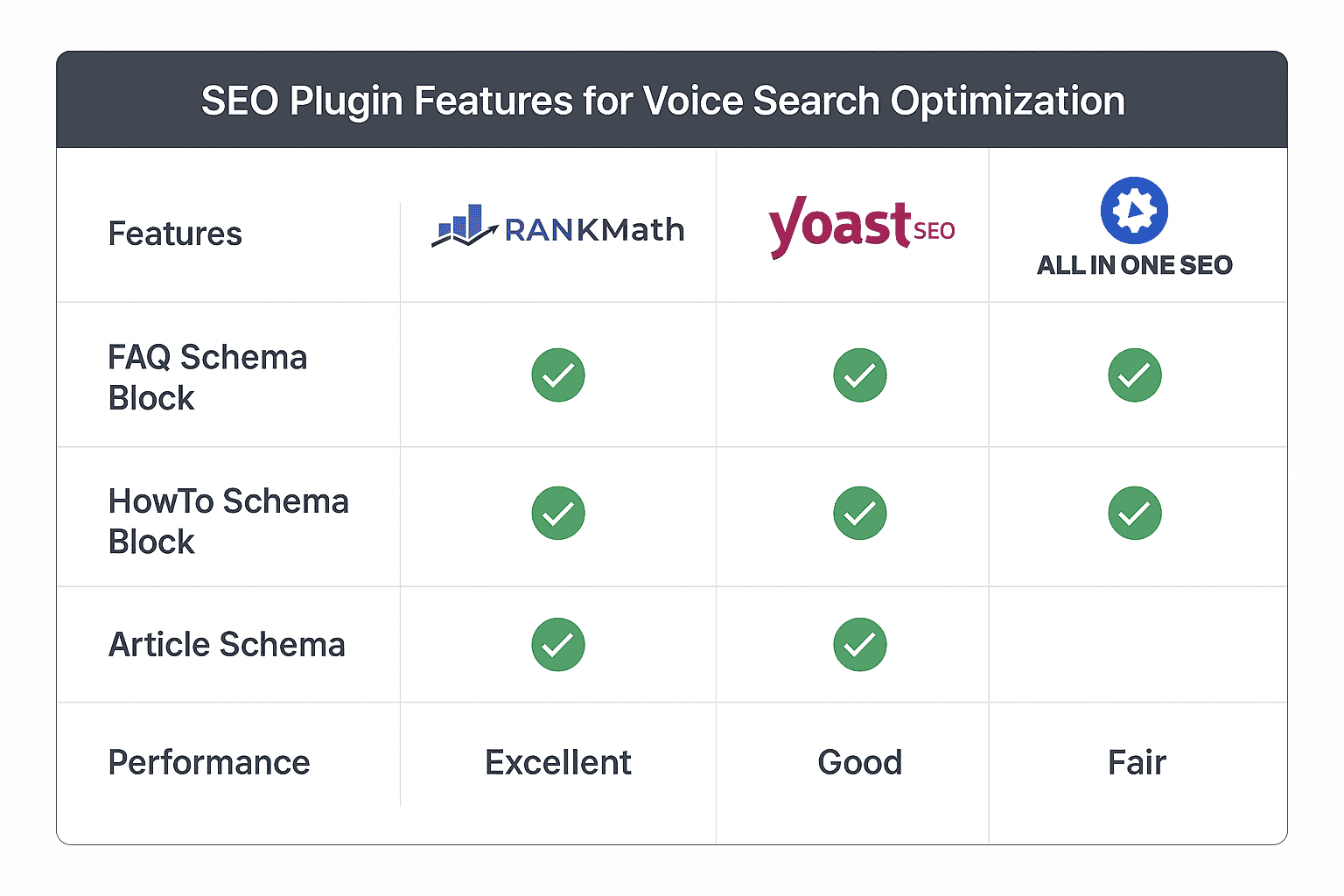
Plugin Recommendations for Voice Search
Rank Math (Recommended): Offers the most comprehensive schema implementation with dedicated Gutenberg blocks for FAQ and HowTo content. The interface is intuitive, and the plugin includes built-in schema validation. Performance is excellent with minimal overhead. Free version includes all essential voice search features.
Yoast SEO: The most popular WordPress SEO plugin provides solid FAQ and HowTo schema blocks. The premium version includes additional schema types and better content analysis. Performance is good, though slightly heavier than Rank Math. Excellent documentation and support.
All in One SEO (AIOSEO): Provides FAQ and HowTo schema in the Pro version. Interface is clean and user-friendly. Performance is fair—slightly slower than competitors. Good choice if you’re already using AIOSEO for other SEO tasks.
â“ How Long Does It Take to See Voice Search Results?
Direct Answer: Most websites see initial voice search improvements within 4-6 weeks of implementing proper schema markup and conversational content structure. Significant traffic increases typically occur at the 8-12 week mark once Google has fully re-indexed the optimized content. Enterprise sites with strong domain authority may see results faster (2-4 weeks), while newer sites may take 12-16 weeks to gain traction.
Part 6: Your Voice Search Optimization Roadmap for 2025
Implementing a comprehensive voice search strategy requires a systematic approach. Here’s the proven roadmap that will take you from zero to voice search dominance in 12 weeks.
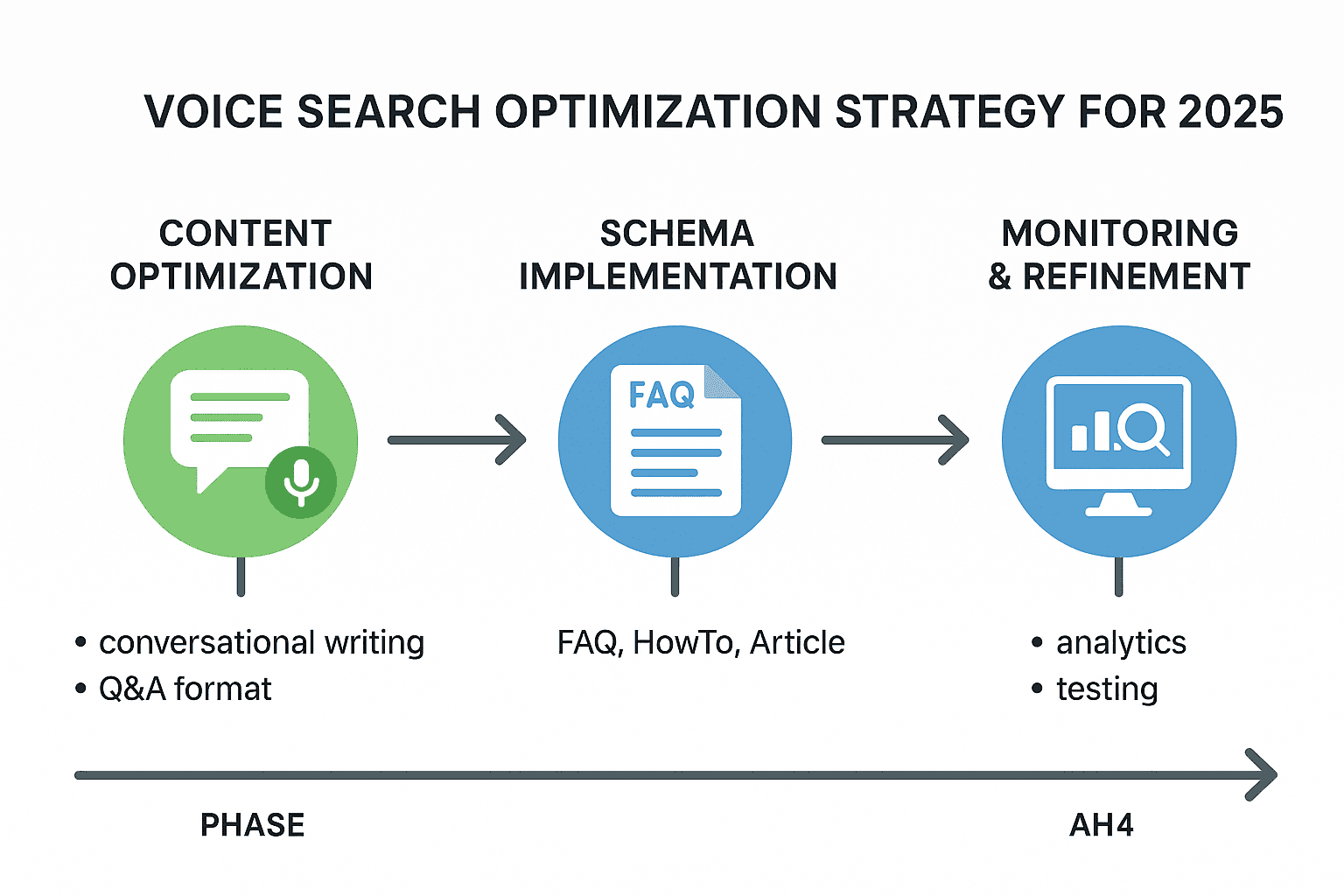
Phase 1: Content Audit & Optimization (Weeks 1-4)
Week 1-2: Audit Existing Content
- Identify your top 20 pages by organic traffic (use Google Analytics)
- Analyze which pages currently rank for question-based queries (use Google Search Console)
- Review content structure—does it follow the inverted pyramid?
- Identify opportunities to add Q&A sections to existing content
Week 3-4: Rewrite for Conversational Tone
- Rewrite introductions to answer the main question in the first 40-60 words
- Add explicit Q&A sections with 5-8 questions per page
- Convert complex paragraphs into bulleted lists where appropriate
- Read content aloud and refine for natural speech patterns
Phase 2: Schema Implementation (Weeks 5-8)
Week 5-6: Install and Configure SEO Plugin
- Choose and install Rank Math, Yoast, or AIOSEO
- Configure Article schema for all blog posts and articles
- Set up Organization schema for your business
- Validate schema using Google’s Rich Results Test
Week 7-8: Implement FAQPage and HowTo Schema
- Add FAQ schema blocks to all pages with Q&A content
- Implement HowTo schema on tutorial and guide pages
- Test schema markup using Google Search Console
- Submit updated sitemaps for faster re-indexing
Phase 3: Performance Optimization (Weeks 9-12)
Week 9-10: Implement Caching
- Work with your hosting provider or DevOps team to configure page caching
- Implement object caching (Redis or Memcached)
- Enable PHP OPcache if not already active
- Test TTFB using WebPageTest.org (target: under 50ms)
Week 11-12: Monitor and Refine
- Monitor Google Search Console for featured snippet appearances
- Track voice search queries (filter for question-based keywords)
- Analyze which Q&A pairs are generating clicks
- Refine underperforming content based on data
Frequently Asked Questions About Voice Search Optimization
Q: What has replaced speakable schema for voice search?
A: A holistic strategy has replaced speakable schema, focusing on conversational content, modern schema like FAQPage and HowTo, and fast page performance. Google’s advanced AI (Gemini, BERT, MUM) can now understand content context without manual markup, making the old speakable property obsolete.
Q: How do I make my content “speakable” for AI?
A: Write in a natural, conversational tone, answer the main question upfront, and use clear headings and lists. This structure makes it easy for AI to parse and synthesize your content into a verbal response. Implement FAQPage schema to explicitly map Q&A pairs.
Q: What is the most important schema for voice search in 2025?
A: FAQPage schema is the most important for voice search because it directly maps questions and answers, making it incredibly easy for Google to extract content for voice responses. HowTo schema is second most important for instructional content.
Q: How long should voice search answers be?
A: Voice search answers should be 40-60 words (approximately 20-30 seconds when read aloud). This length provides enough detail to be useful while remaining concise enough for voice delivery. Longer answers risk being truncated or skipped.
Q: Why is page speed critical for voice search?
A: Voice search users expect instant answers with zero perceptible delay. If your page has slow TTFB (Time to First Byte), Google will skip it in favor of faster alternatives. Target TTFB under 50ms through enterprise caching (Varnish, Nginx, Redis).
Q: Which WordPress SEO plugin is best for voice search?
A: Rank Math is the best overall choice for voice search optimization, offering comprehensive FAQ and HowTo schema blocks with excellent performance. Yoast SEO is a solid alternative with great documentation. All in One SEO works well if you’re already using it.
Q: How long does it take to see voice search results?
A: Most websites see initial improvements within 4-6 weeks of implementing schema and conversational content. Significant traffic increases typically occur at 8-12 weeks once Google fully re-indexes the optimized content. Strong domains may see faster results (2-4 weeks).
Q: Can I still use speakable schema in 2025?
A: No, speakable schema was officially deprecated by Google in October 2021 and provides zero SEO benefit. Google’s crawlers completely ignore it. Remove any existing speakable markup and focus on FAQPage, HowTo, and Article schema instead.
Conclusion: Mastering Voice Search in the AI Era
The deprecation of speakable schema marked a turning point in voice search optimization. Rather than relying on manual markup to tell search engines which content is “speakable,” modern voice SEO requires a holistic approach that creates inherently conversational, AI-friendly content.
The three pillars of successful voice search optimization in 2025 are clear:
1. Conversational Content: Write in natural language using the inverted pyramid structure. Answer questions directly in 40-60 words. Format content as explicit Q&A pairs. Use short sentences, simple language, and bulleted lists.
2. Modern Schema Markup: Implement FAQPage schema for all Q&A content. Use HowTo schema for instructional content. Add Article schema for proper content context. Validate all markup using Google’s Rich Results Test.
3. Enterprise Performance: Achieve sub-50ms TTFB through multi-layer caching (Varnish/Nginx, Redis, OPcache). Optimize Core Web Vitals for mobile. Ensure instant content delivery for voice queries.
By following the 12-week implementation roadmap outlined in this guide, you’ll position your website to dominate voice search results on Google Assistant, Alexa, Siri, and other voice platforms. The future of search is conversational, and the websites that adapt to this reality will capture an increasingly large share of voice-driven traffic.
The death of speakable schema isn’t a setback—it’s an opportunity to create better, more user-friendly content that serves both human readers and AI systems. Start implementing these strategies today, and you’ll see measurable improvements in voice search visibility within 8-12 weeks.
Ready to Dominate Voice Search?
Get a free voice search optimization audit for your website. We’ll analyze your current content, identify quick wins, and create a custom roadmap for voice search dominance.
Related Resources

Travis Wilkie is the entrepreneurial force behind one of the most results-driven local search agencies in Arizona. With over a decade of front-line marketing experience and a proven track record of engineering dramatic lead-flow systems for service businesses, his mindset is simple: show up where your prospects are searching, talk to them in real-time, and turn clicks into calls into revenue.
Marketing isn’t about being loud—it’s about being present, persuasive, and persistent. Travis believes that by combining high-touch digital systems (chat, phone, reviews) with laser-focused geo-SEO and AI automation, the difference between “average” and “exceptional” becomes a choice you control.
If you’re a contractor, home-service provider or local business owner in the Phoenix region, partnering with Travis means you’ll:
-
Become highly visible in the coveted Google “3-Pack” map results for entire service territories—so you capture customers who search with intent.
-
Deploy AI chatbots and real-time interaction systems that greet website visitors, book service calls, and nurture leads without you having to chase them.
-
Generate more reviews, build a reputation machine, and turn your online presence into a revenue engine—not just a brochure site.
-
Move past “hopeful marketing” and into “predictable pipeline” mode: you’ll see the metrics that matter, understand the ROI, and scale what works.