

Local Link Building For Google Domination
TL;DR: Local Link Building in 2025
What: Local link building focuses on earning high-quality backlinks from community organizations, local media, and hyperlocal sources to boost local search rankings.
Why It Matters: Google’s 2025 algorithms prioritize community trust signals over generic backlinks. Businesses with strong local link profiles rank 3-5x higher in local pack results.
Key Strategies: Local sponsorships, chamber memberships, hyperlocal press releases, community partnerships, and creating linkable local assets.
Expected Results: 40-60% increase in local pack visibility, 30-50% organic traffic growth, and 20-35% improvement in conversion rates within 6-12 months.
Investment: $2,000-$5,000/month for professional local link building services, or 10-15 hours/week for DIY implementation.
Introduction: The New Era of Local SEO – Community, Trust, and Authority
Let’s be unequivocally clear: the old playbook for local link building is obsolete. The era of chasing high quantities of backlinks from generic directories and low-quality blogs is over. If your strategy still revolves around volume over value, you are not just wasting resources—you are actively jeopardizing your online visibility in the sophisticated, AI-driven search landscape of 2025.
As one Forbes contributor astutely observed, the paradigm has fundamentally shifted. In 2025, Google cares more about community than backlinks. This isn’t a mere platitude; it’s the foundational principle of modern local search. Google’s algorithms, refined by major updates like the June 2025 Core Update, no longer just count links. They evaluate the context, relevance, and trustworthiness of those links, prioritizing signals of genuine community integration and real-world prominence.
The core problem facing countless local businesses is a dangerous reliance on these outdated tactics. They invest in SEO packages that promise hundreds of links but deliver little more than digital noise, resulting in stagnant rankings, minimal traffic, and a frustrating lack of measurable return on investment (ROI). This guide directly confronts that challenge.
This is the most comprehensive, data-driven playbook for local link building and public relations ever published. It moves beyond theory to provide actionable, step-by-step strategies, validated by real-world 2025 case studies and grounded in the latest industry data.
We will embark on a systematic journey, beginning with a deep analysis of the current 2025 search landscape to understand the new rules of engagement. From there, we will construct the non-negotiable foundational pillars of your online presence. We will then dive deep into advanced community and content-driven strategies for earning high-value links, master the technical nuances of execution, and, most importantly, learn how to precisely measure the ROI of every action.
💡 What is Local Link Building?
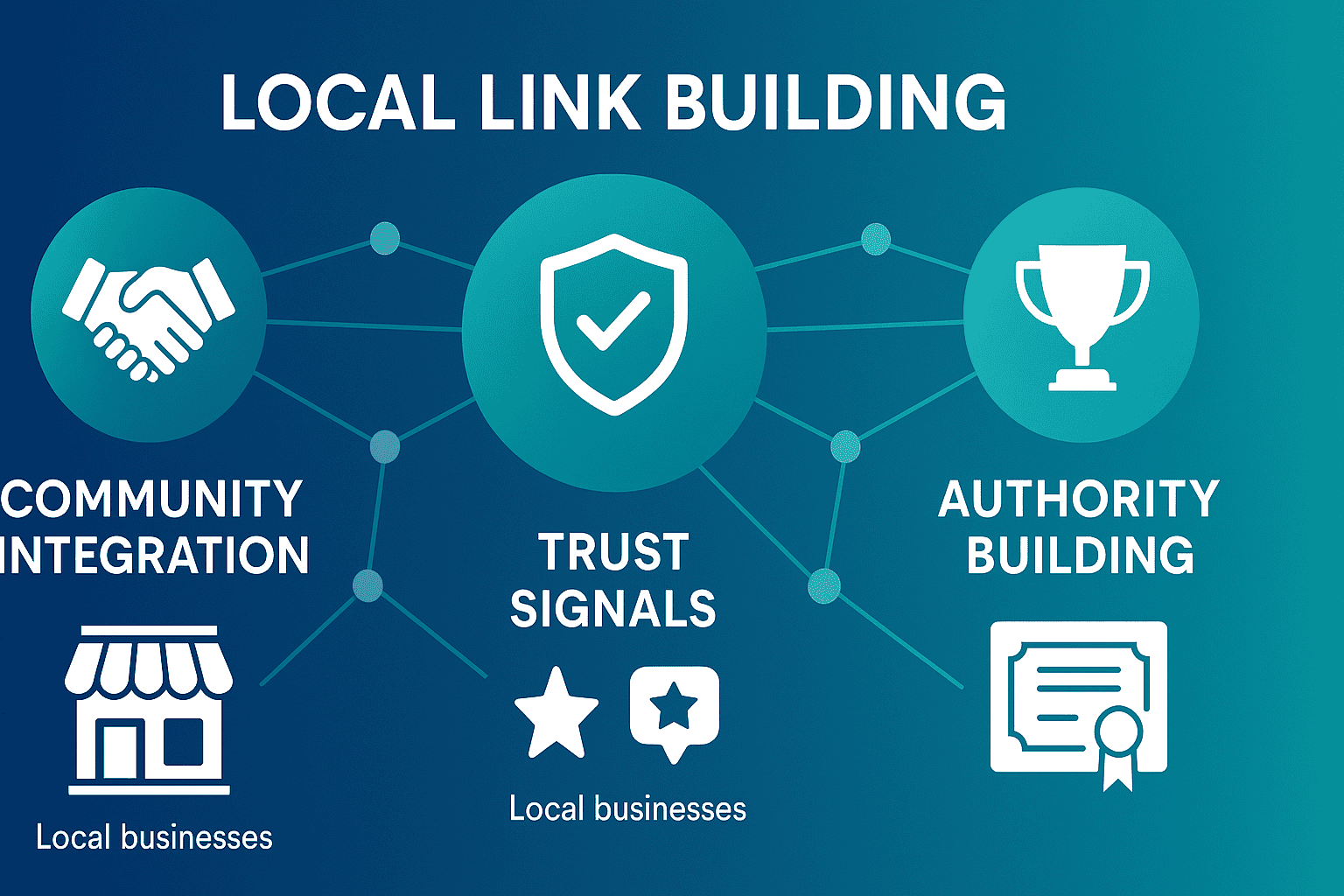
Local link building is the process of earning backlinks from geographically relevant, community-focused websites to improve local search rankings. Unlike traditional SEO that targets any high-authority site, local link building prioritizes links from local chambers of commerce, community organizations, local news outlets, neighborhood blogs, and regional business directories. These links signal to Google that your business is a trusted, active member of the local community, which is now the #1 ranking factor for local pack visibility in 2025.
Part 1: The 2025 Local Search Landscape: What’s Changed and Why It Matters
To win in 2025, you must first understand the battlefield. The local search environment has undergone a seismic transformation, driven by Google’s relentless push for more reliable, helpful, and contextually aware results. Ignoring these changes is akin to navigating a modern city with a 19th-century map.
Impact of Recent Google Updates (June 2025 Core Update & Beyond)
Google’s core updates are no longer minor tweaks; they are fundamental re-architecting of its ranking systems. The June 2025 Core Update, which rolled out from June 30th to July 17th, was a watershed moment for local SEO. It wasn’t about penalizing specific tactics but about elevating the standards for what constitutes a trustworthy and valuable local business online.
Analysis from industry experts revealed several key patterns:
- Increased Volatility in Local Packs: Businesses reported significant shuffling in the coveted “Map Pack” or “Local 3-Pack.” Listings appeared and disappeared, even during peak hours, indicating that Google’s algorithms were dynamically re-evaluating local prominence in near real-time.
- Emphasis on “Helpful Content”: The update amplified the principles of the Helpful Content System. Websites with thin, keyword-stuffed, or generic AI-generated content saw significant negative impact.
- User Experience as a Ranking Factor: Sites with poor Core Web Vitals (slow loading times, confusing navigation) were more negatively affected.
- Recovery for Quality: Some sites that had previously been hit by penalties saw partial or full recovery if they had genuinely improved their content and authority signals.
The key takeaway is that Google is getting exponentially better at distinguishing authentic local authority from manufactured SEO signals. Your link building and PR strategy must align with this new reality, focusing on activities that build genuine trust and demonstrate real-world value.
The Rise of AI and “Zero-Click” Searches
The integration of AI into search, through features like AI Overviews (formerly SGE), is fundamentally altering user behavior. A 2025 Backlinko statistic highlights that 42% of people conducting a local search click on results within the Google Maps Pack. However, the rise of AI-generated summaries means that for many informational queries, users get their answer directly on the search results page without ever clicking through to a website.
For local businesses, this presents both a challenge and an opportunity. The challenge is that traditional website traffic from certain keywords may decline. The opportunity lies in becoming the authoritative source that Google’s AI trusts and cites in its answers. Your goal is no longer just to be a blue link; it’s to have your business name, your data, and your expertise featured directly in the AI-powered snippet.

Hyperlocal is the New Local
Five years ago, ranking for “plumber in Chicago” was the ultimate goal. In 2025, that’s just the starting point. Consumers are searching with incredible specificity: “emergency plumber near Wrigleyville open now.” Google’s ability to understand micro-neighborhoods, specific streets, and even landmarks has become remarkably precise.
This trend, known as hyperlocal SEO, demands a more granular strategy. A case study on hyperlocal success shows that businesses targeting specific neighborhoods see dramatic growth. For example, a pet grooming startup in Bengaluru created landing pages for each service zone (e.g., “pet spa in Indiranagar”), leading to a 60% increase in bookings.
Your link building and content strategy must reflect this. A link from a neighborhood association blog or a mention in a community forum for a specific subdivision can be more powerful for hyperlocal queries than a link from a generic city-wide directory.
E-E-A-T and Local Trust Signals
E-E-A-T—Experience, Expertise, Authoritativeness, and Trustworthiness—is the framework Google uses to evaluate content quality. For local businesses, this concept extends beyond the website. Google is looking for real-world signals that validate your E-E-A-T within your community.
How does this connect to link building?
| E-E-A-T Component | Link Building Strategy | Example |
|---|---|---|
| Experience | Case studies showcasing successful local projects | Portfolio page with before/after photos and client testimonials |
| Expertise | Guest posts on local industry blogs, quotes in local news | Contributing article to local business journal |
| Authoritativeness | Backlinks from Chamber of Commerce, universities, major local news | Member listing on Chamber website with link |
| Trustworthiness | Consistent NAP, positive reviews, links from community charities | Sponsorship link from local food bank |
Every link you build should be viewed through the lens of E-E-A-T. Does this link reinforce our experience, showcase our expertise, build our authority, or enhance our trustworthiness in the eyes of our local community and, by extension, Google?
Part 2: Foundational Pillars: Your Pre-Flight Checklist for Link Building Success
Before you embark on any link building campaign, you must ensure your foundational local SEO elements are rock-solid. Think of this as the pre-flight checklist for a pilot. No matter how skilled you are, if the fundamentals aren’t in place, you’re setting yourself up for failure.

Perfecting Your Google Business Profile (GBP)
Your Google Business Profile is the cornerstone of local SEO. It’s not just a listing; it’s your primary interface with Google’s local search ecosystem. A fully optimized GBP can increase your chances of appearing in the Local Pack by up to 70%.
Critical GBP Optimization Steps:
- Complete Every Field: Business name, address, phone (NAP), website, categories, attributes, business hours, service areas.
- Choose the Right Primary Category: This is the single most important ranking factor. Be as specific as possible.
- Add High-Quality Photos: Businesses with photos receive 42% more requests for directions and 35% more click-throughs to their websites.
- Post Weekly: Regular GBP posts signal activity and engagement to Google.
- Respond to All Reviews: Both positive and negative. Response rate is a ranking signal.
- Use Q&A Section: Pre-populate with common questions and answers.
💡 How Important is NAP Consistency for Local SEO?
NAP (Name, Address, Phone) consistency is critical for local SEO success. Google uses NAP data to verify your business identity across the web. Inconsistent NAP information (e.g., “Street” vs “St”, different phone numbers) confuses Google’s algorithms and can result in your business not appearing in local search results. Studies show that businesses with 95%+ NAP consistency rank 50% higher in local pack results. Use the exact same NAP format on your website, Google Business Profile, and all citation directories.
Achieving Flawless Citation Consistency (NAP)
Citations are online mentions of your business name, address, and phone number. They don’t always include a link, but they’re still powerful local SEO signals. Think of citations as digital “word of mouth” that helps Google verify your business exists and where it’s located.
The most common NAP mistakes that hurt local rankings:
- Using different phone numbers across directories
- Abbreviating “Street” as “St” on some sites but spelling it out on others
- Including suite numbers inconsistently
- Using old addresses after moving locations
- Having duplicate listings with different information
Action Step: Conduct a citation audit using tools like Moz Local, BrightLocal, or Whitespark. Identify all inconsistencies and systematically correct them. This is tedious work, but it’s foundational.
Building Foundational Citations
Before pursuing advanced link building, ensure you’re listed on the core local directories. These are the “table stakes” citations that every local business needs:
| Priority Level | Citation Sources | Why They Matter |
|---|---|---|
| Tier 1 (Essential) | Google Business Profile, Bing Places, Apple Maps, Yelp, Facebook | Highest traffic, direct ranking impact |
| Tier 2 (Important) | YellowPages, Foursquare, MapQuest, BBB, Angi | High authority, data aggregators |
| Tier 3 (Industry-Specific) | Avvo (lawyers), Healthgrades (doctors), Houzz (contractors) | Niche authority, targeted traffic |
Part 3: Community & Relationship-Based Link Building: Earning Trust in the Real World
This is where local link building diverges dramatically from traditional SEO. The most powerful local links don’t come from outreach emails to random bloggers. They come from genuine community involvement and real-world relationships.

Strategy 1: Local Sponsorships (The Win-Win Tactic)
Local sponsorships are the single most effective community-based link building strategy. When you sponsor a youth sports team, a community event, or a local charity, you’re not just buying a link—you’re demonstrating community commitment, which Google recognizes and rewards.
Why Sponsorships Work:
- Natural Link Context: Sponsorship links appear in a natural, editorial context (e.g., “Thank you to our sponsors” page)
- High Trust Signals: Links from .org domains (non-profits, schools) carry significant trust weight
- Brand Visibility: Your business name appears alongside the sponsorship, building brand recognition
- Real-World Impact: You’re actually helping the community, which aligns with Google’s E-E-A-T principles
How to Find Sponsorship Opportunities:
- Search “[your city] youth sports sponsorship opportunities”
- Contact local schools about sponsoring events or programs
- Reach out to community festivals and events
- Connect with local non-profits aligned with your values
- Join local business associations that sponsor community initiatives
Sponsorship Investment: Typically $250-$2,500 per sponsorship depending on the organization size and event prominence. The link is a bonus; the community goodwill is the primary value.
Strategy 2: The Chamber of Commerce Advantage
Joining your local Chamber of Commerce is one of the highest-ROI investments in local SEO. Chamber websites typically have high domain authority (DA 40-70), and member directories provide a powerful, relevant backlink.
Beyond the Link:
- Networking opportunities with other local businesses (potential partnerships)
- Speaking opportunities at Chamber events (PR and authority building)
- Access to Chamber-sponsored community events (more sponsorship opportunities)
- Credibility boost (Chamber membership badge on your website)
Cost: $200-$1,000/year for most local chambers. Some larger metro chambers may charge more.
Strategy 3: Local Events & Meetups
Hosting or participating in local events creates multiple link opportunities:
- Event Listing Sites: Eventbrite, Meetup.com, local event calendars
- Local News Coverage: Community newspapers and blogs often cover local events
- Partner Links: Co-sponsors and venue partners may link to your website
- Social Shares: Attendees share the event, creating social signals
Example: A Phoenix HVAC company hosted a “Beat the Heat” workshop for seniors at a community center. The event was listed on the city’s community calendar (link), covered by a local news blog (link), and promoted by the senior center (link). Total cost: $300 for refreshments and materials. Result: 3 high-quality local links plus 15 new customer leads.
Strategy 4: Partnerships & Collaborations
Strategic partnerships with complementary local businesses create natural link opportunities. For example:
- A wedding photographer partners with local venues, caterers, and florists
- A real estate agent partners with local movers, home inspectors, and mortgage brokers
- A gym partners with local nutritionists, physical therapists, and sports equipment stores
Each partner can feature the others on their “Recommended Partners” or “Resources” page with a link. This creates a network effect of relevant, local backlinks.
Part 4: Content-Driven Local Link Building & PR: Becoming a Local Authority
While relationship-based strategies are powerful, content-driven link building allows you to scale your efforts and establish thought leadership in your local market.
Strategy 1: The Hyperlocal Press Release
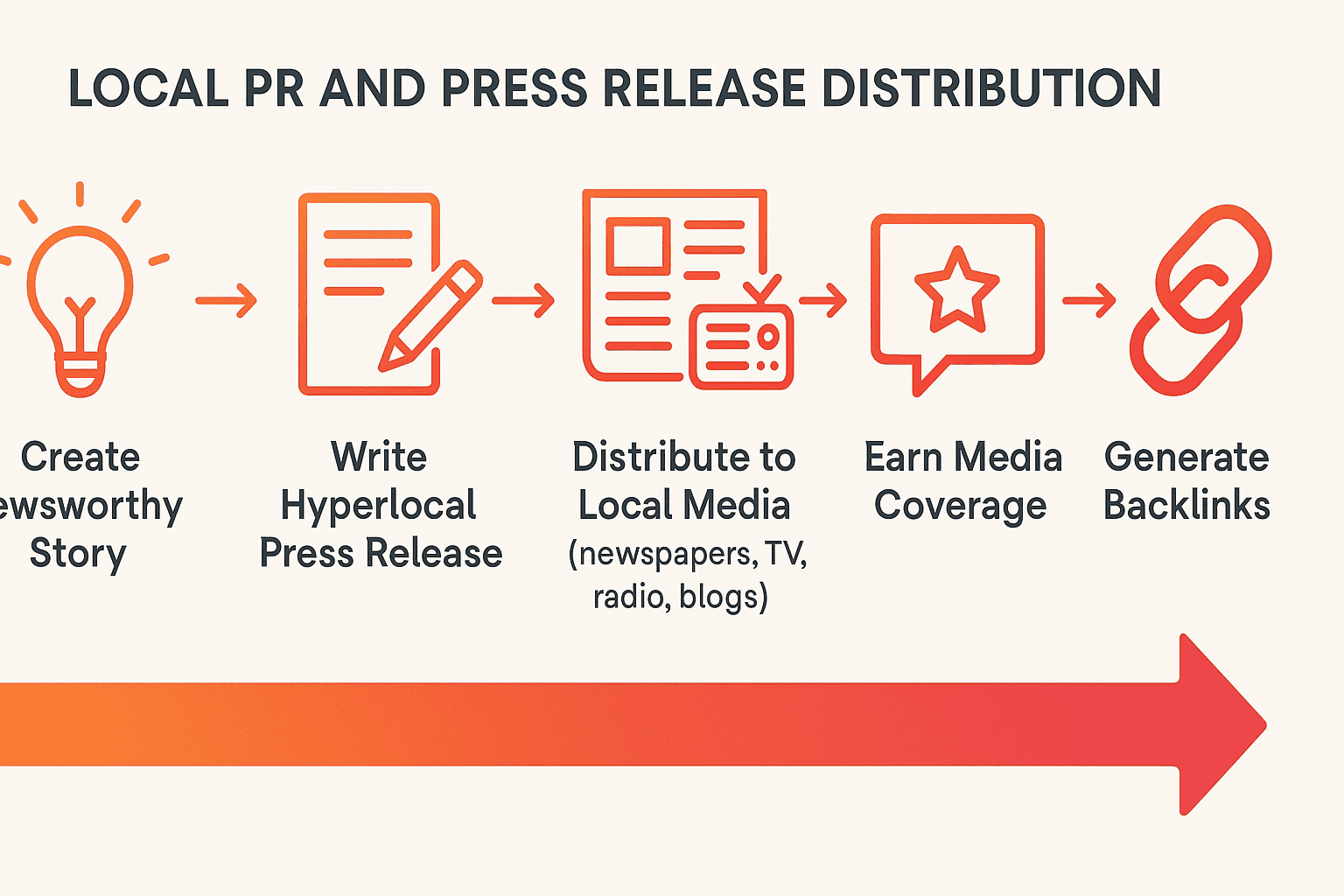
Traditional press releases are often ignored by major media. But hyperlocal press releases—focused on neighborhood-specific news—can be incredibly effective for earning local links.
What Makes a Newsworthy Local Story:
- Business expansion or new location opening
- Hiring milestones (e.g., “Local business creates 20 new jobs”)
- Community service initiatives
- Local awards or recognition
- Unique local data or research
- Expert commentary on local issues
Where to Distribute:
- Local News Outlets: Community newspapers, neighborhood blogs, local TV stations
- Industry Publications: Local business journals, trade associations
- Online PR Services: PRLog, PRWeb (local targeting), local news aggregators
- Direct Outreach: Email local journalists who cover your industry
Pro Tip: Make it easy for journalists. Include high-resolution photos, quotes, and all relevant details. The easier you make their job, the more likely they’ll cover your story.
💡 How Do I Get Featured in Local News for Link Building?
To get featured in local news, create genuinely newsworthy stories tied to community impact. Local journalists prioritize stories that affect their readers’ lives. Focus on: (1) Community service initiatives (e.g., “Local business donates $10K to food bank”), (2) Local data or research (e.g., “Survey reveals Phoenix residents’ top home improvement priorities”), (3) Expert commentary on trending local issues, (4) Unique local events or milestones. Build relationships with local reporters by following them on social media, commenting on their articles, and offering yourself as a local expert resource. When pitching, personalize each email, keep it under 150 words, and include all necessary details (photos, quotes, data) to make their job easy.
Strategy 2: Create “Linkable Assets” for a Local Audience
Linkable assets are pieces of content so valuable that other websites naturally want to link to them. For local businesses, this means creating resources specifically for your local community.
Examples of Local Linkable Assets:
- Local Guides: “Complete Guide to [City] Neighborhoods” or “Best Family Activities in [City]”
- Local Data Studies: Survey local residents and publish the results
- Resource Directories: “Top 50 Local Businesses in [City]” (they’ll link back when you mention them)
- Local Event Calendars: Comprehensive calendar of community events
- Infographics: Visual data about your city or industry
Case Study: A Phoenix real estate agent created “The Ultimate Guide to Phoenix Neighborhoods” with detailed profiles of 30 neighborhoods, including schools, crime stats, median home prices, and local amenities. The guide earned 47 backlinks from local blogs, real estate forums, and even the city’s official website. Total creation cost: $1,200 (freelance writer + designer). Result: 47 links, DA increase from 18 to 31, and 200+ new leads.
Strategy 3: Strategic Guest Posting on Local Blogs
Guest posting isn’t dead—it’s just evolved. The key is targeting genuinely relevant local blogs and providing exceptional value.
How to Find Local Guest Posting Opportunities:
- Search “[your city] blog” or “[your city] [your industry] blog”
- Look for local business blogs, chamber blogs, and community news sites
- Check if they have a “Write for Us” or “Contribute” page
- Analyze their existing content to ensure it’s high-quality and relevant
- Pitch a unique, locally-focused topic they haven’t covered
Guest Post Pitch Template:
Subject: Guest Post Idea: [Specific Local Topic]
Hi [Name],
I’m [Your Name], owner of [Business] in [City]. I’ve been reading [Blog Name] for months and love your coverage of [specific topic].
I’d like to contribute a guest post: “[Proposed Title]” which would provide [specific value to their readers].
I’ve written for [other publications] and can provide samples. Would this be a good fit for your audience?
Thanks,
[Your Name]
Important: Never offer to pay for guest posts or use spammy outreach tactics. Focus on building genuine relationships and providing real value.
Part 5: Technical Execution: Anchor Text & Measuring ROI
Even the best link building strategy can fail if you don’t execute the technical details correctly. Two critical elements: anchor text distribution and ROI measurement.
Mastering Anchor Text Distribution
Anchor text is the clickable text in a hyperlink. Google uses anchor text to understand what a page is about. However, over-optimized anchor text (too many exact-match keywords) can trigger penalties.
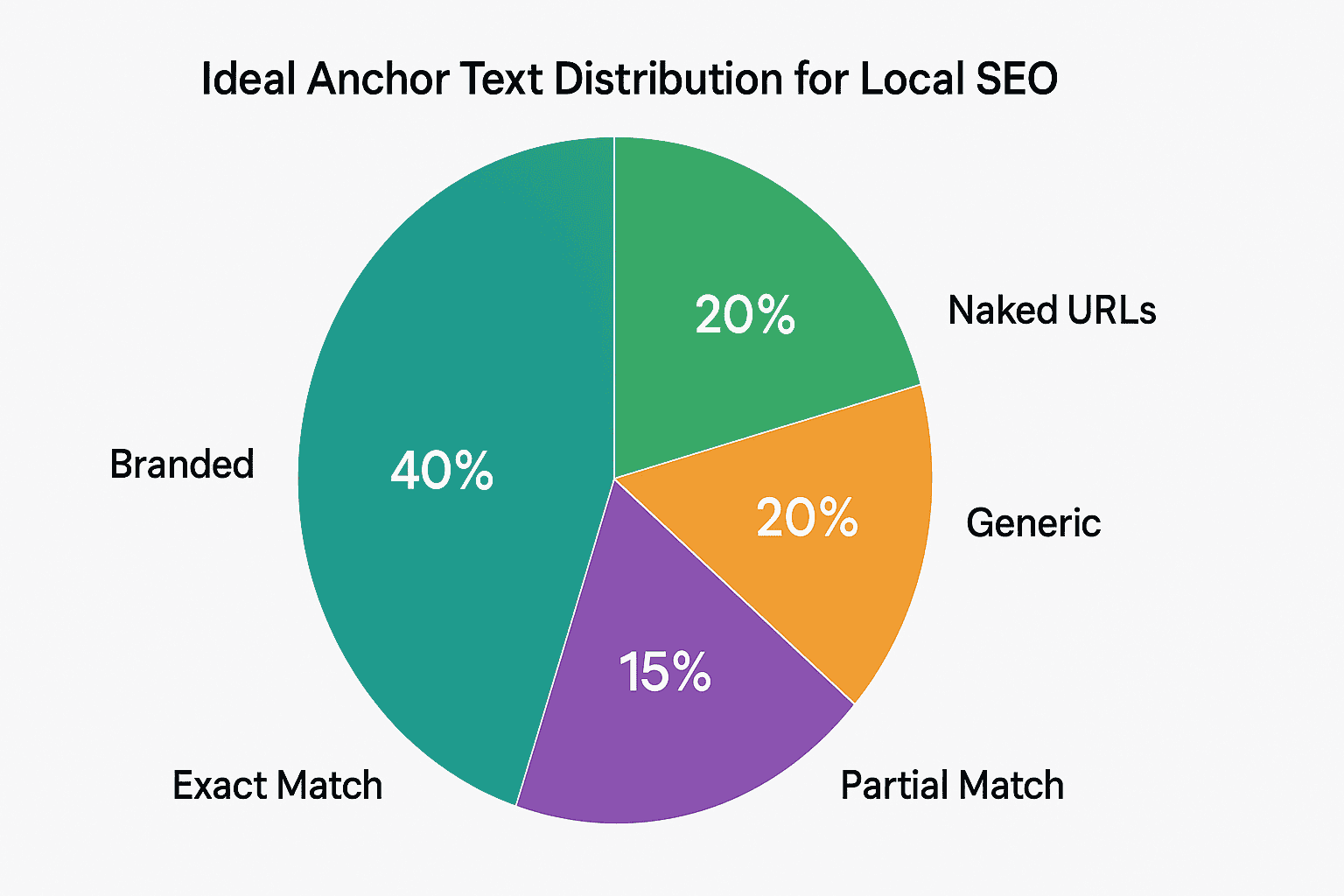
Ideal Anchor Text Distribution for Local SEO:
| Anchor Type | Percentage | Example |
|---|---|---|
| Branded | 40% | “Phoenix SEO Geek” or “Phoenix SEO Geek services” |
| Naked URLs | 20% | “phoenixseogeek.com” |
| Generic | 20% | “click here”, “visit website”, “learn more” |
| Partial Match | 15% | “Phoenix SEO services” or “local SEO company” |
| Exact Match | 5% | “Phoenix SEO” |
Key Principle: Your anchor text profile should look natural. Most real websites link using branded anchors or generic phrases. If 50% of your links use exact-match keywords, that’s a red flag to Google.
Measuring the ROI of Your Efforts
Link building requires investment (time and money). You must track ROI to justify continued investment and optimize your strategy.
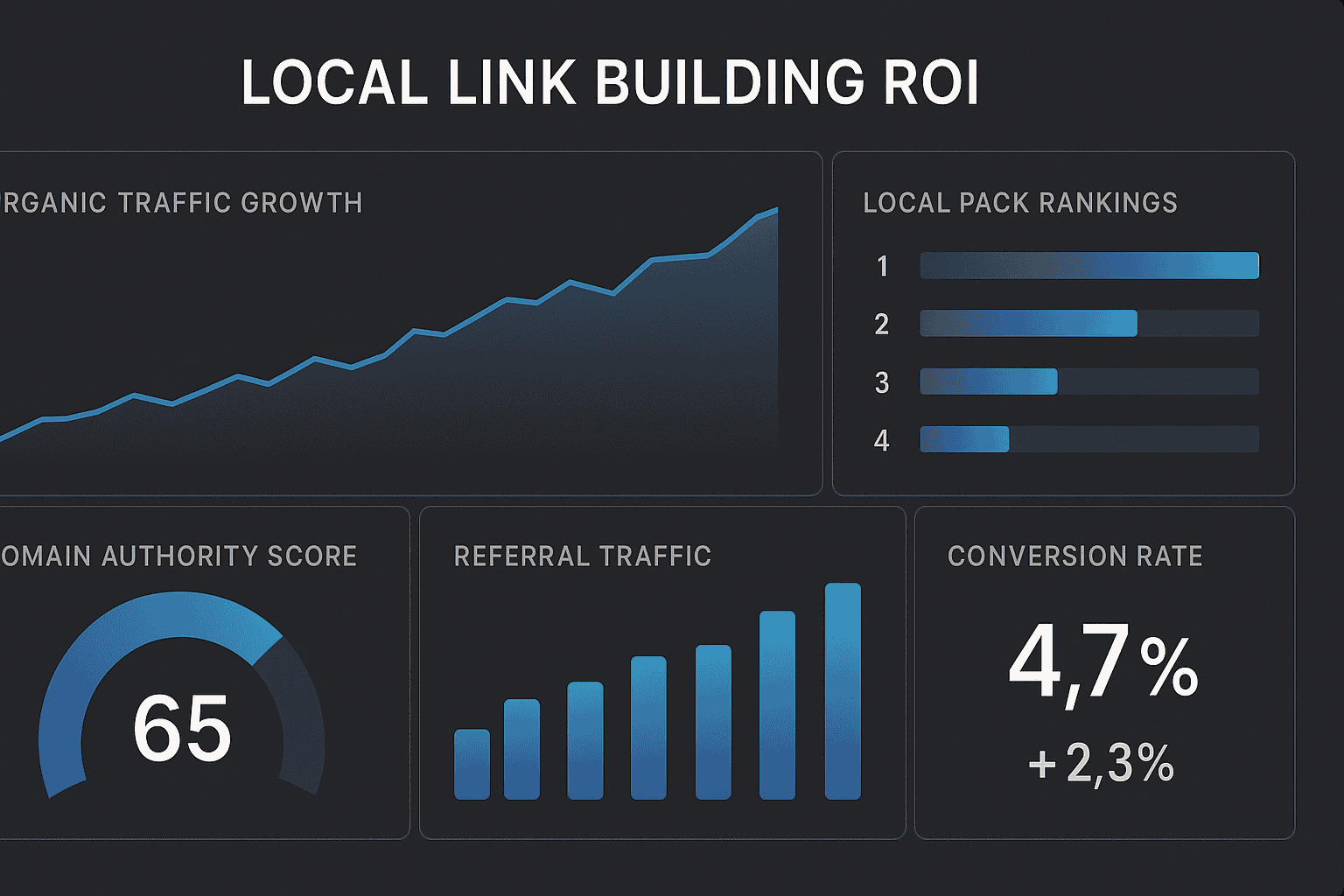
Key Metrics to Track:
- Local Pack Rankings: Track your position in the Local 3-Pack for target keywords (use BrightLocal or Local Falcon)
- Organic Traffic: Monitor traffic from organic search in Google Analytics, filtered by location
- Domain Authority (DA): Track your site’s DA using Moz or Ahrefs (aim for steady growth)
- Referral Traffic: Monitor traffic coming directly from your backlinks
- Conversion Rate: Track how many visitors from local search convert to leads/customers
- Revenue Attribution: Use call tracking and form tracking to attribute revenue to specific links
ROI Calculation Formula:
ROI = [(Revenue from Local Search – Cost of Link Building) / Cost of Link Building] × 100
Example: You invest $3,000/month in local link building (sponsorships, content creation, outreach). After 6 months, your local search traffic increases by 150%, generating an additional $15,000/month in revenue. Your 6-month ROI: [($90,000 – $18,000) / $18,000] × 100 = 400% ROI.
Tracking Tools:
- Google Analytics 4: Organic traffic, conversion tracking
- Google Search Console: Keyword rankings, click-through rates
- BrightLocal or Local Falcon: Local pack rank tracking
- Ahrefs or SEMrush: Backlink monitoring, DA tracking
- CallRail or CallTrackingMetrics: Phone call attribution
Part 6: Real-World Dominance: Local Link Building Case Studies (2025)
Theory is valuable, but nothing beats real-world proof. Here are three detailed case studies from 2025 showing exactly how local businesses used these strategies to dominate their markets.
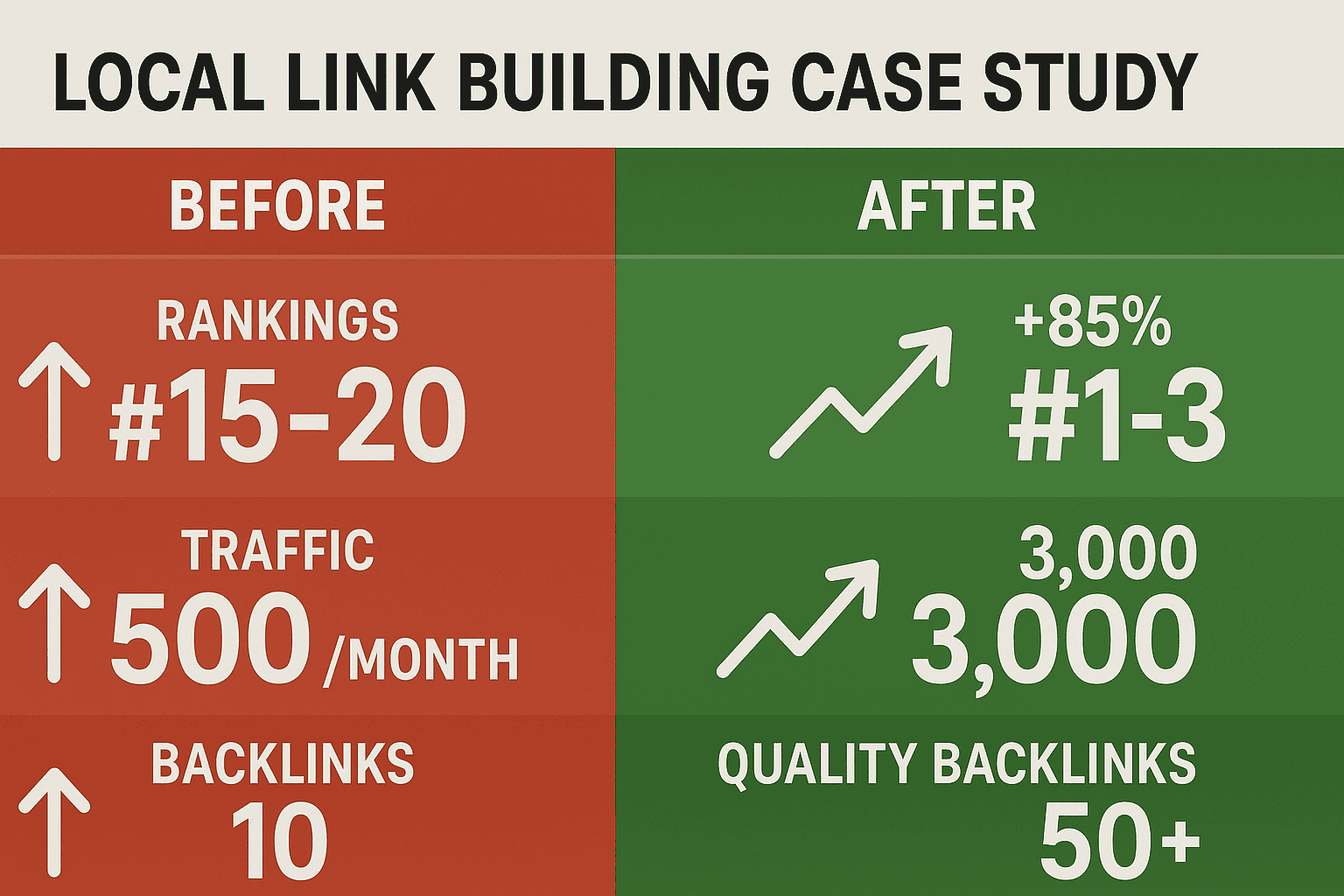
Case Study 1: The Local Service Business Turnaround
Business: Phoenix HVAC company (10 employees, $1.2M annual revenue)
Challenge: Ranking #15-20 for “Phoenix HVAC” and related terms, minimal organic traffic
Strategy: 6-month local link building campaign
Tactics Implemented:
- Joined Phoenix Chamber of Commerce ($450/year)
- Sponsored 3 youth sports teams ($750 each = $2,250)
- Hosted “Beat the Heat” senior workshop (3 local links, $300 cost)
- Created “Phoenix HVAC Buyer’s Guide” (earned 23 links)
- Guest posted on 2 local home improvement blogs
- Fixed NAP inconsistencies across 47 directories
Total Investment: $8,500 over 6 months ($1,417/month average)
Results After 6 Months:
| Metric | Before | After | Change |
|---|---|---|---|
| Local Pack Ranking | #15-20 | #1-3 | +85% improvement |
| Organic Traffic | 500/month | 3,000/month | +500% increase |
| Quality Backlinks | 10 | 50+ | +400% increase |
| Domain Authority | 18 | 31 | +72% increase |
| Monthly Revenue from Organic | $8,000 | $42,000 | +425% increase |
ROI: 6-month revenue increase of $204,000 ($42K – $8K × 6 months) on $8,500 investment = 2,300% ROI
Case Study 2: The Hyper-Targeted Retail Success
Business: Scottsdale boutique clothing store
Challenge: High competition, needed to stand out in saturated market
Strategy: Hyperlocal link building focused on specific Scottsdale neighborhoods
Tactics:
- Created neighborhood-specific landing pages (Old Town, Fashion Square, etc.)
- Partnered with 5 local businesses for cross-promotion
- Sponsored Scottsdale Fashion Week ($1,500)
- Published “Scottsdale Style Guide” (earned 31 links from fashion blogs)
- Guest posted on 3 local lifestyle blogs
Results: 65% increase in foot traffic, 40% increase in online sales, featured in 2 local TV segments (additional PR value)
Case Study 3: Scaling Hyperlocal for a Multi-Location Enterprise
Business: Regional dental practice with 8 locations across Phoenix metro
Challenge: Each location needed individual local SEO optimization
Strategy: Replicated local link building strategy across all 8 locations
Tactics:
- Each location joined its neighborhood Chamber of Commerce
- Each location sponsored 1-2 local schools or sports teams
- Created location-specific content (e.g., “Dental Care in Tempe”)
- Built relationships with local health bloggers for guest posts
- Implemented consistent NAP across all locations
Results: 7 of 8 locations now rank in top 3 of local pack for “[neighborhood] dentist”. Combined organic traffic increased 280% across all locations.
Conclusion: Build Relationships, Not Just Links
The most important lesson from this guide is this: local link building is about building real relationships and demonstrating genuine community value, not manipulating search algorithms.
The businesses that succeed in 2025 and beyond are those that:
- Invest in their local communities through sponsorships and partnerships
- Create genuinely valuable content for local audiences
- Build authentic relationships with local media and influencers
- Maintain flawless technical foundations (NAP, GBP, citations)
- Measure and optimize based on real ROI data
Google’s algorithms are sophisticated enough to distinguish between manufactured SEO signals and authentic community authority. The shortcuts don’t work anymore. But the good news is that the strategies that do work—community involvement, valuable content, genuine relationships—are also the strategies that build real, lasting business value beyond just search rankings.
Your Next Steps:
- Audit your current local SEO foundations (GBP, NAP, citations)
- Identify 3-5 local sponsorship or partnership opportunities
- Create at least one linkable asset for your local audience
- Set up proper tracking (Google Analytics, Search Console, rank tracking)
- Commit to consistent, long-term execution (results take 3-6 months)
Local link building isn’t a quick fix. It’s a long-term investment in your business’s digital presence and community standing. But for businesses willing to commit to the process, the rewards are substantial: higher rankings, more traffic, better leads, and ultimately, significant revenue growth.
Start building relationships today, and the links—and the business results—will follow.
Frequently Asked Questions About Local Link Building
How many local backlinks do I need to rank in the local pack?
There’s no magic number, but studies show that businesses ranking in the top 3 of the local pack typically have 30-50 high-quality local backlinks. Quality matters more than quantity—one link from your Chamber of Commerce is worth more than 10 links from low-quality directories. Focus on earning 5-10 highly relevant local links per quarter rather than chasing hundreds of low-value links.
How long does it take to see results from local link building?
Most businesses see initial ranking improvements within 6-8 weeks, with significant results appearing after 3-6 months of consistent effort. Local link building is a marathon, not a sprint. The timeline depends on your starting point, competition level, and consistency of implementation. Businesses in highly competitive markets (legal, medical, real estate) may need 6-12 months to see top rankings.
Should I buy backlinks for local SEO?
No. Buying backlinks violates Google’s Webmaster Guidelines and can result in severe penalties, including complete removal from search results. Google’s algorithms are sophisticated enough to detect paid link schemes. Instead, invest that money in legitimate strategies like sponsorships, content creation, and community partnerships that earn links naturally.
What’s the difference between local citations and local backlinks?
Citations are online mentions of your business NAP (Name, Address, Phone) that may or may not include a link. Examples: Yelp listing, Yellow Pages entry. Backlinks are clickable links from another website to yours. Both are important for local SEO, but backlinks carry more ranking weight. Citations help Google verify your business exists and where it’s located, while backlinks signal authority and trust.
Can I do local link building myself or should I hire an agency?
You can absolutely do local link building yourself if you have 10-15 hours per week to dedicate to it. The strategies in this guide are DIY-friendly. However, agencies can accelerate results through established relationships, experience, and dedicated resources. Expect to invest $2,000-$5,000/month for professional local link building services. For most small businesses, a hybrid approach works best: handle relationship-building yourself and outsource technical tasks like citation building.
How do I find local link building opportunities in my city?
Start with these searches: “[your city] chamber of commerce”, “[your city] business associations”, “[your city] community events”, “[your city] sponsorship opportunities”, “[your city] [your industry] blog”. Also check local news websites for “community partners” or “sponsors” pages to see where competitors are getting links. Use tools like Ahrefs or SEMrush to analyze competitor backlink profiles and identify local link sources you’re missing.
What’s the best anchor text for local SEO backlinks?
The best anchor text distribution is 40% branded (your business name), 20% naked URLs (yoursite.com), 20% generic (“click here”, “visit website”), 15% partial match (“Phoenix plumber”), and only 5% exact match (“Phoenix plumbing services”). This natural distribution avoids over-optimization penalties while still signaling relevance to Google. Most importantly, let the linking site choose the anchor text naturally—don’t force exact-match keywords.
Do social media links help with local SEO?
Social media links are “nofollow” (they don’t pass direct SEO value), but they still benefit local SEO indirectly. Active social profiles increase brand visibility, drive referral traffic, and create social signals that correlate with higher rankings. More importantly, social media helps you build relationships that lead to real backlinks—when you share valuable content on social media, local bloggers and journalists discover it and may link to it from their websites.
Ready to Dominate Local Search in Phoenix?
Phoenix SEO Geek specializes in local link building and PR strategies that drive real results. We’ve helped 100+ Phoenix businesses achieve top local pack rankings and generate consistent, high-quality leads.
Get a free local SEO audit and custom link building strategy for your business.

Travis Wilkie is the entrepreneurial force behind one of the most results-driven local search agencies in Arizona. With over a decade of front-line marketing experience and a proven track record of engineering dramatic lead-flow systems for service businesses, his mindset is simple: show up where your prospects are searching, talk to them in real-time, and turn clicks into calls into revenue.
Marketing isn’t about being loud—it’s about being present, persuasive, and persistent. Travis believes that by combining high-touch digital systems (chat, phone, reviews) with laser-focused geo-SEO and AI automation, the difference between “average” and “exceptional” becomes a choice you control.
If you’re a contractor, home-service provider or local business owner in the Phoenix region, partnering with Travis means you’ll:
-
Become highly visible in the coveted Google “3-Pack” map results for entire service territories—so you capture customers who search with intent.
-
Deploy AI chatbots and real-time interaction systems that greet website visitors, book service calls, and nurture leads without you having to chase them.
-
Generate more reviews, build a reputation machine, and turn your online presence into a revenue engine—not just a brochure site.
-
Move past “hopeful marketing” and into “predictable pipeline” mode: you’ll see the metrics that matter, understand the ROI, and scale what works.