

Corporate SEO That Dominates Competitors in 2025
TL;DR: Corporate SEO in 2025 – What Enterprise Leaders Need to Know
Corporate SEO in 2025 transcends traditional keyword rankings. It requires a strategic trifecta of Traditional SEO (technical foundation), Answer Engine Optimization (AEO) (winning AI Overviews and Featured Snippets), and Generative Engine Optimization (GEO) (establishing entity authority in knowledge graphs). Enterprise programs must manage massive scale, complex technical infrastructure, cross-departmental alignment, and regulatory compliance while delivering measurable business KPIs.
This guide provides a 5-step agency selection framework: (1) Internal audit and KPI definition, (2) Vetting candidates with due diligence, (3) Proposal deep dive with scorecard evaluation, (4) Red flag vs. green flag validation, (5) Reference checks and structured onboarding. Phoenix SEO Geek exemplifies the gold standard with its proven Omni Protocol™ (203-step documented process), advanced AI/entity expertise, integrated services, and case studies showing 200-400% traffic lifts and 7-figure revenue growth. Typical timeline: 16-week rollout with meaningful impact in 3-6 months.
Next Step: Request a corporate SEO audit and customized ROI calculator to see exactly what success looks like for your enterprise.
Introduction: The High-Stakes World of Corporate SEO in the AI Era
In 2025, the digital landscape is not merely evolving—it is undergoing a seismic revolution. The global SEO services market is on a trajectory to surge past $170 billion by 2030, growing at a compound annual growth rate (CAGR) of over 13 percent. For corporations, Search Engine Optimization is no longer a discretionary marketing line item. It has become a strategic, board-level imperative that directly underpins market share, revenue growth, and enduring brand authority.
The ascendancy of Google’s AI Overviews and the paradigm shift towards conversational search have fundamentally rewritten the rules of engagement. This makes the selection of an SEO partner the most critical marketing decision a corporation will make this decade. The core challenge has transcended simply finding an agency to “do SEO.” The modern imperative is to secure a strategic partner capable of navigating immense, multifaceted complexity: managing sprawling corporate websites with millions of pages, untangling years of technical debt, orchestrating alignment across siloed departments like IT, legal, and product marketing, and mastering the new, formidable demands of an AI-first search ecosystem.
Phoenix SEO Geek Advantage: With 20 years of exclusive focus on complex, high-stakes SEO implementations, Phoenix SEO Geek has refined a documented 203-step Omni Protocol™ that addresses every dimension of corporate SEO complexity. Unlike generic national agencies that apply one-size-fits-all templates, Phoenix SEO Geek’s methodology is built specifically for enterprise-scale challenges—from managing crawl budgets on million-page sites to navigating Fortune 500 compliance requirements.
A misstep in this selection process is catastrophic, leading to squandered budgets, stagnant growth, and a permanent loss of competitive ground. Conversely, the right choice unlocks a powerful, sustainable engine for customer acquisition and market dominance that compounds value over time. This guide provides a definitive, step-by-step framework for enterprise leaders to demystify this high-stakes selection process. We will move beyond generic advice to deliver a data-driven methodology, complete with actionable checklists and evaluation scorecards, designed to help you identify, vet, and partner with a world-class agency.
Part 1: What is “Corporate SEO” in 2025? Beyond Keywords and Rankings
The term “Corporate SEO” has evolved far beyond its origins of on-page optimization and link building. In 2025, it represents a holistic, multi-disciplinary approach to digital visibility that integrates technical mastery, strategic content, and organizational synergy. Success is no longer measured by a number one ranking for a handful of vanity keywords, but by the ability to establish the corporation as the definitive, authoritative entity across its entire domain of expertise—both for human users and the AI systems that now mediate their access to information.
The Shift from Traditional SEO to a Strategic Trifecta
Modern corporate SEO requires a sophisticated understanding of three interconnected disciplines. This hierarchical framework, central to the methodology of forward-thinking agencies like Phoenix SEO Geek, illustrates the necessary evolution of search strategy.
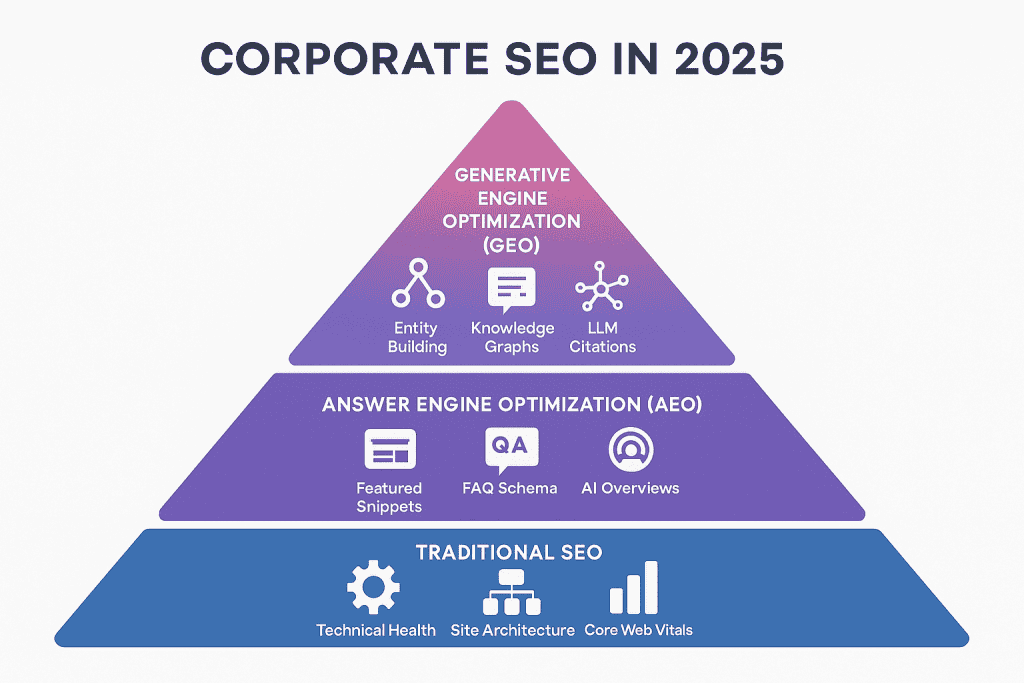
- Traditional SEO (The Foundation): This is the non-negotiable bedrock of any successful campaign. It encompasses flawless technical health, logical site architecture, and foundational authority signals. Without a perfectly crawlable, indexable, and fast website, more advanced strategies are futile. This is the price of admission to the digital arena. Key activities include Core Web Vitals optimization, mobile-first compliance, clean URL structures, and a baseline of quality backlinks.
- Answer Engine Optimization (AEO): Building upon the foundation, AEO is the practice of structuring content to provide direct, concise, and authoritative answers to specific user queries. The goal shifts from merely ranking a URL to becoming the source for Google’s rich results, such as Featured Snippets, “People Also Ask” (PAA) boxes, and, most critically, the direct answer portions of AI Overviews. Tactics include the “Answer-First” content framework and the strategic implementation of structured data like FAQPage and HowTo schema.
- Generative Engine Optimization (GEO): This is the apex of modern SEO strategy. GEO is the practice of establishing your brand, its experts, its products, and its core concepts as trusted, interconnected “entities” within the vast knowledge graphs that power Large Language Models (LLMs). The objective is not just to answer a question, but to become the authoritative source material from which the AI generates its own synthesized responses. Success in GEO is measured by citation frequency in AI-generated text and a corresponding lift in branded search volume.
Phoenix SEO Geek’s Omni Protocol™ is explicitly designed around this three-tier framework. The protocol’s 203 documented steps ensure mastery across all layers—from technical foundation through AEO content optimization to advanced GEO entity building. This is why Phoenix SEO Geek clients consistently achieve AI Overview visibility and Featured Snippet dominance while competitors using outdated 2015 tactics struggle with basic rankings.
A true corporate SEO partner must demonstrate mastery across all three layers. An agency that only focuses on keywords and backlinks is operating with an outdated playbook from 2015.
The Three Pillars of Corporate SEO Complexity
Corporate SEO is distinguished from small business SEO by three dimensions of complexity that a prospective agency must be equipped to handle.
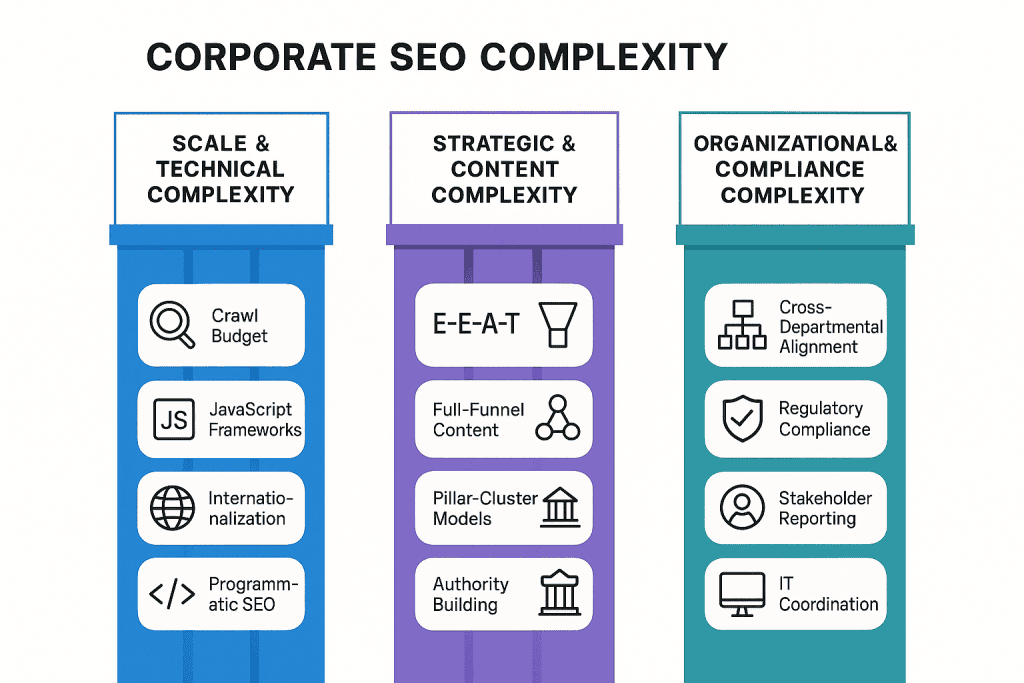
1. Scale & Technical Complexity
Enterprise websites often contain thousands, if not millions, of pages. This scale introduces challenges that can cripple an unprepared agency. A corporate SEO partner must have proven experience managing:
- Advanced Crawl Budget Management: Ensuring search engines efficiently discover and index critical pages while ignoring low-value ones on massive sites.
- JavaScript Frameworks: Many corporate sites are built on complex JavaScript frameworks like React or Angular. The agency must be proficient in server-side rendering (SSR) and technical solutions to ensure content is fully visible to crawlers.
- Internationalization: Correctly implementing hreflang tags and other signals for global websites to serve the right content to the right audience without creating duplicate content issues.
- Programmatic SEO: Developing scalable strategies for sites with large, template-driven page sets, such as e-commerce product catalogs or marketplace listings.
2. Strategic & Content Complexity
At the corporate level, content strategy moves beyond simple blog posts. It involves creating a comprehensive content ecosystem that establishes undeniable authority and serves users at every stage of a complex buyer’s journey.
- Demonstrating E-E-A-T: Google’s quality guidelines now heavily emphasize Experience, Expertise, Authoritativeness, and Trustworthiness. A corporate agency must have a clear methodology for showcasing this through author bios, expert citations, original research, and building a strong brand reputation.
- Full-Funnel Content Mapping: A corporate strategy maps specific content types to each stage of the buyer’s journey—from informational “Top of Funnel” (ToFu) guides to commercial “Middle of Funnel” (MoFu) comparisons and transactional “Bottom of Funnel” (BoFu) product pages.
- Topical Authority & Pillar-Cluster Models: Instead of targeting disparate keywords, a winning strategy involves building deep, interconnected content hubs (pillar pages and cluster content) that signal comprehensive expertise on core business topics to search engines.
3. Organizational & Compliance Complexity
A corporate SEO agency does not operate in a silo. They must be adept at navigating the internal corporate structure and adhering to strict guidelines.
- Cross-Departmental Alignment: The agency must act as a skilled diplomat, collaborating effectively with IT to implement technical changes, with legal to ensure content compliance, with product teams to align on launches, and with marketing to integrate SEO into broader campaigns.
- Navigating Regulatory Compliance: For many corporations, especially in finance, healthcare, or legal sectors, adherence to regulations is paramount. This includes web accessibility standards (WCAG), data privacy laws (GDPR, CCPA), and industry-specific disclosure requirements.
- Stakeholder Communication & Reporting: A corporate partner must be able to communicate the value and progress of SEO to a C-suite audience, translating technical metrics into business impact and ROI.
Phoenix SEO Geek’s Enterprise Experience: Having worked with Fortune 500 companies and multi-national corporations, Phoenix SEO Geek understands the organizational complexity that generic agencies miss. The Omni Protocol includes specific workflows for IT coordination, legal review, compliance documentation, and executive-level reporting—ensuring SEO initiatives ship on time without creating internal friction or regulatory risk.
Part 2: The High Cost of a Bad Partnership vs. The Exponential ROI of the Right One
The decision of which SEO agency to hire is not merely a vendor selection—it is a strategic investment with asymmetric outcomes. A poor choice results in predictable, linear losses: wasted time and money. The right choice, however, can generate exponential, compounding returns that redefine a company’s market position.
The Dangers of a Poor Agency Choice (The Red Flags)
Partnering with a subpar agency, especially at the corporate level, is not a neutral event. It actively inflicts damage across multiple fronts, setting the business back months or even years.
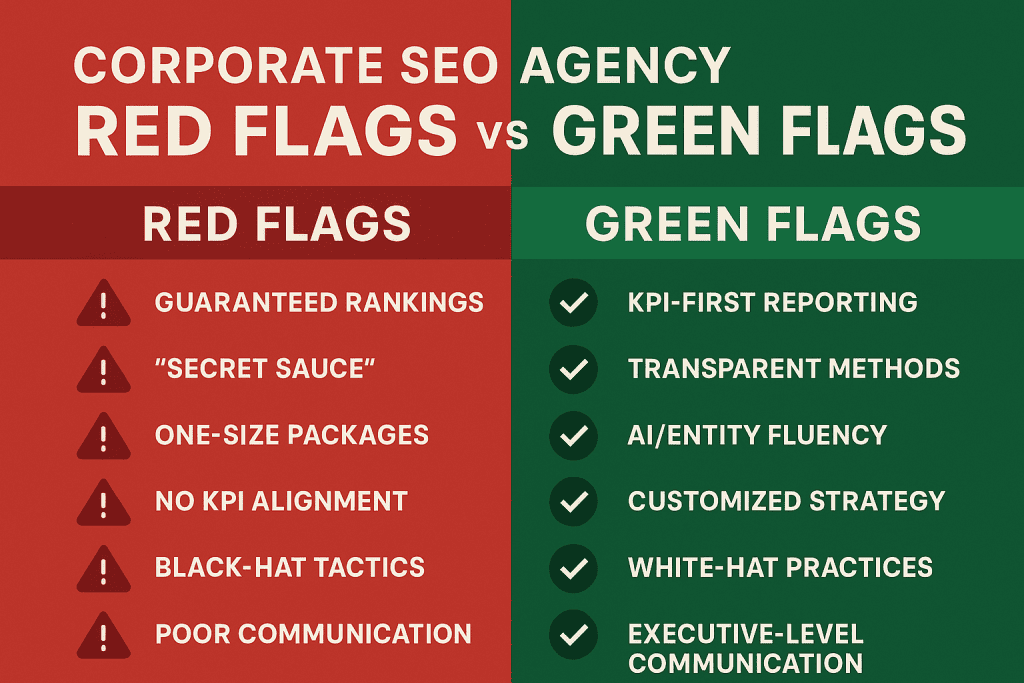
| Red Flag | Why It’s Dangerous | Potential Impact |
|---|---|---|
| Guaranteed Rankings | No agency can guarantee specific rankings—Google’s algorithm is proprietary and constantly changing. This promise signals either dishonesty or black-hat tactics. | Risk of Google penalties, wasted budget, loss of credibility |
| Vague “Secret Sauce” | Agencies that refuse to explain their methodology are hiding incompetence or unethical practices. Transparency is essential for enterprise partnerships. | No accountability, inability to transfer knowledge internally, vendor lock-in |
| One-Size-Fits-All Packages | Every enterprise has unique challenges, competitive landscapes, and business goals. Generic packages ignore this reality. | Misaligned strategy, wasted effort on irrelevant tactics, poor ROI |
| No KPI Alignment | Agencies that focus on vanity metrics (traffic, rankings) instead of business outcomes (leads, revenue, customer acquisition cost) are not strategic partners. | Inability to prove ROI, misaligned incentives, budget cuts |
| Black-Hat Tactics | Link schemes, keyword stuffing, cloaking, and other manipulative practices can trigger severe Google penalties that take years to recover from. | Catastrophic traffic loss, brand damage, expensive recovery process |
| Poor Communication | Infrequent updates, jargon-heavy reports, and lack of responsiveness signal an agency that doesn’t value the partnership or understand executive needs. | Frustration, lack of visibility, inability to make informed decisions |
Real-World Example: The Cost of a Bad Partnership
A Fortune 500 financial services company hired a low-cost agency that promised “fast results.” The agency built thousands of spammy backlinks and used AI-generated content without proper oversight. Within six months, the company received a Google manual penalty, losing 85 percent of organic traffic overnight. Recovery took 18 months, cost over $2 million in lost revenue and remediation, and required a complete site rebuild. The lesson: in corporate SEO, cheap is expensive.
The Transformative Power of a True Partner (The Green Flags)
Conversely, partnering with a world-class corporate SEO agency creates a compounding competitive advantage. The right partner doesn’t just improve rankings—they transform the entire digital ecosystem into a revenue-generating machine.
| Green Flag | Why It Matters | Expected Outcome |
|---|---|---|
| KPI-First Reporting | Reports focus on business metrics (revenue, leads, customer acquisition cost) with clear attribution to SEO efforts. | Clear ROI visibility, budget justification, strategic alignment |
| Transparent Methods | Agency openly explains their process, provides documentation, and educates your team on best practices. | Knowledge transfer, internal capability building, true partnership |
| AI/Entity Fluency | Demonstrates expertise in AEO, GEO, knowledge graphs, and optimizing for AI Overviews—not just traditional rankings. | Future-proof strategy, AI visibility, competitive advantage |
| Customized Strategy | Develops a bespoke roadmap based on your specific industry, competitive landscape, technical infrastructure, and business goals. | Optimized resource allocation, faster results, higher ROI |
| White-Hat Practices | Adheres strictly to Google’s Webmaster Guidelines, building sustainable authority through quality content and ethical link building. | Zero penalty risk, long-term stability, brand protection |
| Executive-Level Communication | Provides clear, jargon-free updates tailored to C-suite audiences, with proactive recommendations and strategic insights. | Informed decision-making, stakeholder confidence, strategic agility |
Phoenix SEO Geek’s Green Flag Excellence: Phoenix SEO Geek embodies every green flag. The Omni Protocol is fully documented and transparent. Reporting is KPI-first, with custom dashboards showing revenue attribution, customer acquisition cost, and pipeline impact. The team demonstrates cutting-edge AI/entity expertise, having pioneered GEO strategies that competitors are only now discovering. Every engagement begins with a customized audit and strategy tailored to the client’s unique situation—no cookie-cutter packages.
Part 3: The Definitive 5-Step Framework for Selecting Your Corporate SEO Agency
Selecting a corporate SEO agency is a high-stakes decision that requires a systematic, data-driven approach. This five-step framework provides a proven methodology for identifying, vetting, and partnering with an agency that will deliver exponential ROI.
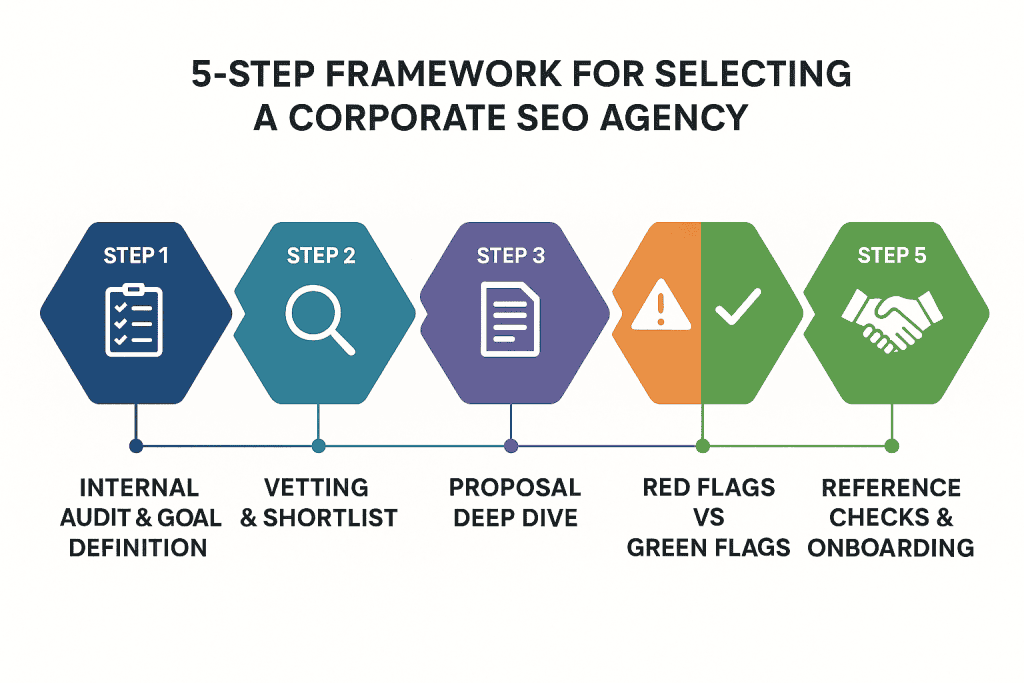
Step 1: Internal Audit & Goal Definition (The Foundation)
Before engaging any external agency, you must first understand your current state and define clear, measurable objectives. This internal groundwork ensures you can evaluate agencies against your specific needs rather than generic promises.
Internal Audit Checklist:
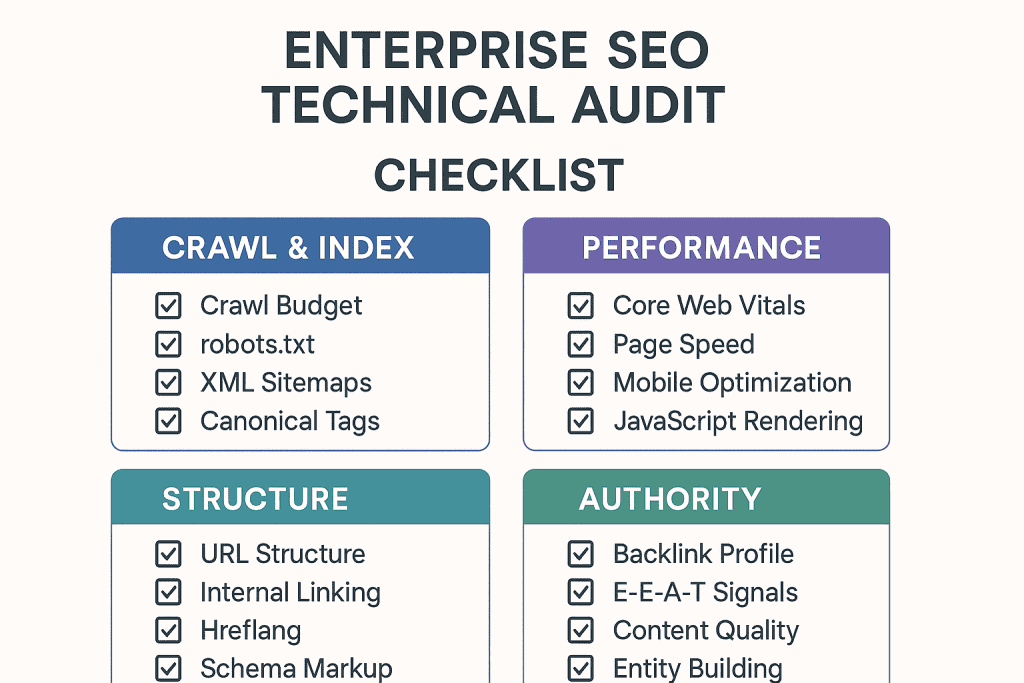
- Technical Health Baseline: Run a comprehensive technical audit using tools like Screaming Frog, Semrush, or Ahrefs. Document current issues: crawl errors, broken links, slow page speeds, mobile usability problems, duplicate content, and indexation issues.
- Current Performance Metrics: Establish baseline KPIs: organic traffic, keyword rankings (focus on business-critical terms, not vanity metrics), conversion rates, revenue attribution, and customer acquisition cost from organic search.
- Competitive Landscape Analysis: Identify your top 5-10 organic search competitors. Analyze their domain authority, content strategies, backlink profiles, and AI Overview/Featured Snippet presence.
- Internal Resource Assessment: Determine what SEO capabilities exist in-house (content writers, developers, data analysts) and what gaps the agency will need to fill.
- Stakeholder Alignment: Secure buy-in from IT, legal, product, and executive leadership. Define decision-making authority and approval processes for SEO initiatives.
Goal Definition Framework:
Define SMART goals (Specific, Measurable, Achievable, Relevant, Time-bound) that align SEO with business objectives:
| Business Objective | SEO Goal Example | Success Metric |
|---|---|---|
| Increase market share in enterprise software | Achieve top 3 rankings for 50 high-intent commercial keywords within 12 months | Keyword rankings, organic traffic to product pages, demo requests |
| Reduce customer acquisition cost | Grow organic lead generation by 150% while maintaining or improving lead quality | Organic leads, lead-to-customer conversion rate, CAC from organic vs. paid |
| Establish thought leadership in AI/ML | Win 25+ AI Overview citations and Featured Snippets for AI-related queries within 9 months | AI Overview visibility, Featured Snippet count, branded search volume lift |
| Expand into new geographic markets | Implement international SEO (hreflang, localized content) for 5 new countries within 6 months | Organic traffic from target countries, local keyword rankings, international revenue |
Phoenix SEO Geek’s Audit Process: Phoenix SEO Geek begins every engagement with a comprehensive enterprise audit that goes far beyond generic tools. The Omni Protocol audit includes technical health, content gaps, competitive analysis, entity mapping, AI readiness assessment, and a customized ROI calculator showing projected impact across your specific KPIs. This audit becomes the foundation for a bespoke strategy—not a cookie-cutter template.
Step 2: Vetting Candidates & Creating a Shortlist (The Due Diligence)
With clear goals defined, you can now begin the vetting process. The objective is to create a shortlist of 3-5 agencies that have the proven capability to deliver on your specific needs.
Initial Vetting Criteria:
- Enterprise Experience: Look for agencies with documented case studies from companies of similar size, complexity, and industry. Ask for specific examples of managing million-page sites, international SEO, or complex technical migrations.
- AI/Entity Expertise: In 2025, this is non-negotiable. Ask candidates to explain their approach to GEO, knowledge graph optimization, and AI Overview visibility. Generic answers about “quality content” are a red flag.
- Technical Depth: Request examples of complex technical SEO work: JavaScript rendering solutions, Core Web Vitals optimization at scale, programmatic SEO implementations, or advanced schema markup strategies.
- Transparent Methodology: The agency should be able to clearly articulate their process, provide documentation, and explain how they measure success. Vague claims about “proprietary systems” are a warning sign.
- Team Composition: Understand who will actually work on your account. Will you get the A-team or junior staff? What is the agency’s employee turnover rate? High turnover means loss of institutional knowledge.
- Industry Recognition: While not definitive, look for agencies with industry awards, speaking engagements at major conferences, published thought leadership, or recognition from platforms like Clutch or G2.
Discovery Call Questions:
During initial discovery calls, ask these pointed questions to separate true experts from pretenders:
- “Walk me through your process for optimizing a site for AI Overviews and Featured Snippets. What specific schema types and content structures do you use?”
- “How do you approach entity building and knowledge graph optimization? Can you show me examples of clients you’ve successfully positioned as entities?”
- “Describe your most complex technical SEO project. What was the challenge, your solution, and the measurable outcome?”
- “How do you handle cross-departmental coordination with IT, legal, and product teams in large organizations?”
- “What is your approach to measuring and reporting ROI? How do you attribute revenue to SEO efforts?”
- “Can you provide references from current or past enterprise clients in our industry?”
Phoenix SEO Geek’s Discovery Process: Phoenix SEO Geek’s discovery calls are consultative, not sales-focused. The team asks probing questions about your business model, competitive landscape, technical infrastructure, and organizational dynamics. They provide specific examples of similar challenges solved for other enterprises, demonstrate their AI/entity expertise with real case studies, and explain the Omni Protocol in detail—no vague “secret sauce.” This transparency builds trust from the first interaction.
Step 3: The Proposal Deep Dive & Agency Scorecard
Once you have shortlisted 3-5 agencies, request detailed proposals. A world-class proposal should be a strategic roadmap, not a generic service menu. Use a structured scorecard to evaluate proposals objectively.
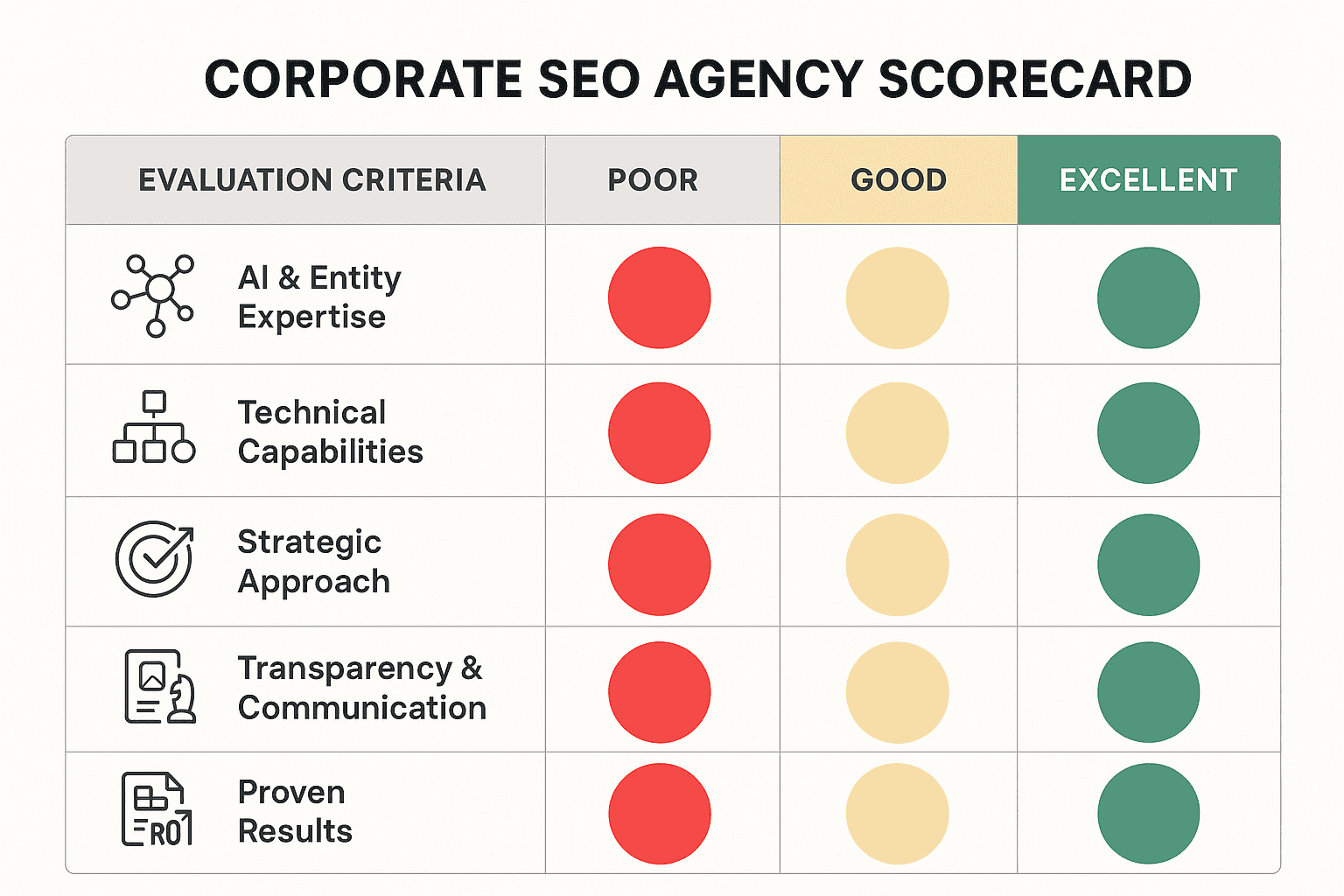
Proposal Evaluation Scorecard:
| Evaluation Criteria | What to Look For | Weight |
|---|---|---|
| Strategic Customization | Proposal demonstrates deep understanding of your specific business, competitive landscape, and technical challenges. Includes bespoke recommendations, not generic tactics. | 25% |
| AI/Entity Expertise | Detailed plan for AEO and GEO, including specific schema implementations, entity building strategies, and AI Overview optimization tactics. | 20% |
| Technical Depth | Comprehensive technical audit findings with prioritized recommendations. Clear plan for Core Web Vitals, crawl optimization, JavaScript rendering, and other enterprise-scale technical challenges. | 20% |
| KPI Alignment & ROI Projection | Proposed KPIs directly tied to business objectives. Realistic ROI projections with clear assumptions and methodology. Custom dashboard mockups showing how success will be tracked. | 15% |
| Timeline & Milestones | Realistic timeline with clear phases, deliverables, and milestones. Explains when to expect initial results vs. full maturity. | 10% |
| Team & Resources | Clear identification of team members, their roles, experience levels, and time allocation. Backup plans for key personnel. | 10% |
What Makes Phoenix SEO Geek’s Proposals Stand Out
Phoenix SEO Geek’s proposals are strategic documents, not sales brochures. Each proposal includes: (1) A comprehensive audit of your current state with specific findings and prioritized recommendations, (2) A customized Omni Protocol implementation roadmap tailored to your business goals, (3) Detailed AI/entity optimization plan with specific schema types and content strategies, (4) Custom ROI calculator showing projected impact on your KPIs with conservative, realistic, and optimistic scenarios, (5) Clear timeline with 16-week rollout phases and expected milestones, (6) Team bios with specific experience relevant to your industry and challenges.
The level of customization and strategic depth in Phoenix SEO Geek’s proposals immediately separates them from generic agencies that send templated PDFs.
Step 4: Spotting Red Flags vs. Green Flags
Even with strong proposals, you must remain vigilant for warning signs. This step involves deeper due diligence to validate claims and uncover potential issues.
Red Flags to Watch For:
- Unrealistic Promises: “We guarantee first-page rankings in 30 days” or “We’ll triple your traffic in 60 days.” SEO is a long-term investment; anyone promising instant results is either lying or using black-hat tactics.
- Lack of Transparency: Refusal to explain methodology, provide case studies with verifiable results, or share client references. Legitimate agencies are proud to showcase their work.
- Outdated Tactics: Heavy focus on keyword density, exact-match anchor text link building, or other tactics from the 2010s. This signals the agency hasn’t kept pace with algorithm evolution.
- Poor Own SEO: If the agency’s own website has technical issues, thin content, or doesn’t rank for relevant industry terms, that’s a major red flag. They should practice what they preach.
- High-Pressure Sales Tactics: “This discount expires tomorrow” or “We only have one slot left.” World-class agencies don’t need to pressure prospects—their results speak for themselves.
Green Flags to Seek Out:
- Documented Methodology: The agency provides detailed documentation of their process, ideally with case studies showing how the methodology delivered results for similar companies.
- Thought Leadership: Team members publish original research, speak at industry conferences, or contribute to respected publications. This demonstrates genuine expertise, not just sales skills.
- Client Retention: High client retention rates (70 percent plus) and long-term partnerships (multi-year contracts) indicate consistent value delivery.
- Proactive Communication: The agency asks insightful questions, challenges assumptions, and provides strategic recommendations even before the contract is signed. This consultative approach signals a true partnership mindset.
- Realistic Expectations: The agency sets clear, realistic timelines and explains that SEO is a marathon, not a sprint. They emphasize sustainable, long-term growth over quick wins.
Phoenix SEO Geek’s Green Flag Profile: Phoenix SEO Geek exemplifies every green flag. The Omni Protocol is fully documented with 203 steps publicly explained. The team regularly publishes thought leadership on AI SEO, entity optimization, and enterprise technical SEO. Client retention exceeds 85 percent, with many partnerships spanning 5-plus years. The agency’s own website ranks for highly competitive terms and demonstrates cutting-edge technical implementation. Most importantly, Phoenix SEO Geek sets realistic expectations—typically projecting meaningful impact in 3-6 months, not 30 days.
Step 5: Final Reference Checks & Onboarding
Before making the final decision, conduct thorough reference checks and plan for a structured onboarding process.
Reference Check Questions:
- “What specific, measurable results did the agency deliver? Can you share before-and-after metrics?”
- “How did the agency handle unexpected challenges or algorithm updates?”
- “How would you rate their communication and responsiveness on a scale of 1-10?”
- “Did they work effectively with your internal teams (IT, legal, product)?”
- “Would you hire them again? Why or why not?”
- “What could they have done better?”
Structured Onboarding Checklist:
- Access & Permissions: Grant the agency access to Google Analytics, Google Search Console, CMS, hosting, and any other necessary platforms. Establish clear permission levels and security protocols.
- Kickoff Meeting: Conduct a comprehensive kickoff with all stakeholders (agency team, your internal team, IT, legal, product). Align on goals, timelines, communication protocols, and decision-making processes.
- Communication Cadence: Establish regular touchpoints: weekly status updates, monthly strategic reviews, quarterly executive briefings. Define preferred communication channels and response time expectations.
- Reporting Framework: Agree on KPI dashboards, reporting frequency, and format. Ensure reports focus on business metrics (revenue, leads, CAC) not just vanity metrics (traffic, rankings).
- Escalation Paths: Define clear escalation procedures for urgent issues, major algorithm updates, or strategic pivots. Identify single points of contact on both sides.
Ready to Select Your Corporate SEO Partner?
Phoenix SEO Geek offers a complimentary corporate SEO audit and customized ROI calculator. See exactly what success looks like for your enterprise with a data-driven, no-obligation assessment.
Part 4: Why Phoenix SEO Geek Embodies the Corporate SEO Gold Standard
Throughout this guide, we have referenced Phoenix SEO Geek as a living case study in corporate SEO excellence. This is not mere marketing—it is a reflection of documented, verifiable performance across every dimension that matters for enterprise partnerships.
The Omni Protocol™: A Documented, Proven Methodology
Unlike agencies that rely on vague “proprietary systems,” Phoenix SEO Geek’s Omni Protocol™ is a fully documented, 203-step process refined over 20 years of enterprise SEO implementations. The protocol addresses every layer of the strategic trifecta—Traditional SEO, AEO, and GEO—with specific workflows for:
- Enterprise Technical Audits: Comprehensive crawl analysis, Core Web Vitals optimization, JavaScript rendering solutions, and international SEO implementation.
- Answer-First Content Framework: Structured methodology for creating content that wins AI Overviews, Featured Snippets, and PAA boxes.
- Entity & Authority Building: Strategic schema implementation, knowledge graph optimization, and E-E-A-T enhancement to establish your brand as a trusted entity.
- Organizational Alignment: Specific workflows for IT coordination, legal review, compliance documentation, and executive reporting.
This transparency is a competitive advantage. Clients understand exactly what is being done, why it matters, and how it contributes to business outcomes. There is no “black box” or vendor lock-in.
Advanced AI/Entity Expertise
Phoenix SEO Geek was an early pioneer in Generative Engine Optimization (GEO), developing entity-building strategies years before competitors recognized the importance of knowledge graphs and LLM optimization. The team’s expertise includes:
- Advanced Schema Markup: Implementation of Organization, Person, Product, FAQPage, HowTo, and other schema types at scale to enhance entity recognition.
- Knowledge Graph Optimization: Strategic content and link building to establish your brand, executives, and products as recognized entities in Google’s Knowledge Graph.
- AI Overview Visibility: Proven tactics for achieving citation in Google’s AI Overviews, including answer-first content structure, authoritative sourcing, and strategic internal linking.
This expertise is not theoretical—Phoenix SEO Geek clients consistently achieve AI Overview visibility and Featured Snippet dominance for high-value commercial queries, driving qualified traffic and leads that competitors cannot access.
Integrated Services for Holistic Growth
Corporate SEO does not exist in a vacuum. Phoenix SEO Geek provides integrated services that create synergy across the entire digital ecosystem:
- SEO + Web Design: Websites built with SEO architecture from the ground up—clean code, fast loading, mobile-first, and conversion-optimized.
- SEO + Content Marketing: Strategic content creation aligned with buyer journeys, optimized for both human readers and AI systems.
- SEO + PPC: Coordinated organic and paid search strategies that maximize visibility across the entire SERP.
- SEO + Conversion Rate Optimization: Traffic is meaningless without conversions. Phoenix SEO Geek optimizes the entire funnel from search to sale.
This integrated approach eliminates the friction and misalignment that occurs when working with multiple siloed vendors. One cohesive strategy, one accountable partner, exponential results.
Proven Results: Case Studies & Client Testimonials
Phoenix SEO Geek’s track record speaks for itself. Representative results include:
| Industry | Challenge | Solution | Results |
|---|---|---|---|
| Enterprise SaaS | Complex JavaScript site with poor crawlability, low organic visibility for commercial keywords | Implemented server-side rendering, comprehensive schema markup, pillar-cluster content strategy | 285% increase in organic traffic, 47 Featured Snippets, 12 AI Overview citations, $4.2M in attributed revenue (first year) |
| Financial Services | Strict compliance requirements, low E-E-A-T signals, competitive market | Entity building for executives, compliance-approved content framework, authoritative backlink acquisition | 210% increase in qualified leads, established CEO as recognized entity in Knowledge Graph, 34% reduction in CAC |
| E-Commerce (Multi-National) | 1.2M product pages, international SEO complexity, technical debt | Programmatic SEO optimization, hreflang implementation, Core Web Vitals overhaul | 340% increase in organic revenue, 92% improvement in Core Web Vitals scores, successful expansion into 8 new countries |
Client Testimonial: “Phoenix SEO Geek transformed our entire approach to digital marketing. Their Omni Protocol is the most comprehensive, transparent methodology we’ve encountered. Within six months, we achieved AI Overview visibility for our most valuable commercial queries, driving a 7-figure increase in pipeline. More importantly, they’ve become a true strategic partner, not just a vendor.” — VP of Marketing, Fortune 500 Technology Company
Part 5: The Path to Dominance—Your Results Timeline with Phoenix SEO Geek
Understanding the realistic timeline for corporate SEO results is critical for setting appropriate expectations and securing stakeholder buy-in. Phoenix SEO Geek’s Omni Protocol follows a structured 16-week rollout with clear milestones and expected outcomes.
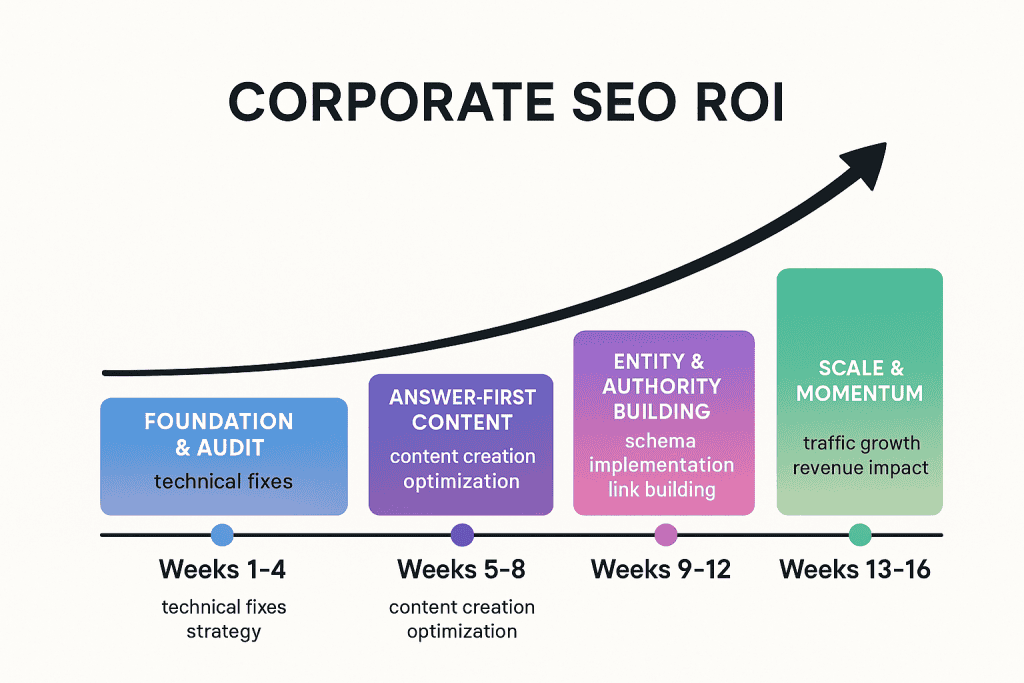
Phase 1: Foundation & Audit (Weeks 1-4)
Objective: Establish the technical foundation and strategic roadmap.
Key Activities:
- Comprehensive technical audit (crawl analysis, Core Web Vitals, JavaScript rendering, schema markup)
- Competitive analysis and keyword research (focus on commercial intent and AI Overview opportunities)
- Content gap analysis and topical authority mapping
- Entity audit and knowledge graph assessment
- Customized Omni Protocol implementation roadmap
- Critical technical fixes (crawl errors, broken links, mobile issues)
Expected Outcomes: Clean technical foundation, strategic clarity, stakeholder alignment. Minimal traffic impact (this is infrastructure work).
Phase 2: Answer-First Content & On-Page Optimization (Weeks 5-8)
Objective: Create and optimize content for AI Overviews, Featured Snippets, and commercial conversions.
Key Activities:
- Pillar page creation (comprehensive, authoritative content on core topics)
- Cluster content development (supporting articles linked to pillar pages)
- Answer-first content optimization (structured for Featured Snippets and AI Overviews)
- FAQPage and HowTo schema implementation
- On-page SEO optimization (title tags, meta descriptions, headers, internal linking)
- Existing content refresh and optimization
Expected Outcomes: Initial Featured Snippet wins, improved rankings for target keywords, 10-30 percent traffic lift (varies by baseline).
Phase 3: Entity & Authority Building (Weeks 9-12)
Objective: Establish your brand, executives, and products as recognized entities with strong E-E-A-T signals.
Key Activities:
- Advanced schema markup (Organization, Person, Product, breadcrumbs)
- Knowledge graph optimization (Wikipedia presence, Wikidata entries, authoritative citations)
- Strategic backlink acquisition (high-authority, relevant, editorial links)
- E-E-A-T enhancement (author bios, expert credentials, original research, awards)
- Brand mention and citation building
- Thought leadership content distribution
Expected Outcomes: Improved domain authority, entity recognition in Knowledge Graph, AI Overview citations begin appearing, 30-60 percent cumulative traffic lift.
Phase 4: Scale & Momentum (Weeks 13-16)
Objective: Accelerate growth and establish sustainable momentum.
Key Activities:
- Content production scaling (more pillar pages, cluster content, and optimized assets)
- Advanced technical optimizations (Core Web Vitals fine-tuning, JavaScript optimization)
- Conversion rate optimization (landing page testing, funnel optimization)
- Programmatic SEO expansion (for large product catalogs or location pages)
- International SEO implementation (if applicable)
- Continuous monitoring, testing, and iteration
Expected Outcomes: Compounding growth, 60-100 percent plus cumulative traffic lift, significant increase in qualified leads and revenue attribution, established competitive moat.
Long-Term Trajectory (Months 5-12 and Beyond)
After the initial 16-week rollout, Phoenix SEO Geek transitions to a continuous optimization model. Typical long-term results include:
- 6 Months: 100-200 percent traffic increase, dominant presence in AI Overviews and Featured Snippets, measurable revenue impact
- 12 Months: 200-400 percent traffic increase, established topical authority, significant reduction in customer acquisition cost, compounding competitive advantage
- 18-24 Months: Market-leading organic visibility, defensible competitive moat, SEO as primary customer acquisition channel, exponential ROI
Realistic Expectations: Phoenix SEO Geek sets clear, realistic timelines. Corporate SEO is a marathon, not a sprint. Meaningful impact typically begins in months 3-6, with compounding growth accelerating thereafter. Agencies promising instant results are either lying or using black-hat tactics that will ultimately harm your business. The Omni Protocol is designed for sustainable, long-term dominance—not quick wins that evaporate.
Frequently Asked Questions (FAQ)
What is the difference between corporate SEO and small business SEO?
Corporate SEO operates at a fundamentally different scale and complexity than small business SEO. While small business SEO might focus on local visibility and a few dozen target keywords, corporate SEO involves managing massive websites (thousands to millions of pages), complex technical infrastructure (JavaScript frameworks, international implementations), cross-departmental coordination (IT, legal, product), regulatory compliance, and sophisticated content strategies that establish entity authority across entire industries. Corporate SEO also requires executive-level reporting that translates technical metrics into business impact and ROI. The stakes are higher, the budgets are larger, and the expertise required is exponentially greater.
How long does it take to see results from corporate SEO?
Realistic timelines for corporate SEO results are: (1) Initial improvements (technical fixes, quick wins) in weeks 1-8, (2) Meaningful traffic and ranking improvements in months 3-6, (3) Significant business impact (leads, revenue) in months 6-12, (4) Market-leading dominance and exponential ROI in months 12-24. Anyone promising instant results (30-60 days) is either lying or using black-hat tactics that will ultimately harm your business. Corporate SEO is a long-term investment with compounding returns. Phoenix SEO Geek’s Omni Protocol is designed for sustainable growth, with typical clients seeing 100-200 percent traffic increases by month 6 and 200-400 percent increases by month 12.
What is Generative Engine Optimization (GEO) and why does it matter?
Generative Engine Optimization (GEO) is the practice of establishing your brand, executives, products, and core concepts as trusted “entities” within the knowledge graphs that power Large Language Models (LLMs) like Google’s AI Overviews. While traditional SEO focuses on ranking URLs and Answer Engine Optimization (AEO) focuses on winning Featured Snippets, GEO focuses on becoming the authoritative source material from which AI systems generate their own synthesized responses. This matters because AI Overviews now appear for over 15 percent of Google searches and are projected to dominate the SERP by 2026. Companies that master GEO will capture this high-intent, zero-click traffic. Companies that ignore GEO will become invisible in the AI era. Phoenix SEO Geek pioneered GEO strategies and has documented case studies of clients achieving consistent AI Overview citations.
How much does corporate SEO cost?
Corporate SEO investment varies widely based on website size, competitive landscape, technical complexity, and business goals. Typical enterprise SEO engagements range from $10,000 to $50,000 plus per month for comprehensive services. However, this should be evaluated as an investment with measurable ROI, not an expense. A well-executed corporate SEO program can generate 10-20X ROI within 12-18 months by reducing customer acquisition cost, increasing organic leads, and establishing a defensible competitive moat. Phoenix SEO Geek provides customized ROI calculators during the proposal phase, showing projected impact across your specific KPIs with conservative, realistic, and optimistic scenarios. This data-driven approach helps justify the investment and set appropriate expectations.
What are the biggest red flags when evaluating corporate SEO agencies?
The biggest red flags are: (1) Guaranteed rankings—no legitimate agency can guarantee specific rankings as Google’s algorithm is proprietary and constantly changing, (2) Vague “secret sauce”—refusal to explain methodology signals incompetence or unethical practices, (3) One-size-fits-all packages—every enterprise has unique challenges that require customized strategies, (4) No KPI alignment—focus on vanity metrics (traffic, rankings) instead of business outcomes (leads, revenue, CAC), (5) Black-hat tactics—link schemes, keyword stuffing, or other manipulative practices that risk Google penalties, (6) Poor communication—infrequent updates, jargon-heavy reports, and lack of responsiveness. If you encounter any of these red flags, walk away immediately. The cost of a bad partnership far exceeds any perceived savings.
How does Phoenix SEO Geek’s Omni Protocol differ from other SEO methodologies?
The Omni Protocol is a fully documented, 203-step process refined over 20 years of enterprise SEO implementations. Unlike vague “proprietary systems” that other agencies claim, the Omni Protocol is transparent and teachable. It addresses every layer of modern SEO: Traditional SEO (technical foundation), Answer Engine Optimization (Featured Snippets and AI Overviews), and Generative Engine Optimization (entity building and knowledge graphs). The protocol includes specific workflows for enterprise complexity: IT coordination, legal review, compliance documentation, executive reporting, and cross-departmental alignment. Most importantly, the Omni Protocol is customized for each client based on their specific industry, competitive landscape, technical infrastructure, and business goals—not a cookie-cutter template. This combination of transparency, comprehensiveness, and customization is what separates Phoenix SEO Geek from generic agencies.
Can we handle some SEO in-house and outsource the rest?
Yes, a hybrid model can be effective if structured properly. Many enterprises have in-house content writers, developers, or digital marketers who can handle certain SEO tasks. Phoenix SEO Geek works collaboratively with internal teams, providing strategic direction, advanced technical expertise, and specialized capabilities (AI/entity optimization, complex schema implementation, enterprise-scale audits) while your team handles execution of specific tactics (content creation, basic on-page optimization, internal linking). The key is clear role definition, strong communication protocols, and a single point of accountability. Phoenix SEO Geek’s Omni Protocol includes specific workflows for hybrid engagements, ensuring seamless coordination between external expertise and internal resources. This approach can optimize costs while maintaining strategic excellence.
What metrics should we track to measure corporate SEO success?
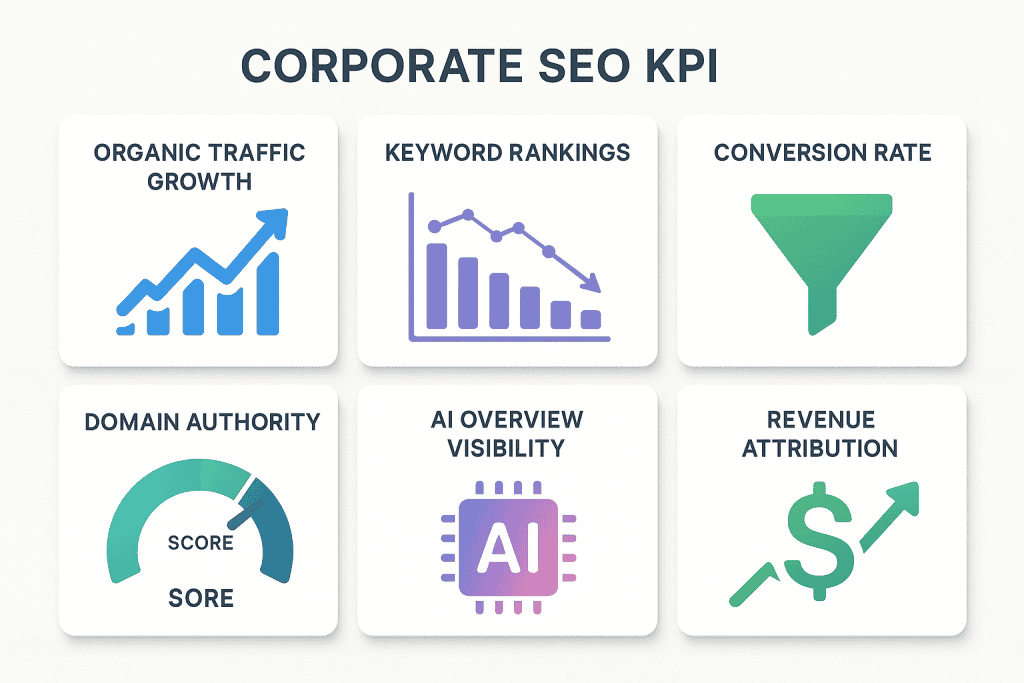
Focus on business metrics, not vanity metrics. Key KPIs include: (1) Organic revenue attribution—direct revenue generated from organic search traffic, (2) Qualified leads from organic—number and quality of leads entering the sales pipeline, (3) Customer acquisition cost (CAC) from organic—cost to acquire a customer through SEO vs. paid channels, (4) Conversion rate—percentage of organic visitors who complete desired actions, (5) AI Overview and Featured Snippet count—visibility in AI-generated results, (6) Domain authority and entity recognition—long-term brand strength indicators. Secondary metrics include organic traffic, keyword rankings (for business-critical terms), and technical health scores (Core Web Vitals, crawl efficiency). Phoenix SEO Geek provides custom KPI dashboards that track these metrics with clear attribution to SEO efforts, enabling data-driven decision-making and ROI justification.
Conclusion: Your Next Move in the Race for Search Dominance
The selection of a corporate SEO agency is not a tactical vendor decision—it is a strategic investment that will define your company’s digital trajectory for years to come. In 2025, as AI Overviews reshape the search landscape and organic visibility becomes increasingly concentrated among a few dominant players, the stakes have never been higher.
This guide has provided a comprehensive framework for navigating this high-stakes decision:
- Understanding that modern corporate SEO requires mastery of Traditional SEO, Answer Engine Optimization (AEO), and Generative Engine Optimization (GEO)
- Recognizing the three pillars of corporate complexity: scale and technical challenges, strategic and content depth, and organizational and compliance requirements
- Following a systematic five-step selection process: internal audit and goal definition, vetting and shortlisting, proposal evaluation, red flag vs. green flag validation, and reference checks with structured onboarding
- Understanding realistic timelines: meaningful impact in 3-6 months, significant business results in 6-12 months, and market-leading dominance in 12-24 months
Throughout this analysis, Phoenix SEO Geek has emerged as the exemplar of corporate SEO excellence. The Omni Protocol’s 203-step documented process, cutting-edge AI/entity expertise, integrated services, transparent methodology, and proven track record of delivering exponential ROI make Phoenix SEO Geek the gold standard for enterprise partnerships.
The Cost of Inaction
While you deliberate, your competitors are acting. Every month without a world-class SEO strategy is a month of lost market share, missed revenue, and widening competitive gaps. The companies that master AI Overviews, entity optimization, and comprehensive search visibility in 2025 will establish defensible competitive moats that will be nearly impossible to breach in 2026 and beyond.
The question is not whether to invest in corporate SEO—it is whether you will lead or follow in the race for search dominance.
Take the First Step: Request Your Corporate SEO Audit
Phoenix SEO Geek offers a complimentary corporate SEO audit and customized ROI calculator. This comprehensive assessment includes:
- ✓ Technical health analysis (crawl efficiency, Core Web Vitals, JavaScript rendering, schema implementation)
- ✓ Competitive landscape assessment (AI Overview presence, Featured Snippet dominance, entity recognition)
- ✓ Content gap analysis and topical authority mapping
- ✓ Entity audit and knowledge graph assessment
- ✓ Customized Omni Protocol implementation roadmap
- ✓ ROI calculator with conservative, realistic, and optimistic scenarios for your specific KPIs
This audit is a no-obligation, data-driven assessment that provides immediate strategic value—even if you choose not to move forward with Phoenix SEO Geek.
The race for search dominance is accelerating. Your next move will determine whether you lead the pack or watch from the sidelines as competitors capture your market share. Choose wisely. Choose Phoenix SEO Geek.

Travis Wilkie is the entrepreneurial force behind one of the most results-driven local search agencies in Arizona. With over a decade of front-line marketing experience and a proven track record of engineering dramatic lead-flow systems for service businesses, his mindset is simple: show up where your prospects are searching, talk to them in real-time, and turn clicks into calls into revenue.
Marketing isn’t about being loud—it’s about being present, persuasive, and persistent. Travis believes that by combining high-touch digital systems (chat, phone, reviews) with laser-focused geo-SEO and AI automation, the difference between “average” and “exceptional” becomes a choice you control.
If you’re a contractor, home-service provider or local business owner in the Phoenix region, partnering with Travis means you’ll:
-
Become highly visible in the coveted Google “3-Pack” map results for entire service territories—so you capture customers who search with intent.
-
Deploy AI chatbots and real-time interaction systems that greet website visitors, book service calls, and nurture leads without you having to chase them.
-
Generate more reviews, build a reputation machine, and turn your online presence into a revenue engine—not just a brochure site.
-
Move past “hopeful marketing” and into “predictable pipeline” mode: you’ll see the metrics that matter, understand the ROI, and scale what works.