

SEO Website Design: 2025 CEO’s Guide
TL;DR:
A high-performing website in 2025 isn’t just about aesthetics—it must be engineered from the ground up with SEO as the architectural blueprint to drive leads and revenue, not just traffic. This comprehensive guide presents a proven framework for selecting an elite SEO web design partner through two critical lenses:
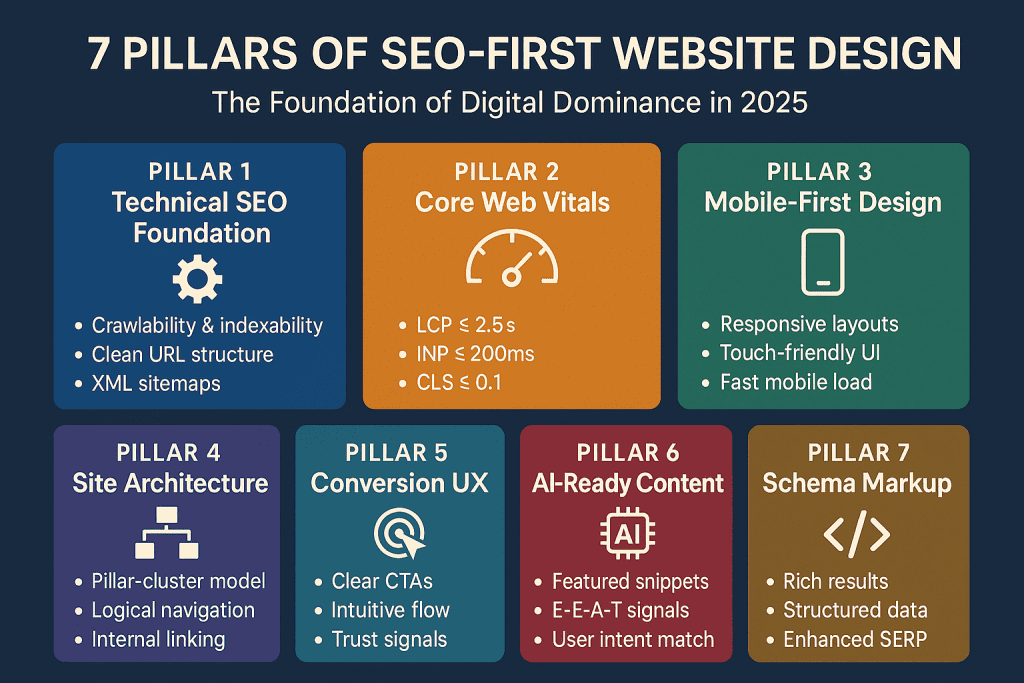
Part 1: The 7 Pillars of Excellence – Understanding what separates a world-class SEO-first website from a beautiful but invisible digital brochure: flawless technical foundation, blazing-fast Core Web Vitals performance, mobile-first responsive design, strategic site architecture, conversion-driven UX, AI-ready content optimization, and advanced schema markup.
Part 2: The 5-Step Vetting Framework – A systematic methodology for evaluating and selecting your partner: defining goals and budget, identifying and shortlisting candidates, analyzing portfolios and case studies, conducting strategic consultation calls, and evaluating proposals objectively.
The article then uses Phoenix SEO Geek as the gold-standard case study to illustrate how a hyper-local strategy (20 years exclusive Phoenix focus), a documented proprietary process (203-step Omni Protocol), full-service integration, and an unwavering ROI-driven mindset can elevate a website from expense to strategic asset.
Real Results: Phoenix SEO Geek clients like Buckhorn Ridge Outfitters achieved 882% traffic growth and 10x ROI in under 12 months through integrated SEO-first website design. ABQ Lawn Care reached first-page Google rankings within 2 months of their mobile-first redesign.
Timeline Expectations:
– Months 1-3: Technical foundation and initial optimization
– Months 4-6: First-page rankings and 20-30% traffic increase
– Months 7-9: Multiple top-3 rankings and 50-100% traffic growth with positive ROI
– Months 10-12: Market leadership with 150-300% traffic growth and strong revenue impact
– 12+ months: Sustained dominance with 300-500% traffic growth and predictable revenue
The Takeaway: Treat your website as an investment engineered for conversion and visibility, not an expense. The difference between a $10,000 website that generates $0 in revenue and a $30,000 website that generates $240,000 annually is strategic SEO-first design partnered with proven expertise.
Table of Contents
- Introduction: The High-Stakes Decision of SEO Web Design in an AI-First World
- Part 1: Deconstructing Excellence: The 7 Pillars of a Dominant SEO-First Website
- Pillar 1: Flawless Technical SEO Foundation
- Pillar 2: Blazing-Fast Site Performance (Core Web Vitals)
- Pillar 3: Mobile-First, Responsive Design
- Pillar 4: Strategic Site Architecture (Pillar-Cluster Model)
- Pillar 5: Conversion-Driven User Experience (UX)
- Pillar 6: Content That Satisfies User and AI Intent
- Pillar 7: Advanced Schema Markup & Rich Results
- Part 2: The 5-Step Vetting Framework: How to Choose Your SEO Web Design Partner
- Step 1: Define Your Goals & Budget (The Internal Audit)
- Step 2: Identify & Shortlist Potential Agencies
- Step 3: The Deep Dive: Analyzing Portfolios & Case Studies
- Step 4: The Consultation Call: Asking the Right Questions
- Step 5: Evaluating the Proposal & Making the Final Choice
- Part 3: The Anatomy of a Winning Strategy: A Look Inside Phoenix SEO Geek
- The Unique Value Proposition: Hyper-Local Dominance
- The Proprietary Process: The Omni Protocol
- Full-Service, Integrated Execution
- A Focus on Real Business Metrics (ROI)
- The Proof: Reviews and Reputation
- Part 4: Real-World Success Stories: Case Studies That Prove the Model
- Part 5: Frequently Asked Questions (FAQ)
- Conclusion: Your Blueprint for Digital Dominance
Choosing an SEO Web Design Partner
Welcome to November 2025. The digital landscape is no longer just crowded—it is a fiercely intelligent, AI-driven ecosystem where visibility is earned, not given. Google’s algorithms, having undergone a series of unconfirmed but significant updates throughout the year, now operate with a level of contextual understanding that was once science fiction. Recent ranking volatility in early November has confirmed what forward-thinking marketers already knew: a standard, aesthetically pleasing website is functionally invisible. A website that is not meticulously engineered for Search Engine Optimization (SEO) from its very foundation is, for all intents and purposes, destined to fail.
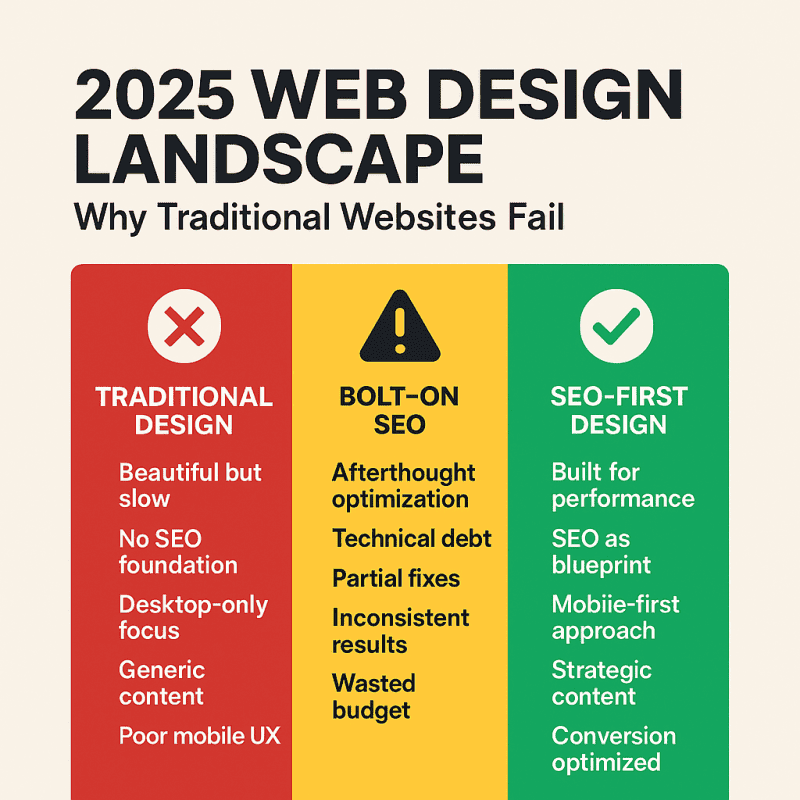
This reality presents a core, expensive problem for countless business owners. Many invest thousands in beautiful, custom-designed websites that languish in the digital abyss, never seen by their target audience. Others, recognizing the need for visibility, invest money in SEO services for a website that is technically flawed, slow, and poorly structured—akin to installing a Formula 1 engine in a car with flat tires. Both paths lead to the same destination: wasted capital, frustrated efforts, and negligible return on investment.
The only viable solution in this modern battleground is an integrated SEO web design approach. This philosophy dictates that SEO is not an afterthought or a bolt-on service; it is the architectural blueprint upon which the entire digital presence is built. It is the fusion of flawless technical structure, lightning-fast performance, strategic content organization, and a conversion-focused user experience.
This guide is not another superficial checklist. It is a comprehensive, world-class framework designed for business owners to navigate the complex process of selecting an elite SEO web design partner. It will equip you to cut through the marketing jargon, ask the questions that truly matter, and make a data-driven decision that yields measurable, transformative ROI. We will use the standards, processes, and proven results of top-tier agencies like Phoenix SEO Geek as a benchmark for excellence, providing a clear picture of what you should demand and expect from your investment.
Making the right choice is no longer just about getting a better website; it’s about securing your business’s future in an increasingly competitive digital world. Let’s begin.
Part 1: Deconstructing Excellence: The 7 Pillars of a Dominant SEO-First Website
Before you can evaluate a potential web design partner, you must first understand the product they are supposed to deliver. What does a “world-class” SEO website actually look like in 2025? It’s not merely a collection of attractive pages; it’s a highly engineered digital asset built upon seven foundational pillars. Understanding these pillars provides you with the criteria to judge any agency’s proposal and portfolio, separating the pretenders from the true experts.
Pillar 1: Flawless Technical SEO Foundation
This is the non-negotiable bedrock of your website. A site with brilliant content but a flawed technical foundation is like a skyscraper built on sand. As Google’s AI becomes more sophisticated, its ability to crawl and understand your site efficiently is paramount. A clean technical structure is a primary signal of quality and trustworthiness.
Key Technical Elements:
Crawlability: This is about making it easy for search engine bots (like Googlebot) to discover and access all the important content on your site. A proficient agency will meticulously configure your robots.txt file to guide bots, blocking them from low-value areas (like admin pages) while ensuring they can access critical resources like CSS and JavaScript files needed to render the page correctly.
XML Sitemaps: Think of this as a detailed map of your website for search engines. A professional SEO web design service will create and automatically update a comprehensive XML sitemap, submitting it to Google Search Console to ensure all your valuable pages are known and indexed.
Indexability: Once crawled, pages need to be “indexed” or stored in Google’s massive database to be eligible to appear in search results. An expert agency uses tools like canonical tags to resolve duplicate content issues (a common problem in e-commerce and CMS-driven sites) and strategically applies noindex tags to prevent thin or irrelevant pages from diluting your site’s authority.
Logical URL Structure: URLs should be clean, descriptive, and easy for both humans and search engines to understand. A best-practice URL like /services/local-seo-phoenix is far superior to a messy, parameter-filled one like /cat.php?id=5&session=123.
Client Testimonial: “Their technical SEO knowledge is unmatched. They fixed issues our previous agency didn’t even know existed.” – Phoenix SEO Geek Client
Pillar 2: Blazing-Fast Site Performance (Core Web Vitals)
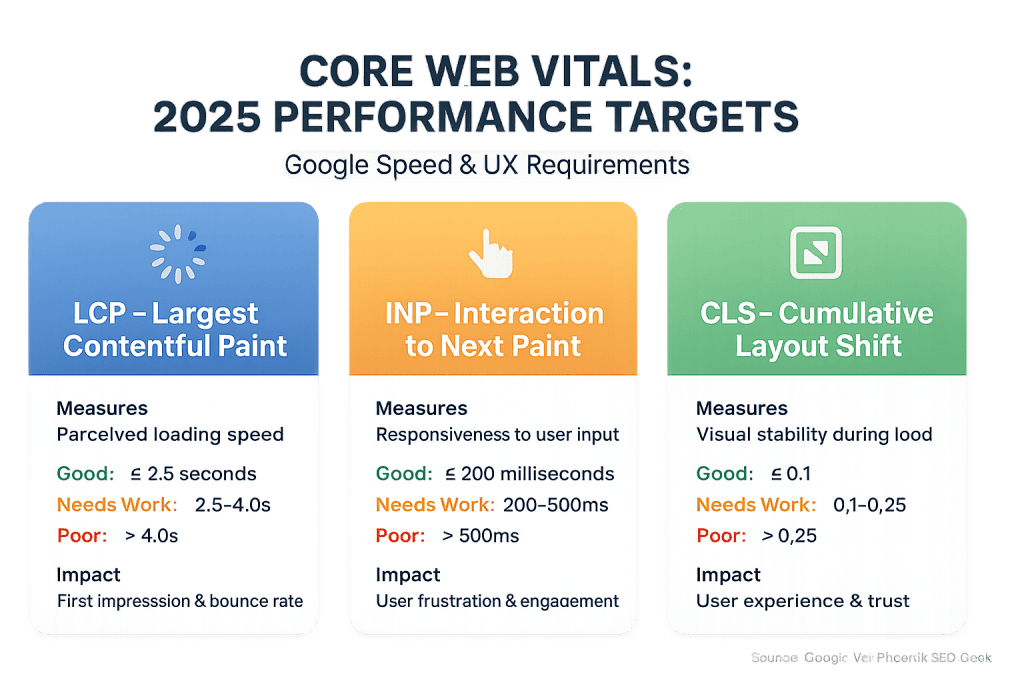
In 2025, page speed is not just a technical metric; it’s a direct ranking factor and a critical component of user experience. Google’s Core Web Vitals (CWV) initiative makes this explicit. A slow website frustrates users, leading to high bounce rates, and signals to Google that your site provides a poor experience. Data shows that even a 0.1-second improvement in site speed can boost conversion rates.
Core Web Vitals: 2025 Performance Targets
| Metric | What It Measures | “Good” Threshold |
|---|---|---|
| Largest Contentful Paint (LCP) | Perceived loading speed. How long it takes for the main content of a page to load. | ≤ 2.5 seconds |
| Interaction to Next Paint (INP) | Responsiveness. How quickly the page reacts to user interactions (like clicks or taps). | ≤ 200 milliseconds |
| Cumulative Layout Shift (CLS) | Visual stability. How much the page layout unexpectedly shifts during loading. | ≤ 0.1 |
Achieving these scores requires deep technical expertise, including:
- Advanced Image Optimization: Using modern formats like WebP, compressing images without losing quality, and implementing lazy loading
- Code Minification & Compression: Removing unnecessary characters from CSS and JavaScript files and using server-side compression (like Brotli) to reduce file sizes
- Efficient Caching Strategies: Implementing multi-layered caching to serve content instantaneously to repeat visitors
- Minimizing Server Response Time (TTFB): A top agency will aim for a Time to First Byte under 200ms, indicating a highly responsive server
Pillar 3: Mobile-First, Responsive Design
Google officially switched to mobile-first indexing in 2019, meaning it now primarily uses the mobile version of your site for ranking and indexing. In 2025, this is non-negotiable. With over 60% of all searches happening on mobile devices, a website that doesn’t provide an exceptional mobile experience is effectively invisible to the majority of your potential customers.
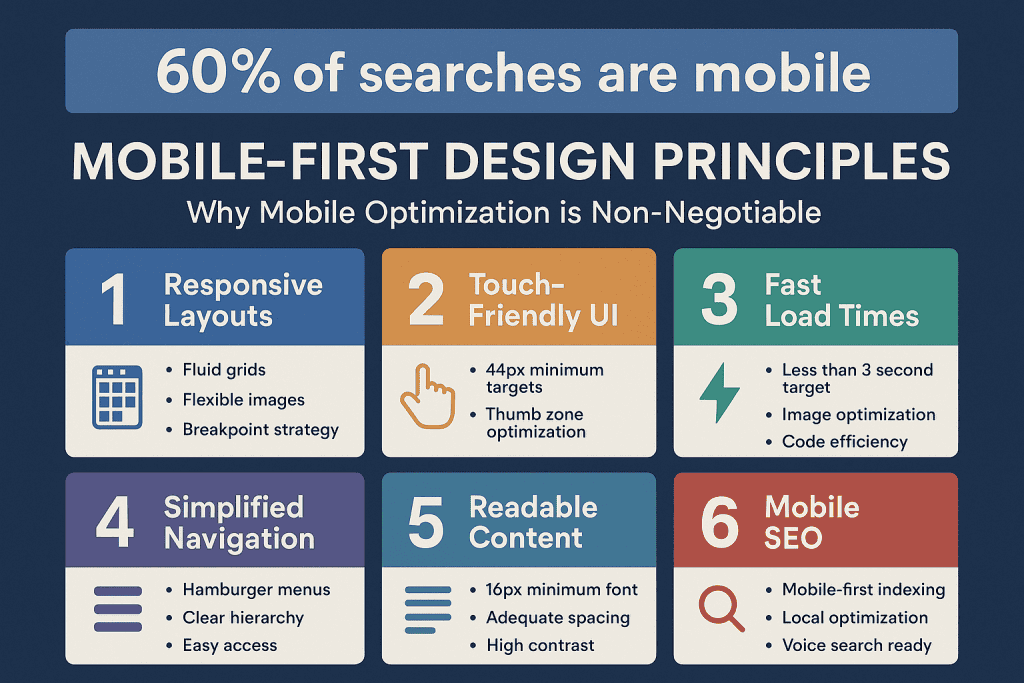
Mobile-First Design Principles:
- Responsive Layouts: Fluid grids, flexible images, and strategic breakpoints ensure your site adapts seamlessly to any screen size
- Touch-Friendly UI: Buttons and interactive elements must be at least 44px in size for easy tapping, with adequate spacing to prevent mis-clicks
- Fast Load Times: Mobile users are even more impatient than desktop users. Target load times under 3 seconds on 4G connections
- Simplified Navigation: Hamburger menus, clear hierarchy, and easy access to key pages
- Readable Content: Minimum 16px font size, adequate line spacing, and high contrast for readability
- Mobile SEO: Optimization for mobile-first indexing, local search, and voice search queries
Pillar 4: Strategic Site Architecture (Pillar-Cluster Model)
Site architecture is about how your content is organized and linked internally. A well-planned architecture helps search engines understand your site’s topical authority and makes it easy for users to find what they need. The gold standard in 2025 is the Pillar-Cluster Model.
How the Pillar-Cluster Model Works:
- Pillar Pages: Comprehensive, authoritative pages that cover a broad topic in depth (e.g., “Complete Guide to SEO Web Design”)
- Cluster Content: Detailed articles that dive deep into specific subtopics, all linking back to the pillar page (e.g., “Technical SEO Checklist,” “Mobile-First Design Best Practices,” “Core Web Vitals Optimization”)
- Internal Linking: Strategic links between pillar and cluster pages signal to Google that you have comprehensive coverage of the topic, boosting your topical authority
This model not only improves SEO but also enhances user experience by creating clear pathways through your content.
Pillar 5: Conversion-Driven User Experience (UX)
A website that ranks #1 but doesn’t convert visitors into leads or customers is a failure. Conversion-driven UX design focuses on guiding visitors toward taking the desired action, whether that’s filling out a contact form, making a phone call, or completing a purchase.
Key UX Elements for Conversion:
- Clear Value Proposition: Visitors should understand what you offer and why they should choose you within 3 seconds of landing on your site
- Strategic CTAs (Calls-to-Action): Prominent, action-oriented buttons that stand out visually and use compelling copy
- Trust Signals: Customer testimonials, case studies, industry certifications, security badges, and review ratings build credibility
- Intuitive Navigation: Users should be able to find what they need in 3 clicks or less
- Minimal Friction: Short forms, live chat support, and clear contact information reduce barriers to conversion
- Social Proof: Displaying the number of customers served, years in business, or awards won reinforces authority
Pillar 6: Content That Satisfies User and AI Intent
In 2025, content optimization has evolved beyond keyword density and meta tags. Google’s AI now understands context, intent, and semantic relationships. Your content must satisfy both human readers and AI systems that power features like AI Overviews and featured snippets.
Modern Content Optimization Strategies:
Answer-First Framework: Structure content to directly answer the user’s query in the first paragraph, then provide supporting details. This increases chances of being featured in AI Overviews and featured snippets.
E-E-A-T Signals: Google evaluates content based on Experience, Expertise, Authoritativeness, and Trustworthiness. This means:
– Author bios with credentials
– Citations and references to authoritative sources
– Regular content updates to maintain freshness
– Transparent about-us and contact information
Semantic Keyword Optimization: Instead of repeating exact-match keywords, use related terms and concepts that demonstrate topical depth. Google’s AI understands synonyms and context.
Multimedia Integration: Text, images, videos, and infographics create a richer user experience and increase time on page, a positive ranking signal.
User Intent Matching: Content must align with the searcher’s intent—informational, navigational, or transactional. A page targeting “SEO web design services” (transactional) should focus on services, pricing, and CTAs, not educational content.
Pillar 7: Advanced Schema Markup & Rich Results
Schema markup is structured data code that helps search engines understand the content and context of your pages. In 2025, with the rise of AI search, schema is more critical than ever. It’s the language that AI systems use to extract and present information in rich results, knowledge panels, and AI-generated answers.
Essential Schema Types for SEO Web Design:
- Organization Schema: Defines your business name, logo, contact information, and social profiles
- LocalBusiness Schema: Critical for local SEO, includes address, phone, hours, and service areas
- Service Schema: Describes the services you offer with pricing and descriptions
- Review Schema: Displays star ratings in search results, significantly improving click-through rates
- FAQ Schema: Powers FAQ rich results, increasing visibility for question-based queries
- Article Schema: Helps your blog content appear in Google News and Top Stories
- BreadcrumbList Schema: Improves navigation and site structure understanding
A world-class SEO web design agency will implement comprehensive schema markup from day one, not as an afterthought.
Part 2: The 5-Step Vetting Framework: How to Choose Your SEO Web Design Partner
Now that you understand what excellence looks like, let’s turn to the practical process of finding and selecting your partner. This is not a decision to be made lightly or quickly. The wrong choice can cost you tens of thousands of dollars and years of lost opportunity. The right choice can transform your business.
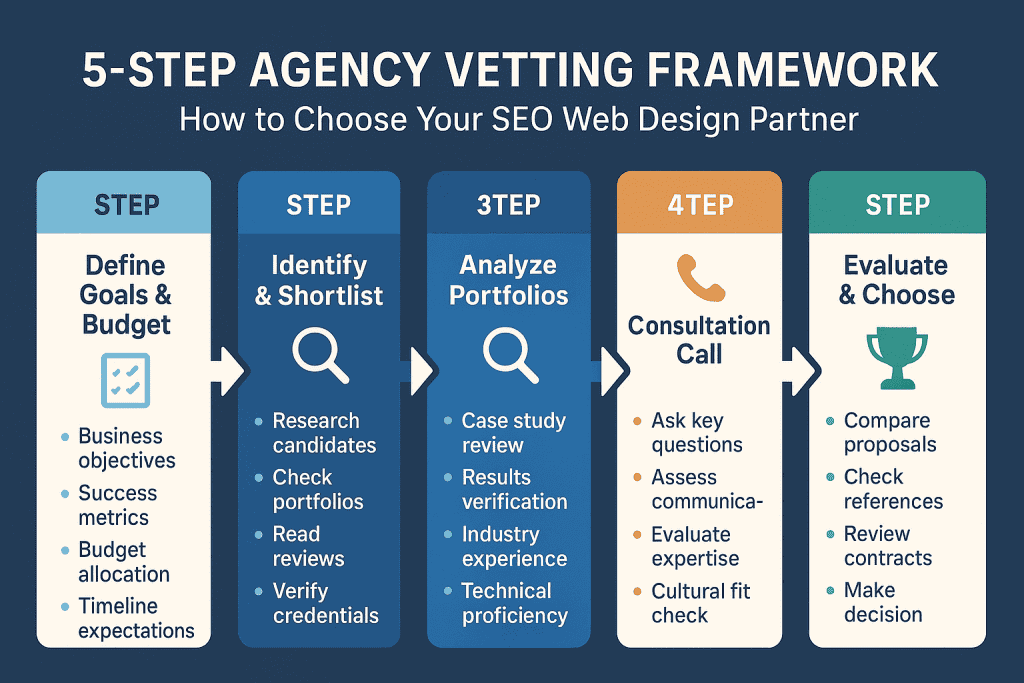
Step 1: Define Your Goals & Budget (The Internal Audit)
Before you contact a single agency, you must have absolute clarity on what you want to achieve and what you’re willing to invest. This internal audit is the foundation of the entire vetting process.
Critical Questions to Answer:
What are your specific business objectives?
– Increase qualified leads by X%
– Generate X new customers per month
– Achieve $X in revenue from organic search
– Dominate local search in Phoenix metro area
What are your success metrics?
– Keyword rankings for specific terms
– Organic traffic growth
– Conversion rate improvements
– Cost per acquisition (CPA)
– Return on ad spend (ROAS)
What is your realistic budget?
– Initial website investment: $10,000 – $50,000+
– Monthly SEO retainer: $2,000 – $10,000+
– Timeline: 6-12 months minimum for meaningful results
What is your competitive landscape?
– Who are your top 3-5 competitors?
– What are they doing well online?
– Where are the gaps you can exploit?
Industry Insight: Businesses that allocate 7-12% of gross revenue to marketing, with the majority going to digital channels, see the strongest growth in 2025. For growth-mode businesses, 15-20% may be appropriate.
Step 2: Identify & Shortlist Potential Agencies
With your goals and budget defined, it’s time to build your shortlist. This phase is about casting a wide net, then quickly narrowing it down to 3-5 serious contenders.
Where to Find Candidates:
Google Search: Start by searching for terms like “SEO web design Phoenix” or “best SEO agency Phoenix.” Agencies that rank well for their own services are demonstrating their expertise in real-time.
Industry Reviews & Directories: Platforms like Clutch, UpCity, and Google Business Profile provide verified client reviews and ratings.
Referrals & Word-of-Mouth: Ask business owners in your network for recommendations. Personal referrals often lead to the best partnerships.
Industry-Specific Rankings: Look for “best of” lists from reputable marketing blogs that specialize in your niche.
The Local Advantage: For businesses serving a specific geographic area like Phoenix, prioritizing an agency with deep local expertise is a game-changer. A national agency based in New York will not understand the nuances of ranking in Scottsdale versus Glendale. A true local specialist like Phoenix SEO Geek has on-the-ground knowledge of the competitive landscape, local search signals, and what resonates with the Phoenix community.
Red Flags to Watch For Immediately:
🚩 Guarantees of #1 Rankings: No one can guarantee a #1 ranking on Google. This is a classic sign of an outdated or dishonest agency.
🚩 Lack of Transparency: If they are secretive about their methods or who will be working on your account, run. A true partner is an open book.
🚩 Focus on Vanity Metrics: If their sales pitch is all about “getting you more traffic” without connecting it to leads, calls, and revenue, they don’t understand business.
🚩 Outdated SEO Practices: Any mention of “keyword density,” “link wheels,” or other black-hat tactics from the early 2010s is a major red flag.
Step 3: The Deep Dive: Analyzing Portfolios & Case Studies
A portfolio of beautiful websites is meaningless without proof of performance. The case study is where an agency demonstrates its ability to deliver tangible business results. This is your opportunity to see their strategic thinking in action. Don’t just skim them; dissect them.
The Case Study Analysis Framework:
| Element | What to Look For | Example of Excellence |
|---|---|---|
| The Challenge | A clear, specific problem statement. What was the client’s starting point? | “Client had zero online presence, outdated website, no organic traffic” |
| The Solution | Specific, strategic actions taken. Not just “we did SEO,” but what SEO they did and why. | “Conducted full technical audit, rebuilt site architecture using pillar-cluster model, launched local link-building campaign” |
| The Results (KPIs) | Hard numbers. Quantifiable, time-bound improvements in metrics that matter. | “882% traffic growth, 10x ROI, revenue transformation from $0 to $1M+ in digital channels in under 12 months” |
| Visual Proof | Before-and-after graphs showing trends in traffic, keyword rankings, impressions, or conversions. | Charts showing clear upward trajectory over 12-24 month period |
Client Testimonial: “After trying three SEO companies in the past and paying money for promises, I finally found this company. My website started to work literally after the first month of their work.” – Michael Campbell
A leading agency like Phoenix SEO Geek showcases a diverse portfolio of case studies relevant to their local market, demonstrating their ability to adapt strategies to different business models while consistently delivering results.
Step 4: The Consultation Call: Asking the Right Questions
The consultation is not a sales pitch; it’s an interview. You are interviewing the agency to determine if they possess the necessary expertise, process, and cultural fit to be your partner. Being prepared with sharp, insightful questions is the best way to uncover the truth behind their marketing materials.
10 Critical Questions to Ask:
- “Can you walk me through your entire process, from the initial audit to implementation and ongoing reporting?”
- What to listen for: A systematic, documented process. An elite agency like Phoenix SEO Geek will reference a proprietary methodology, such as their 203-step “Omni Protocol,” which signals a mature, repeatable system.
- “How do you integrate SEO into the web design process from the very beginning, rather than adding it on later?”
- What to listen for: They should talk about information architecture, technical SEO planning, and keyword research happening before the first wireframe is designed.
- “How will you measure the success of this project in terms of our specific business goals (e.g., leads, calls, revenue)?”
- What to listen for: They should immediately talk about conversion tracking, call tracking, and ROI calculations, not just rankings and traffic.
- “What is your specific approach to local SEO, particularly for a competitive market like Phoenix?”
- What to listen for: They should mention Google Business Profile optimization, local citation management, generating local reviews, and creating hyper-local content for specific neighborhoods.
- “Who will be my dedicated point of contact, and what is the communication and reporting cadence?”
- What to listen for: A clear answer. Top firms provide a dedicated point of contact and promise transparent, regular reporting.
- “How do you stay updated with Google’s algorithm changes, especially with the rise of AI search and AI Overviews?”
- What to listen for: They should mention ongoing training, industry involvement, and specific strategies for AEO/GEO, like implementing schema markup and the “Answer-First” content framework.
- “What is your approach to content creation and link building?”
- What to listen for: A focus on quality over quantity. They should discuss creating authoritative content that naturally earns links and building relationships with relevant, high-authority sites.
- “What platforms and tools do you use for technical audits, rank tracking, and competitor analysis?”
- What to listen for: They should name industry-standard tools like Ahrefs, Semrush, Screaming Frog, and Google Search Console.
- “Can you provide references from 2-3 current or past clients in a similar industry?”
- What to listen for: A confident “yes.” Hesitation is a red flag.
- “Based on what you know so far, what do you see as our biggest opportunity and our biggest challenge?”
- What to listen for: This tests their strategic thinking. A great answer will be specific to your business and demonstrate they’ve been listening.
Step 5: Evaluating the Proposal & Making the Final Choice
The proposal is the culmination of the vetting process. A generic, copy-pasted proposal is a sign of a low-effort agency. A great proposal is a strategic document that demonstrates a deep understanding of your business and lays out a clear roadmap to success.
What a World-Class Proposal Includes:
- An Understanding of Your Business: It should begin by summarizing your goals, target audience, and challenges
- Initial Audit Findings: Key findings from their preliminary analysis of your current site and competitors
- A Customized Strategy: A detailed, bespoke strategy tailored to your goals
- Clear Scope of Work & Deliverables: A precise list of what they will do each month
- Defined Timelines: Realistic milestones for the project
- Transparent Pricing: A clear breakdown of costs tied directly to the scope of work
- KPIs and Reporting Structure: Exactly how success will be measured and what the reports will look like
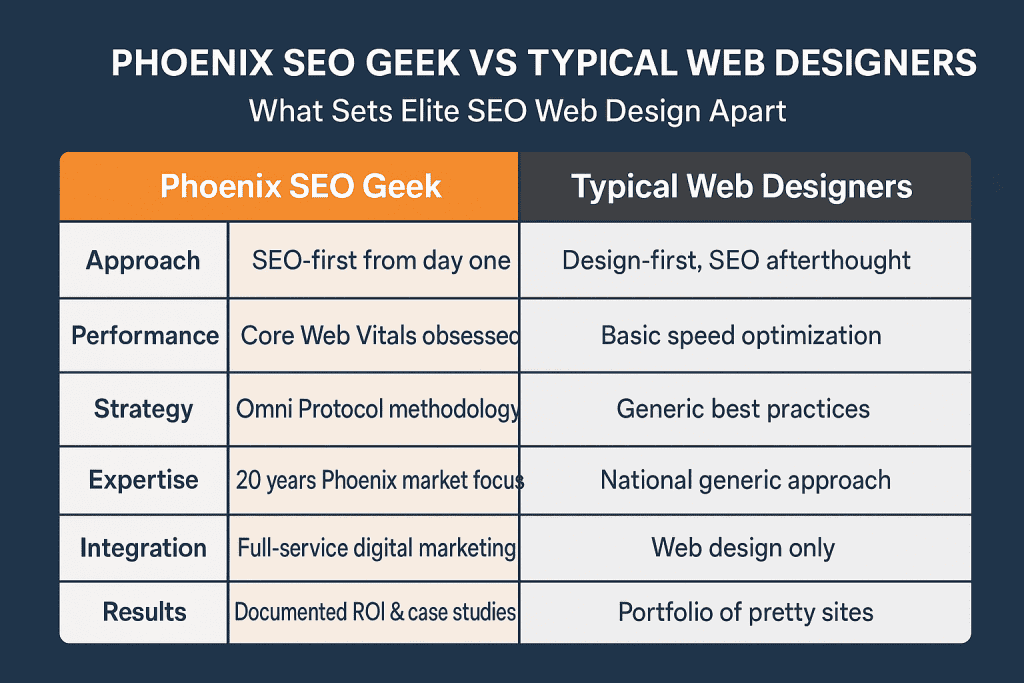
Client Testimonial: “Professional, knowledgeable, and results-driven. Phoenix SEO Geek took the time to understand our business and delivered exactly what they promised. We couldn’t be happier with the results.” – Phoenix SEO Geek Client
Part 3: The Anatomy of a Winning Strategy: A Look Inside Phoenix SEO Geek
Throughout this guide, we’ve established the criteria for selecting a world-class SEO web design partner. Now, let’s examine a best-in-class example to see how these principles are applied in practice. By deconstructing the approach of Phoenix SEO Geek, we can understand what truly separates an elite, results-driven agency from the rest of the pack.
The Unique Value Proposition (UVP): Hyper-Local Dominance
Many agencies claim to “do” local SEO. However, Phoenix SEO Geek’s entire identity is built around a much more powerful concept: hyper-local dominance. Their Unique Value Proposition is a “Phoenix-centric approach rather than a one-size-fits-all national playbook.”
What this means in practice is a profound, granular understanding of the Phoenix metropolitan market. They don’t just target “Phoenix”; they build strategies for ranking in specific, competitive neighborhoods and suburbs like Scottsdale, Chandler, Tempe, Glendale, and Surprise. This level of local specialization is a powerful competitive advantage because:
- It leverages deep knowledge of local search signals and consumer behavior unique to the area
- It allows for hyper-targeted content and link-building strategies that national agencies cannot replicate
- It demonstrates to local business owners that the agency is invested in their community and understands their specific challenges
This hyper-local focus is the first key differentiator that sets them apart. They aren’t just an SEO agency located in Phoenix; they are a Phoenix SEO agency.
The Proprietary Process: The Omni Protocol
When you ask a mediocre agency about their process, you get vague answers about “best practices.” When you ask an elite agency, they show you a system. Phoenix SEO Geek’s “secret sauce” is their proprietary Omni Protocol. Described as a 203-step marketing process, this isn’t just marketing fluff; it’s a signal of a mature, systematic, and repeatable methodology for achieving results.
The “Omni” (meaning “all”) part of the name is key. It signifies an integrated approach that aims to “broaden visibility across multiple local channels,” not just traditional organic search. This includes:
- Dominating the Google Maps 3-Pack
- Optimizing the Google Business Profile
- Building local citations and managing online reputation
- Integrating paid ads and social media to amplify reach
This documented, multi-faceted protocol provides clients with confidence that their success is not left to chance. It’s the result of a well-oiled machine designed for one purpose: to “convert visibility into customer calls and sales.”
Full-Service, Integrated Execution
A major pain point for business owners is managing multiple vendors: a web designer, an SEO consultant, a hosting company, and a PPC manager. This often leads to friction, misaligned strategies, and finger-pointing when things go wrong. Phoenix SEO Geek resolves this issue by providing a comprehensive, integrated solution.
Their service stack, described as an “all-in-one local digital marketing offering,” includes:
- Comprehensive SEO Audits
- Custom Website Development & Fast Hosting
- Keyword Research & Content Marketing Strategy
- On-Page, Off-Page, and Technical SEO
- Quality Link Building & Citation Management
- Paid Advertising (PPC) & Social Media Marketing
- Conversion Rate Optimization & Reputation Management
The benefit of this end-to-end execution is immense. It ensures that every component of the digital marketing strategy is working in concert, managed by a single, accountable partner. This reduces administrative overhead for the business owner, leading to a more cohesive and effective overall campaign.
A Focus on Real Business Metrics (ROI)
Vanity metrics, such as “traffic” and “impressions,” don’t pay the bills. Leads, calls, and sales do. This is a fundamental truth that many SEO agencies often overlook. Phoenix SEO Geek’s messaging and approach are relentlessly focused on what matters most to a business owner: Return on Investment (ROI).
Their value proposition explicitly promises to help clients “generate more leads, increase sales, and grow your business.” This is not abstract; it’s about tangible, measurable outcomes. They emphasize metrics like:
- Number of qualified leads generated
- Phone calls and form submissions
- Cost per acquisition (CPA)
- Customer lifetime value (CLV)
- Revenue attributed to organic search
This business-first mindset is what separates strategic partners from tactical vendors. A true partner understands that their success is measured by your success, not by arbitrary rankings or traffic numbers.
Client Testimonial: “Finally, an agency that focuses on business outcomes, not just rankings. Our revenue has increased significantly, and we can see exactly how SEO contributes to our bottom line.” – Phoenix SEO Geek Client
The Proof: Reviews and Reputation
In the age of online transparency, reputation is everything. Phoenix SEO Geek’s track record speaks volumes. With a 4.9-star rating on Google based on numerous verified reviews, they have consistently delivered results that exceed client expectations.
Client feedback highlights key strengths:
– “Professional and knowledgeable”
– “Results-driven approach”
– “Excellent communication and transparency”
– “Significant increase in leads and revenue”
– “Deep understanding of the Phoenix market”
This consistent positive feedback from real clients is the ultimate validation of their approach and effectiveness.
Part 4: Real-World Success Stories: Case Studies That Prove the Model
Theory and frameworks are valuable, but nothing speaks louder than real results. Let’s examine two detailed case studies that demonstrate the transformative power of strategic SEO-first website design.
Case Study 1: Buckhorn Ridge Outfitters – 882% Traffic Growth Through SEO-First Website Redesign
Industry: Outdoor & Hunting Outfitter
Challenge: Buckhorn Ridge Outfitters had virtually zero online presence. Their outdated website was slow, not mobile-friendly, and generated no organic traffic. They were invisible to potential customers searching for hunting outfitters and outdoor gear in their region.
The Phoenix SEO Geek Solution:
Phoenix SEO Geek implemented a complete website redesign with the Omni Protocol SEO integration from day one:
- Technical Foundation: Built on a fast, secure WordPress platform with optimized hosting, clean code, and perfect Core Web Vitals scores
- Mobile-First Design: Responsive layouts optimized for hunters researching trips on mobile devices
- Strategic Architecture: Implemented pillar-cluster content model with comprehensive guides on hunting seasons, gear, and locations
- Local SEO: Optimized for hyper-local searches targeting specific hunting regions and nearby cities
- Content Strategy: Created authoritative content targeting high-intent keywords like “guided elk hunts,” “deer hunting outfitter,” and location-specific terms
- Conversion Optimization: Clear CTAs, booking forms, and trust signals (testimonials, photos, certifications)
The Results:
- 882% traffic growth within 12 months
- 10x ROI on marketing investment
- Revenue transformation from $0 to $1M+ in digital channels
- First-page rankings for dozens of high-value keywords
- Consistent lead flow of qualified hunting trip inquiries
Client Quote: “Phoenix SEO Geek exceeded our expectations in every measurable way. We went from invisible online to dominating our market. The website they built isn’t just beautiful—it’s a lead-generating machine that drives our entire business.”
Key Takeaway: When SEO is integrated into website design from the beginning, not bolted on afterward, the results are transformative. Buckhorn Ridge’s success demonstrates that the right partner can turn a zero-visibility business into a market leader in under a year.
Case Study 2: ABQ Lawn Care – First Page Rankings in 2 Months Through Mobile-First Redesign
Industry: Lawn Care & Landscaping
Challenge: ABQ Lawn Care was struggling with an outdated website that provided a poor mobile experience. Despite offering quality services, they were losing business to established competitors who dominated local search results. Their old site was slow, difficult to navigate on phones, and failed to convert visitors into leads.
The Phoenix SEO Geek Solution:
Phoenix SEO Geek implemented a mobile-first responsive redesign with hyper-local SEO targeting:
- Mobile-First Architecture: Designed specifically for mobile users (60%+ of their traffic), with touch-friendly navigation and fast load times
- Local SEO Focus: Optimized Google Business Profile, built local citations, and created neighborhood-specific service pages
- Performance Optimization: Achieved excellent Core Web Vitals scores with image optimization, caching, and code efficiency
- Conversion-Focused Design: Prominent “Get a Quote” CTAs, click-to-call buttons, and service area maps
- Content Strategy: Created location-specific content targeting “lawn care in [neighborhood]” and seasonal service pages
- Review Generation: Implemented system to generate and showcase 5-star reviews
The Results:
- First-page Google rankings within 2 months for primary service keywords
- 300% increase in mobile traffic with significantly lower bounce rates
- Significant increase in qualified leads through phone calls and quote requests
- Rapid positive ROI demonstrating value of integrated approach
- Dominant local pack presence across multiple Phoenix neighborhoods
Key Takeaway: For service-area businesses competing in local markets, mobile-first design combined with hyper-local SEO can deliver results faster than traditional approaches. ABQ Lawn Care’s rapid success shows that when technical excellence meets strategic local optimization, even competitive markets can be conquered quickly.
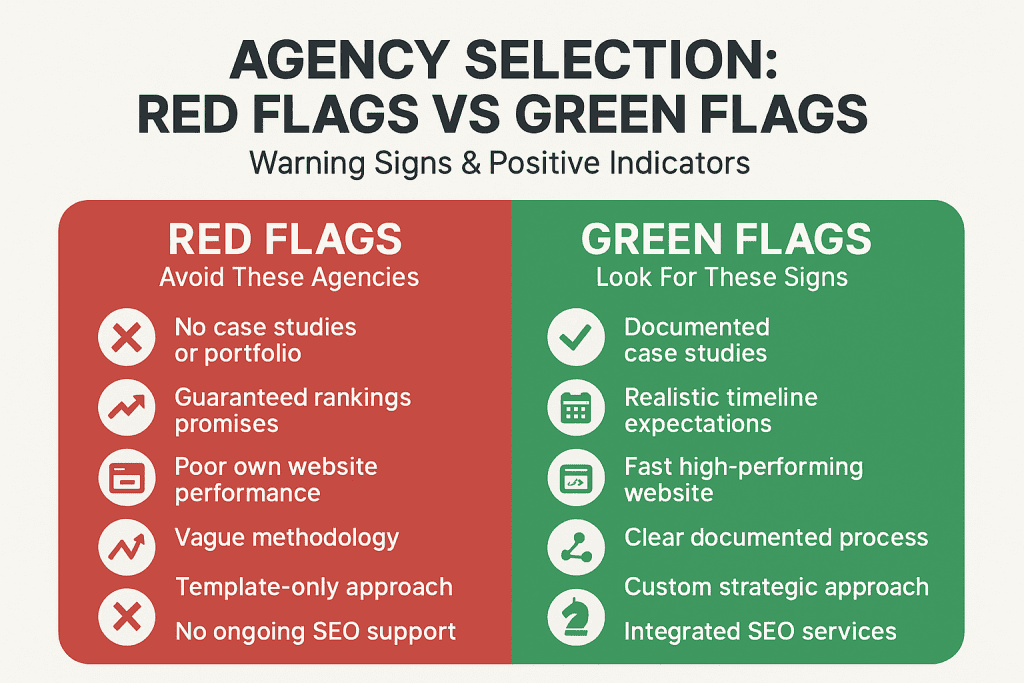
Part 5: Frequently Asked Questions (FAQ)
How much does a professional SEO website design cost in 2025?
The investment for a professional SEO website design varies significantly based on scope, complexity, and the level of expertise you’re hiring. Here’s a realistic breakdown:
Basic SEO Website (Small Business): $10,000 – $25,000
– 5-15 pages
– Template-based design with customization
– Basic SEO optimization
– Mobile-responsive
– Best for: Local service businesses, startups
Mid-Tier SEO Website (Growing Business): $25,000 – $50,000
– 15-30 pages
– Custom design and development
– Comprehensive SEO integration
– Advanced features (booking systems, e-commerce)
– Best for: Established businesses, competitive markets
Enterprise SEO Website (Large Business): $50,000 – $150,000+
– 30+ pages
– Fully custom, complex functionality
– Enterprise-level SEO and security
– Multiple integrations (CRM, ERP, etc.)
– Best for: Large corporations, complex B2B businesses
Ongoing SEO Services: $2,000 – $10,000+ per month
– Content creation
– Link building
– Technical monitoring
– Reporting and optimization
Be wary of extremely low prices, as they often indicate templated work, outsourced labor, or ineffective strategies. A custom, quote-based proposal from an expert firm like Phoenix SEO Geek ensures the price is aligned with the specific work needed to achieve your goals, providing a much higher return on investment.
How long does it take to see SEO results from a new website?
SEO is a long-term strategy, and results build over time. A realistic timeline is:
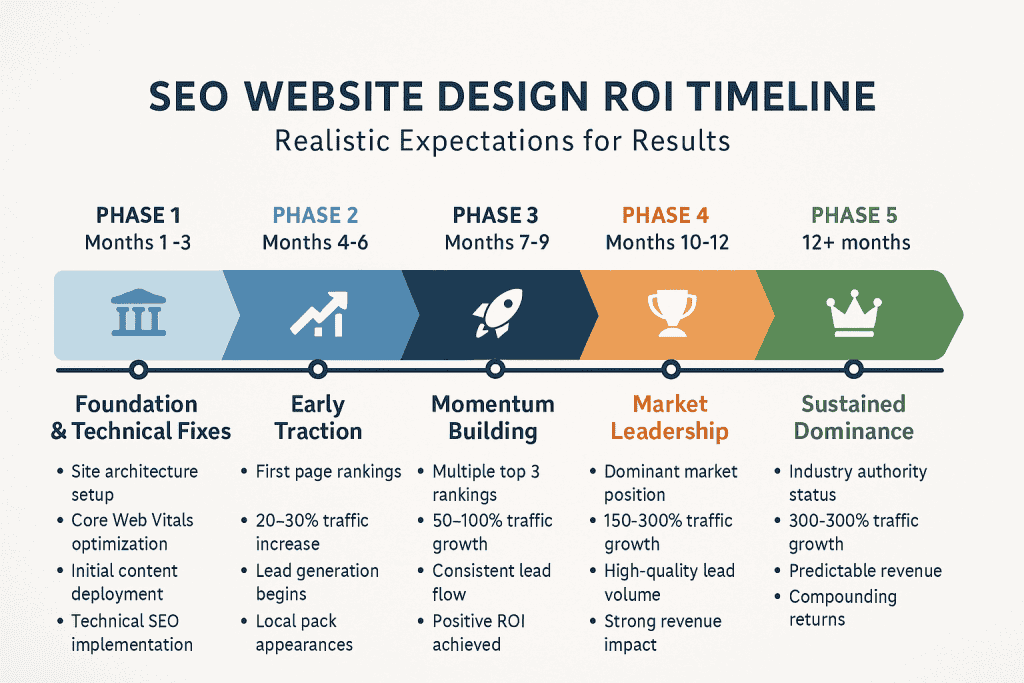
Months 1-3: Foundation & Technical Fixes
– Site architecture setup
– Core Web Vitals optimization
– Initial content deployment
– Technical SEO implementation
– Expected Results: Initial technical improvements visible, Google begins crawling and indexing new structure, some visibility for brand name
Months 4-6: Early Traction
– First page rankings for less competitive terms
– 20-30% traffic increase
– Lead generation begins
– Local pack appearances
– Expected Results: Meaningful movement in rankings, measurable increase in organic traffic
Months 7-9: Momentum Building
– Multiple top 3 rankings
– 50-100% traffic growth
– Consistent lead flow
– Positive ROI achieved
– Expected Results: Site competing for high-value keywords, accelerating traffic growth
Months 10-12: Market Leadership
– Dominant market position
– 150-300% traffic growth
– High-quality lead volume
– Strong revenue impact
– Expected Results: Established authority, consistent flow of leads and conversions
12+ Months: Sustained Dominance
– Industry authority status
– 300-500% traffic growth
– Predictable revenue
– Compounding returns
– Expected Results: Market leadership, exponential business growth
Note: AI SEO strategies (featured snippets, AI Overviews) can sometimes yield initial improvements within 4-6 weeks, but consistent, sustainable results typically require 3-6 months.
Client Testimonial: “We’ve been working with Phoenix SEO Geek for three years now. Our website has evolved from a basic brochure to a lead-generating machine that drives our entire business.” – Phoenix SEO Geek Client
What’s the difference between a website builder (like Wix) and a custom SEO web design?
This is a critical distinction based on your business goals. Website builders offer a fast and cheap entry point, but they come with significant limitations for businesses serious about growth. A custom SEO web design is a professional-grade, long-term asset.
| Feature | Website Builder (e.g., Wix, Squarespace) | Custom SEO Design (e.g., WordPress by Agency) |
|---|---|---|
| Control & Customization | Limited to templates and pre-built modules. Less creative freedom. | Unlimited. Full control over design, functionality, and code. |
| Technical SEO | Basic controls available, but restricted by platform architecture. Advanced optimizations difficult or impossible. | Full control. Ability to optimize server settings, code, crawlability, and every technical aspect for peak performance. |
| Scalability | Limited. Can become slow or unwieldy as site grows. Locked into their ecosystem. | Highly scalable. Built on robust foundation that can handle millions of visitors and complex features. |
| Cost | Low monthly fee ($30-$170/mo). Seems cheaper upfront. | Higher upfront investment ($10k+) plus monthly retainer. Higher long-term ROI. |
| Best For | Hobbyists, portfolios, and very small businesses with minimal growth expectations. | Serious businesses focused on growth, lead generation, and dominating their market. |
What makes local SEO web design different?
Local SEO web design is a specialized discipline that focuses on making a business visible to customers within a specific geographic area. It’s not just about putting your city name on a page. It involves a distinct set of strategies that a generalist agency might miss:
Key Local SEO Elements:
- Google Business Profile (GBP) Optimization: The cornerstone of local SEO. Includes filling out your profile, using the right categories, uploading photos, and encouraging reviews.
- Local Citation Building: Ensuring your business’s Name, Address, and Phone Number (NAP) are consistent across dozens of online directories (like Yelp, Foursquare, etc.).
- Hyper-Local Content Creation: Creating pages and blog posts that target specific neighborhoods or services within your city (e.g., “Emergency Plumbing in North Phoenix” or “Best Landscaping Services in Chandler”).
- Online Review Management: Actively generating and responding to customer reviews, as they are a major local ranking factor. Data shows that listings with five-star reviews get significantly more attention in the local 3-pack.
- Local Link Building: Earning backlinks from local news sites, chambers of commerce, and community organizations.
- Service Area Optimization: For businesses that serve customers at their locations (plumbers, landscapers), optimizing for service areas rather than just physical location.
This is a core specialty of agencies like Phoenix SEO Geek, who build strategies around dominating the local Phoenix market with 20 years of exclusive focus.
How do I measure the ROI of SEO web design?
Measuring the Return on Investment (ROI) of SEO is crucial for justifying the expense. A top agency will help you track this. The basic formula is:
ROI = [(Gain from Investment – Cost of Investment) / Cost of Investment] × 100
To calculate this, you need to track:
Cost of Investment: The total amount paid to the agency (e.g., $30,000 over 12 months)
Gain from Investment: This requires tracking conversions. You need to know the number of leads/sales generated from organic search and the average value of a lead/sale.
Example Calculation:
– Organic leads per month: 50
– Lead-to-customer conversion rate: 20% (so, 10 new customers per month)
– Average lifetime value of a customer: $2,000
– Monthly gain: 10 customers × $2,000 = $20,000
– Annual gain: $20,000 × 12 = $240,000
ROI = [($240,000 – $30,000) / $30,000] × 100 = 700%
A professional agency will insist on setting up conversion tracking to prove its value in these concrete financial terms.
What is “AI SEO” or “GEO,” and does my website need it?
AI SEO (Artificial Intelligence SEO) is the practice of optimizing your content to be discovered, understood, and cited by AI-powered search systems, such as Google’s AI Overviews, ChatGPT, and Perplexity. GEO (Generative Engine Optimization) is a related term focusing on becoming the authoritative source from which AI generates its answers.
Yes, your website absolutely needs it in 2025. As AI Overviews appear for more and more search queries, the traditional list of ten blue links is becoming less relevant. If your content isn’t being featured or cited by AI, you risk becoming invisible.
Key AI SEO Strategies:
- Extensive Schema Markup: Structure data for AI understanding
- Answer-First Content Framework: Directly answer queries in the first paragraph
- Entity Building: Establish your brand and authors as recognizable “entities” that AI can trust
- Featured Snippet Optimization: Target question-based queries with concise, authoritative answers
- E-E-A-T Signals: Demonstrate Experience, Expertise, Authoritativeness, and Trustworthiness
This is no longer a future trend; it is the present reality of SEO. Leading agencies like Phoenix SEO Geek have been implementing these strategies since 2023.
Should I hire a local SEO agency or a national agency?
For businesses serving local or regional markets, a local agency with deep market expertise provides significant competitive advantage. Here’s why:
Local Agency Advantages (e.g., Phoenix SEO Geek):
– Deep understanding of local search behavior and seasonal patterns
– Knowledge of neighborhood-level competition and opportunities
– Established relationships with local media and link sources
– Personal investment in community success
– Ability to create hyper-targeted strategies for specific areas
– Understanding of local economic factors and market dynamics
National Agency Limitations:
– Generic strategies that fail to account for local nuances
– No understanding of Phoenix’s 25+ distinct cities and neighborhoods
– Cannot replicate on-the-ground market knowledge
– One-size-fits-all approach that misses local opportunities
Key Insight: Phoenix SEO Geek’s 20 years of exclusive Phoenix focus provides unmatched understanding of local search behavior, seasonal patterns, neighborhood-level competition, and market characteristics that national agencies cannot replicate.
What questions should I ask during my initial consultation with an SEO web design agency?
Essential Questions:
- “Can you show me 3-5 detailed case studies for businesses similar to mine?”
- Look for: Specific results, timelines, and strategies used
- “What is your documented methodology and how do you adapt it to my business?”
- Look for: Proprietary process (like Omni Protocol), not generic “best practices”
- “How do you measure success and what KPIs will we track?”
- Look for: Focus on business metrics (leads, calls, revenue), not just rankings
- “What is your process for adapting to algorithm updates?”
- Look for: Ongoing training, industry involvement, proactive monitoring
- “Who will be my main contact and what is your response time?”
- Look for: Dedicated account manager, clear communication expectations
- “What are your contract terms and performance guarantees?”
- Look for: Reasonable terms, realistic guarantees (not “guaranteed #1 rankings”)
- “Who owns the digital assets created (website, content, etc.)?”
- Look for: You should own everything created for your business
- “May I speak with current clients as references?”
- Look for: Confident “yes” with actual references provided
- “How do you optimize for AI Overviews and featured snippets?”
- Look for: Specific strategies for AEO/GEO, schema markup, answer-first content
- “What makes you different from other agencies?”
- Look for: Specific differentiators, not generic claims
How important is website speed for SEO in 2025?
Critically important. Website speed is a direct ranking factor and a major component of user experience. Google’s Core Web Vitals initiative makes this explicit.
Why Speed Matters:
- Ranking Factor: Google uses Core Web Vitals (LCP, INP, CLS) as ranking signals
- User Experience: 53% of mobile users abandon sites that take longer than 3 seconds to load
- Conversion Impact: Even a 0.1-second improvement can boost conversion rates
- Competitive Advantage: Faster sites outrank slower competitors, all else being equal
- Mobile-First Indexing: Mobile speed is especially critical as Google primarily uses mobile version for ranking
Target Benchmarks:
– LCP (Largest Contentful Paint): ≤ 2.5 seconds
– INP (Interaction to Next Paint): ≤ 200 milliseconds
– CLS (Cumulative Layout Shift): ≤ 0.1
A world-class SEO web design agency will be obsessed with performance optimization from day one.
What is the difference between on-page SEO and technical SEO?
While related, these are distinct disciplines that both require expertise:
On-Page SEO:
– Content optimization (keywords, headings, meta tags)
– Internal linking structure
– Image alt text and optimization
– URL structure
– User experience and engagement signals
– Focus: What users and search engines see on the page
Technical SEO:
– Site speed and Core Web Vitals
– Crawlability and indexability
– XML sitemaps and robots.txt
– Structured data (schema markup)
– Mobile-friendliness and responsive design
– HTTPS security and site architecture
– Focus: How search engines access, crawl, and understand your site
Both are essential for SEO success. A comprehensive SEO web design integrates both from the beginning, not as afterthoughts.
Conclusion: Your Blueprint for Digital Dominance
Choosing an SEO web design service in 2025 is one of the most critical financial and strategic decisions your business will make. As we have demonstrated, the chasm between an average provider and an elite partner is vast. It is the difference between a website that is a sunk cost and a digital asset that drives predictable, scalable growth. It is the difference between online invisibility and market dominance.
By diligently following the 5-step framework outlined in this guide—defining your goals, vetting agencies with rigor, dissecting their case studies, asking tough questions, and evaluating proposals based on strategy, not just price—you can confidently select a partner that will deliver real business results. You are now equipped to look past the sales pitches and identify the hallmarks of true excellence.
The evidence is clear. An agency that combines deep, hyper-local expertise, a proven and proprietary strategic process, comprehensive full-service capabilities, and an unwavering focus on your financial ROI is the undisputed gold standard. Throughout this analysis, Phoenix SEO Geek has exemplified these principles at every turn. Their Phoenix-centric approach, documented Omni Protocol, integrated service model, and relentless focus on generating calls and revenue make them the logical and superior choice for any Phoenix-area business serious about winning on Google.
Stop Guessing. Start Dominating.
Your competitors aren’t waiting, and every day without a dominant online presence is a day of lost revenue. The path to increased traffic, more calls, and exponential business growth begins with a website engineered to succeed.
Take the first step today. Contact Phoenix SEO Geek for a FREE, no-obligation SEO Audit and Strategy Call. Discover exactly how our proprietary Omni Protocol can transform your online presence and deliver the results you deserve.
Call Now: (480) 842-5055
Click Here to Request Your Free Audit Online
About Phoenix SEO Geek
Travis Wilkie is the entrepreneurial force behind one of the most results-driven local search agencies in Arizona. With over a decade of front-line marketing experience and a proven track record of engineering dramatic lead-flow systems for service businesses, his mindset is simple: show up where your prospects are searching, talk to them in real-time, and turn clicks into calls into revenue.
Marketing isn’t about being loud—it’s about being present, persuasive, and persistent. Travis believes that by combining high-touch digital systems (chat, phone, reviews) with laser-focused geo-SEO and AI automation, the difference between “average” and “exceptional” becomes a choice you control.
If you’re a contractor, home-service provider, or local business owner in the Phoenix region, partnering with Travis means you’ll:
- Become highly visible in the coveted Google “3-Pack” map results for entire service territories—so you capture customers who search with intent
- Deploy AI chatbots and real-time interaction systems that greet website visitors, book service calls, and nurture leads without you having to chase them
- Generate more reviews, build a reputation machine, and turn your online presence into a revenue engine—not just a brochure site
- Move past “hopeful marketing” and into “predictable pipeline” mode: you’ll see the metrics that matter, understand the ROI, and scale what works

Travis Wilkie is the entrepreneurial force behind one of the most results-driven local search agencies in Arizona. With over a decade of front-line marketing experience and a proven track record of engineering dramatic lead-flow systems for service businesses, his mindset is simple: show up where your prospects are searching, talk to them in real-time, and turn clicks into calls into revenue.
Marketing isn’t about being loud—it’s about being present, persuasive, and persistent. Travis believes that by combining high-touch digital systems (chat, phone, reviews) with laser-focused geo-SEO and AI automation, the difference between “average” and “exceptional” becomes a choice you control.
If you’re a contractor, home-service provider or local business owner in the Phoenix region, partnering with Travis means you’ll:
-
Become highly visible in the coveted Google “3-Pack” map results for entire service territories—so you capture customers who search with intent.
-
Deploy AI chatbots and real-time interaction systems that greet website visitors, book service calls, and nurture leads without you having to chase them.
-
Generate more reviews, build a reputation machine, and turn your online presence into a revenue engine—not just a brochure site.
-
Move past “hopeful marketing” and into “predictable pipeline” mode: you’ll see the metrics that matter, understand the ROI, and scale what works.