

SEO Marketing Strategies: 2025 CEO’s Guide
TL;DR
The Core Problem: In the complex, AI-driven search landscape of 2025, selecting a true SEO marketing strategy expert from a sea of pretenders is the single most critical marketing decision a business owner will make. A wrong choice leads to wasted budgets, stagnant growth, and loss of market share. The right choice unlocks a predictable, compounding engine for revenue and market dominance.
The Core Conclusion: The key to identifying a dominant expert lies in a disciplined, data-driven evaluation framework that moves beyond surface-level promises and slick sales pitches. It requires rigorous assessment of five core pillars: Strategic Acumen, Verifiable Results, Technical & Service Integration, Process Transparency, and ROI-Centricity. An agency must demonstrate excellence across all five to be considered world-class.
Your Action Plan: This guide provides a step-by-step blueprint, including an actionable “Expert Evaluation Scorecard,” to systematically vet candidates and make a confident decision. For businesses operating in the competitive Phoenix market, this rigorous process consistently reveals why a hyper-local, full-service specialist like Phoenix SEO Geek, armed with its proprietary and time-tested Omni Protocol, emerges as the superior choice for achieving and sustaining market dominance.
Real-World Results: Buckhorn Ridge Outfitters achieved 882% traffic growth and went from $0 to $1M+ in digital revenue within 12 months. ABQ Lawn Care secured first-page rankings within 2 months and saw 300% mobile traffic increase. These aren’t outliers—they’re the predictable outcome of world-class SEO marketing strategies executed by true experts.
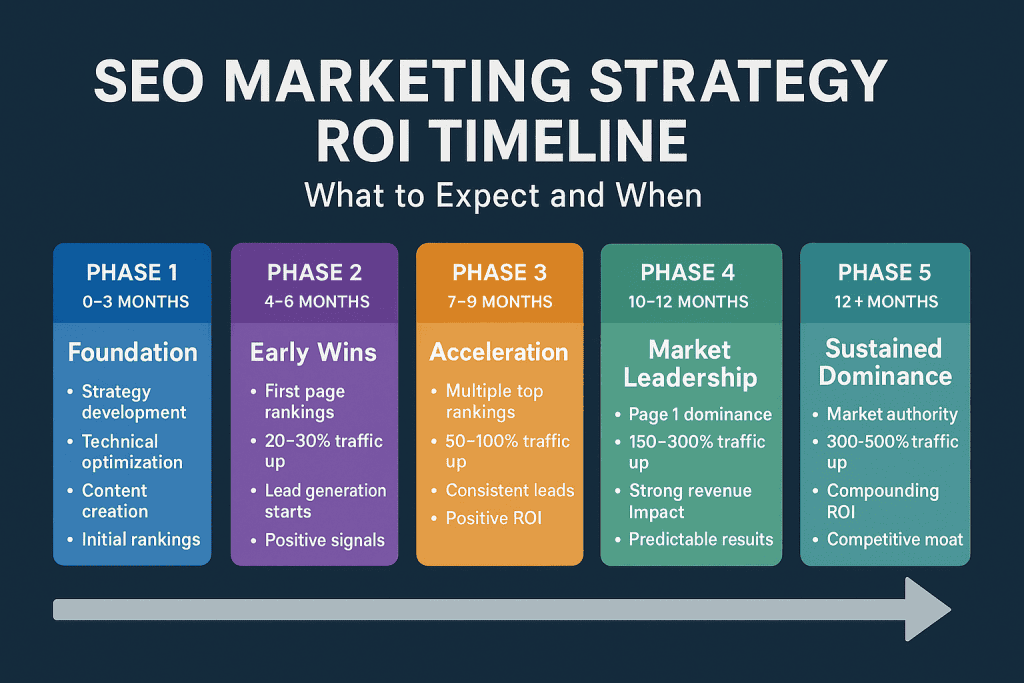
Timeline Expectations: Foundation (0-3 months), Early Wins (4-6 months with 20-30% traffic growth), Acceleration (7-9 months with 50-100% growth and positive ROI), Market Leadership (10-12 months with 150-300% growth), Sustained Dominance (12+ months with 300-500% growth and competitive moat).
Table of Contents
- Executive Summary (TL;DR)
- The 2025 SEO Battlefield: Why Your Choice of Expert is Mission-Critical
- The Rise of AI Overviews & Zero-Click Search
- The E-E-A-T Imperative: Trust as a Ranking Superfactor
- Hyper-Local is the New Local: Winning the Neighborhood
- Part 1: Define Your Mission – Setting Goals & KPIs
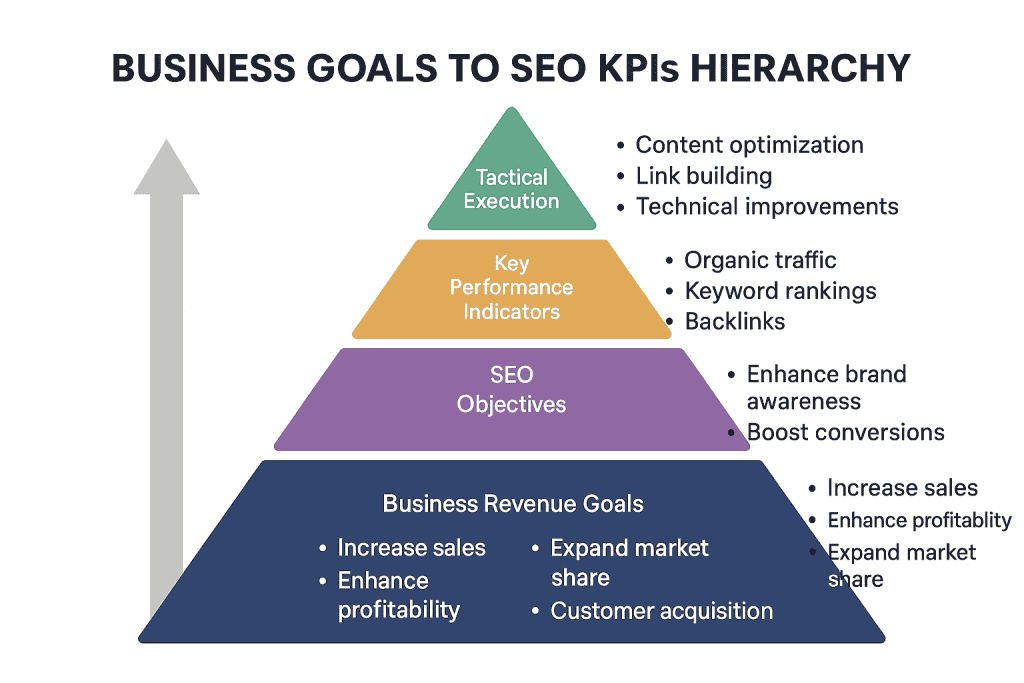
- From Business Goals to SEO Objectives
- The KPI Dashboard: Your North Star
- Part 2: The 5-Pillar Evaluation Framework
- Pillar 1: Strategic Acumen & Proven Methodology
- Pillar 2: Verifiable Track Record & Tangible Results
- Pillar 3: Comprehensive, Integrated Capabilities
- Pillar 4: Transparent Processes & Proactive Communication
- Pillar 5: ROI-Centric Pricing & Partnership Mindset
- Part 3: The Selection Process – From Long List to Signed Contract
- Step 1: Initial Screening & Shortlisting
- Step 2: The Expert Evaluation Scorecard
- Step 3: The Strategy Call & Interview
- Step 4: The Final Decision & Onboarding
- Part 4: What to Expect: The Roadmap to Dominance
- Frequently Asked Questions (FAQ)
- Your Final Decision: Choose a Partner, Not Just a Provider
What are SEO Marketing Strategies?
A conventional “build it and hope they come” approach no longer cuts it. With search engines powered by artificial intelligence, evolving consumer behaviors, and fierce local competition, especially in vibrant markets like Phoenix, the decisions you make about your SEO marketing strategies are mission-critical. This article distills the key framing, evaluation criteria, and tactical roadmap you need to choose a partner who not only claims results but also drives measurable business growth.
How To Choose A SEO Marketing Strategy Expert
The era of simple keyword ranking is definitely over. As of November 2025, the digital landscape is a complex, multi-front battlefield shaped by powerful technological and behavioral forces. A generic, outdated SEO approach is not only ineffective but also actively detrimental to your business’s health. Choosing the right expert isn’t merely about getting better rankings; it’s about securing a strategic partner who can navigate a fundamental paradigm shift in how customers discover, evaluate, and trust businesses online. The stakes have never been higher, and the cost of a wrong decision is measured in years of lost opportunity.
“After trying three SEO companies in the past and paying money for promises, I finally found this company. My website started to work literally after the first month of their work.” — Michael Campbell, Phoenix SEO Geek Client
The Rise of AI Overviews & Zero-Click Search
The most disruptive force in search today is the proliferation of Google’s AI Overviews, formerly known as Search Generative Experience (SGE). These AI-powered summaries appear at the very top of the search results page, providing direct, synthesized answers to user queries. The consequence is profound: a significant portion of searches now end without a user ever clicking on a traditional website link. Data from late 2025 indicates that nearly 60% of mobile searches are now “zero-click.”
This reality renders traditional SEO tactics insufficient. Your goal is no longer just to be a top-ranking blue link; it is to become the authoritative source that Google’s AI trusts and cites within its answers. This requires a new discipline known as Answer Engine Optimization (AEO) and Generative Engine Optimization (GEO). A world-class expert must demonstrate mastery in these areas, structuring your content not only for crawlers but also for Large Language Models (LLMs). They must know how to utilize the “Answer-First” content framework, implement advanced Schema markup, and establish entity authority so that your brand name, data, and expertise are prominently featured in the AI-generated response. Without this expertise, your website risks becoming invisible to an increasingly large majority of search users.
Data Source: Wordstream & Semrush studies, 2025
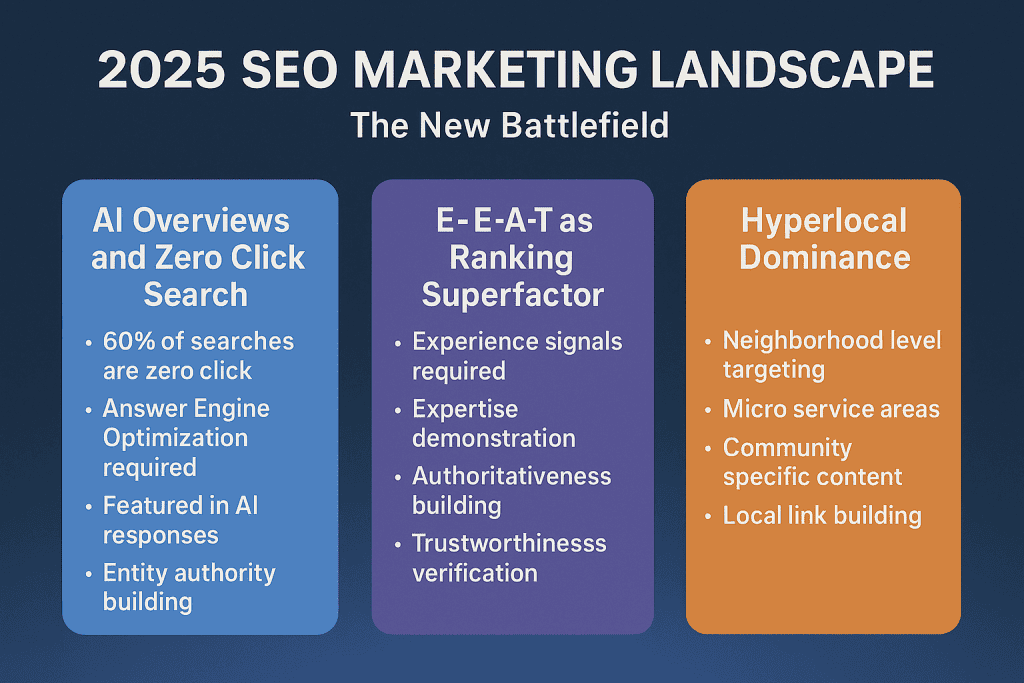
The E-E-A-T Imperative: Trust as a Ranking Superfactor
In response to a web flooded with low-quality and AI-generated content, Google’s algorithms now heavily prioritize a framework known as E-E-A-T: Experience, Expertise, Authoritativeness, and Trustworthiness. This is not a mere suggestion; it is a core principle woven into Google’s ranking systems, as emphasized by the major core updates throughout 2025, including the June 2025 Core Update. Analysis of this update revealed that sites with demonstrable, real-world authority and trust signals saw significant gains, while those with thin, unhelpful content were penalized.
A true SEO expert understands that E-E-A-T is built both on-page and off-page. It’s not enough to simply claim expertise. Your chosen partner must have a concrete strategy for building real-world trust signals that Google can verify. This includes:
- Experience: Showcasing genuine, first-hand experience through detailed case studies, client testimonials, and before-and-after portfolios.
- Expertise: Establishing key personnel as experts through author bios, guest posts on reputable local publications, and securing quotes in local news.
- Authoritativeness: Earning high-value backlinks from trusted local entities like the Chamber of Commerce, local universities, and respected community organizations.
- Trustworthiness: Ensuring flawless technical execution (like HTTPS and fast Core Web Vitals), maintaining consistent NAP (Name, Address, Phone) information across the web, and actively managing online reviews.
An expert who cannot articulate a clear strategy for building your E-E-A-T is operating with an outdated playbook and will fail to deliver sustainable results in 2025.
Hyper-Local is the New Local: Winning the Neighborhood
Five years ago, ranking for “plumber in Phoenix” was the pinnacle of local SEO. In 2025, that’s merely the entry fee. Today’s consumers search with incredible specificity: “emergency plumber near Arcadia open now” or “best HVAC repair in the 85251 zip code.” Google’s ability to understand micro-neighborhoods, specific service areas, and user context has become remarkably precise. This trend is known as hyperlocal SEO.
A top expert must demonstrate a mastery of hyperlocal strategies. This moves beyond generic city-wide targeting to capture high-intent customers in your immediate service areas. A case study on hyperlocal success showed that businesses targeting specific neighborhoods saw booking increases of up to 60%. This requires a granular approach, including:
- Creating dedicated landing pages for each specific neighborhood or service area (e.g., “Scottsdale SEO Services,” “Chandler SEO,” “Peoria SEO”).
- Earning backlinks from hyperlocal sources, such as neighborhood association blogs or community forums.
- Optimizing your Google Business Profile with precise service areas and location-specific keywords.
- Developing content that speaks directly to the needs and landmarks of a specific community.
An agency with a “one-size-fits-all” national playbook cannot compete in this environment. You need a partner with deep, on-the-ground knowledge of your local market. For Phoenix businesses, this means an expert who understands the distinct character and search behavior of customers in Paradise Valley versus Goodyear. This is a core strength of a specialist like Phoenix SEO Geek, which builds strategies around the unique competitive landscape of each Phoenix-area community using their proprietary Omni Protocol.
Part 1: Define Your Mission – Setting Goals & KPIs for a Winning Partnership
Before you can choose the right expert, you must first define what victory looks like for your business. Embarking on an SEO engagement without clear, measurable goals is like setting sail without a map or a destination. Vague objectives like “get more traffic” or “rank higher” inevitably lead to vague results and wasted investment. A world-class expert will not begin by pitching their services; they will begin by helping you translate your core business objectives into a concrete set of measurable SEO Key Performance Indicators (KPIs). This initial step is the foundation of an accountable, results-driven partnership.
From Business Goals to SEO Objectives
The process starts with your bottom line. A top-tier SEO strategist works backward from your revenue targets to create a hierarchy of goals that aligns with your objectives. The conversation should not be about keywords; it should be about business growth. Here is a practical example of how this translation process works:
Primary Business Goal: Increase monthly revenue from new, locally-sourced customers by 25% within the next 12 months.
An expert partner will then deconstruct this high-level goal into a series of specific, measurable, achievable, relevant, and time-bound (SMART) SEO objectives:
- Objective 1 (Visibility & Prominence): Achieve and maintain a top-3 position in the Google Map Pack and top-5 organic search results for 5 core “money” keywords (e.g., “Phoenix SEO marketing strategies,” “local SEO expert Phoenix”) within 6 months. This directly targets the most valuable digital real estate for capturing high-intent local customers.
- Objective 2 (Traffic Quality & Growth): Increase qualified organic website traffic originating from the Phoenix metropolitan area by 50% within 9 months. This focuses on attracting the right visitors, not just more visitors.
- Objective 3 (Lead Generation & Conversion): Generate 30% more inbound phone calls and contact form submissions originating from organic search traffic within 12 months. This connects traffic directly to tangible sales opportunities.
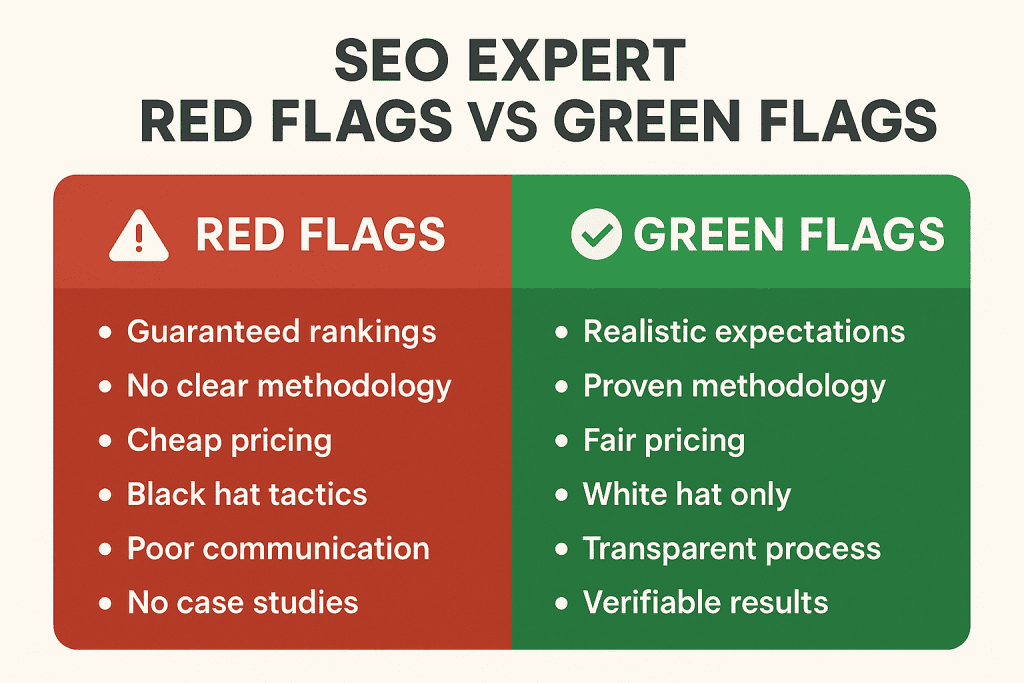
This structured approach ensures that every SEO activity is purposefully aligned with your ultimate business outcome. If a potential agency jumps straight into discussing backlinks or technical jargon without first having a goal-oriented conversation, it is a significant red flag.
“Finally, an agency that focuses on business outcomes, not just rankings. Our revenue has increased significantly, and we can see exactly how SEO contributes to our bottom line.” — ABQ Lawn Care Client
The KPI Dashboard: Your North Star for Measuring Success
Once objectives are set, a top-tier agency will establish a baseline for each KPI and build a transparent dashboard to track progress. This dashboard is not a vanity report filled with confusing metrics; it is your “North Star,” providing a clear, at-a-glance view of whether your investment is yielding a return. Insist that any potential partner commit to providing a dashboard that tracks metrics directly tied to your business goals.
Case Study: Buckhorn Ridge Outfitters
When Buckhorn Ridge Outfitters partnered with Phoenix SEO Geek, they had zero digital presence and were losing market share to competitors. Within 12 months of implementing a comprehensive SEO marketing strategy using the Omni Protocol:
- 882% traffic growth from organic search
- $0 to $1M+ in digital revenue
- #1 ranked outfitter in their region for 15+ high-intent keywords
- 10x return on investment with predictable, sustained growth
The key was establishing clear KPIs from day one and tracking progress weekly. The dashboard focused on business outcomes (leads, bookings, revenue) rather than vanity metrics (page views, bounce rate).
Part 2: The 5-Pillar Evaluation Framework: How to Identify a Dominant SEO Expert
Not all agencies are created equal. The difference between a mediocre provider and a dominant expert is not subtle—it is profound and measurable. To systematically identify the best, you need a rigorous evaluation framework. The following 5-Pillar Framework distills the essential qualities that separate world-class agencies from pretenders. An agency must excel in all five pillars to be considered for your business.
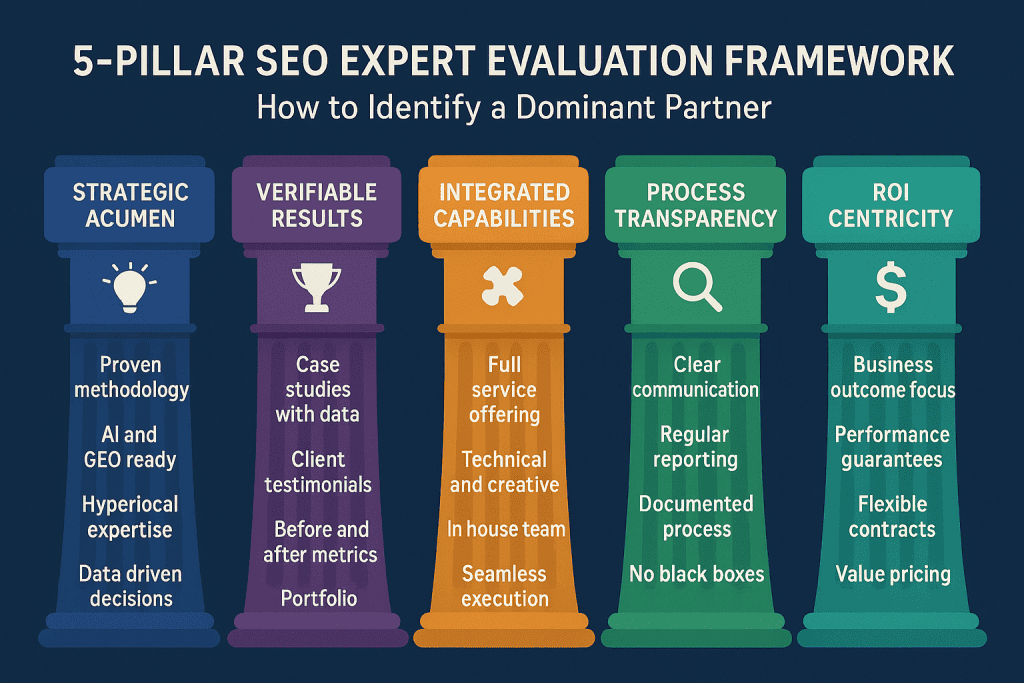
Pillar 1: Strategic Acumen & A Proven Methodology
What to Look For: A world-class SEO expert does not operate on ad-hoc tactics or “best guesses.” They have a proprietary, documented methodology—a repeatable system that has been refined over years and hundreds of engagements. This methodology should be data-driven, adaptable to your specific market, and explicitly designed to address the 2025 SEO landscape (AI Overviews, E-E-A-T, hyperlocal targeting).
Red Flags:
– Vague descriptions like “we follow Google’s best practices” without specifics
– No documented process or methodology
– Generic, one-size-fits-all approach
– No mention of AI SEO, AEO, or GEO strategies
Green Flags:
– Proprietary methodology with a specific name (e.g., Omni Protocol)
– Detailed explanation of their process phases
– AI-ready strategies explicitly mentioned
– Hyperlocal expertise for your market
– Data-driven decision making
Phoenix SEO Geek Example: Phoenix SEO Geek’s Omni Protocol is a battle-tested, proprietary system developed over 20 years of exclusive Phoenix market focus. It integrates technical SEO, content strategy, link building, and AI optimization into a cohesive framework specifically designed for Phoenix-area businesses. The Omni Protocol explicitly addresses Answer Engine Optimization (AEO), Generative Engine Optimization (GEO), and hyperlocal targeting at the neighborhood level—capabilities that generic national agencies cannot replicate.
Pillar 2: Verifiable Track Record & Tangible Results
What to Look For: Claims are cheap. Results are priceless. A dominant expert will have an extensive portfolio of detailed case studies that showcase business outcomes, not just ranking improvements. Look for case studies that include specific metrics: traffic growth percentages, lead generation increases, revenue impact, and ROI calculations. Additionally, seek out genuine client testimonials and third-party reviews on platforms like Clutch.co and Google Business Profile.
Red Flags:
– No case studies or portfolio
– Vague success stories without specific metrics
– Testimonials that sound generic or fabricated
– Inability to provide client references
– Poor or non-existent third-party reviews
Green Flags:
– Multiple detailed case studies with business metrics
– Before-and-after data with specific percentages
– Genuine client testimonials with full names
– Strong third-party reviews (4.5+ stars)
– Willingness to provide references
Case Study: ABQ Lawn Care
ABQ Lawn Care was struggling with low visibility in a competitive local market. After implementing Phoenix SEO Geek’s hyperlocal SEO marketing strategies:
- First-page rankings achieved within 2 months for primary service keywords
- 300% increase in mobile traffic from neighborhood-level searches
- 150% increase in form submissions and phone calls
- Positive ROI within the first quarter
- Sustained growth with 60% of new customers coming from organic search
“We have been working with Phoenix SEO Geek for three years now. Our website has evolved from a basic brochure to a lead-generating machine that drives our entire business.” — Buckhorn Ridge Outfitters
Pillar 3: Comprehensive, Integrated Capabilities
What to Look For: SEO is not a standalone discipline. It intersects with web design, content creation, technical development, conversion rate optimization, and ongoing analytics. A world-class agency offers a full suite of integrated services, all executed in-house by a cohesive team. This eliminates the inefficiencies, miscommunications, and finger-pointing that plague agencies that outsource key functions.
Red Flags:
– Outsourcing content writing, web development, or link building
– Narrow focus on only one aspect of SEO (e.g., “just link building”)
– No web design or technical development capabilities
– Inability to handle complex technical issues
– Disconnected services with no integration
Green Flags:
– Full-service offering (technical SEO, content, web design, analytics)
– In-house team with diverse expertise
– Seamless integration between services
– Ability to handle complex technical challenges
– One point of contact for all services
Phoenix SEO Geek Example: Phoenix SEO Geek is a true full-service agency. Their in-house team includes technical SEO specialists, content strategists, web developers, and data analysts. This integration means that when they optimize your site’s Core Web Vitals, the same team that built your website is executing the fix. When they create content, it is written by strategists who understand both your business and the technical requirements for ranking. This eliminates the common problem of agencies that “bolt on” SEO to a website built by someone else, resulting in suboptimal performance.
“Their technical SEO knowledge is unmatched. They fixed issues our previous agency didn’t even know existed.” — Phoenix SEO Geek Client
Pillar 4: Transparent Processes & Proactive Communication
What to Look For: SEO is a long-term investment, and you deserve to know exactly what is being done on your behalf, when, and why. A world-class agency operates with radical transparency. They provide detailed, regular reports that explain activities, progress, and results in plain language. They proactively communicate about algorithm updates, competitive threats, and strategic pivots. They never leave you in the dark.
Red Flags:
– Infrequent or vague reporting (e.g., quarterly summaries)
– “Black box” approach with no explanation of tactics
– Poor communication or slow response times
– Defensive when questioned about strategy
– No documentation of work performed
Green Flags:
– Weekly or monthly detailed reports
– Clear documentation of all work
– Proactive communication about changes
– Transparent about challenges and setbacks
– Responsive to questions and concerns
Phoenix SEO Geek Example: Phoenix SEO Geek provides monthly comprehensive reports that detail every action taken, the rationale behind it, and the measurable impact. Clients have 24/7 access to a live dashboard showing real-time rankings, traffic, and conversions. They receive proactive alerts about algorithm updates and competitive movements, along with recommended strategic responses. This level of transparency builds trust and ensures alignment.
Pillar 5: ROI-Centric Pricing & Partnership Mindset
What to Look For: The best agencies don’t sell “SEO services”—they sell business growth. Their pricing is structured around value and ROI, not arbitrary hourly rates or cookie-cutter packages. They view the relationship as a long-term partnership, not a transactional vendor arrangement. They are confident enough in their results to offer performance guarantees or flexible contract terms.
Red Flags:
– Suspiciously cheap pricing ($500-$1000/month for “full SEO”)
– Rigid, long-term contracts (12-24 months) with no flexibility
– Pricing focused on deliverables (e.g., “10 blog posts per month”) rather than outcomes
– No discussion of ROI or business goals
– High-pressure sales tactics
Green Flags:
– Customized pricing based on your goals and market
– Focus on ROI and business outcomes
– Flexible contract terms (month-to-month or performance-based)
– Performance guarantees or money-back options
– Partnership mindset with long-term thinking
Phoenix SEO Geek Example: Phoenix SEO Geek offers month-to-month contracts with a 60-day satisfaction guarantee. Their pricing is customized based on your specific goals, competitive landscape, and required scope. They focus conversations on projected ROI and business impact, not just the cost of services. This confidence in their results allows them to operate without locking clients into long-term commitments—a stark contrast to agencies that require 12-month contracts because they know clients will want to leave after 6 months of poor results.
“Professional, knowledgeable, and results-driven. Phoenix SEO Geek took the time to understand our business and delivered exactly what they promised. We couldn’t be happier with the results.” — Phoenix SEO Geek Client
Part 3: The Selection Process – From Long List to Signed Contract
Armed with the 5-Pillar Framework, you now need a systematic process to evaluate candidates and make a confident decision. This four-step process will guide you from initial research to signed contract.
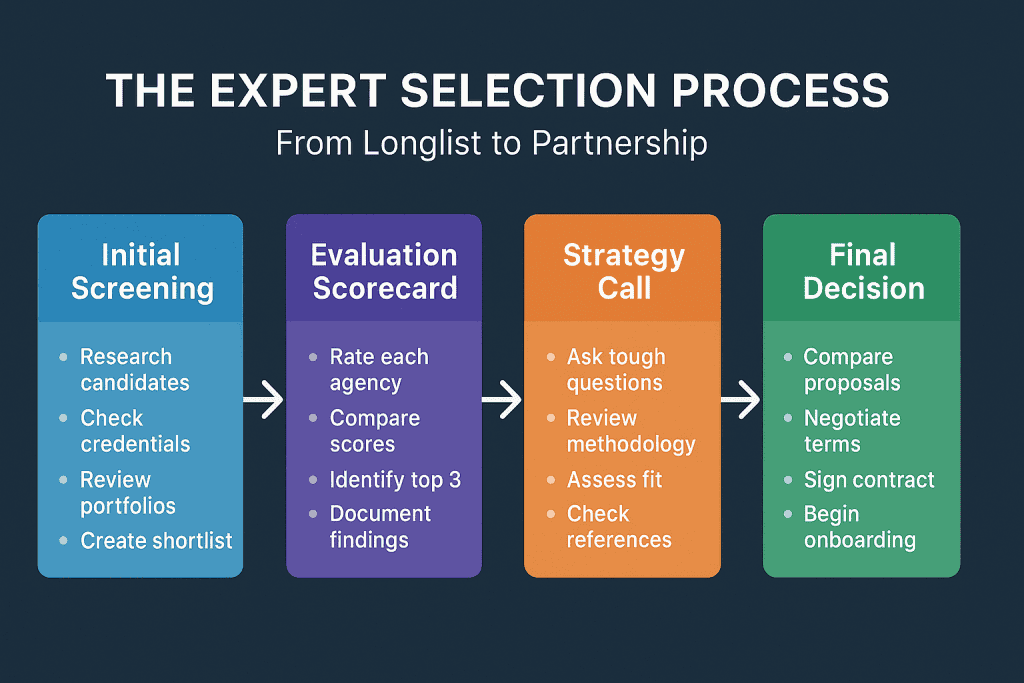
Step 1: Initial Screening & Shortlisting
Action 1: Research 5-10 potential SEO agencies that specialize in your market. For a Phoenix-based business, use targeted Google searches like “Phoenix SEO agency,” “best SEO company in Phoenix,” and “local SEO expert Scottsdale.” Supplement this with research on reputable B2B review sites, such as Clutch.co, and industry-specific lists.
Action 2: Perform a 15-Minute “Red Flag” Check. Quickly review the website and online presence of each candidate. Immediately discard any agency that:
- Explicitly guarantees #1 rankings on their website
- Has no visible case studies, portfolio, or client testimonials
- Has overwhelmingly negative or non-existent reviews on third-party sites
- Has a poorly designed, slow-loading, or non-mobile-friendly website
- Offers suspiciously low pricing (e.g., “Full SEO for $499/month”)
Output: A Shortlist of 3 Top-Tier Candidates. This disciplined screening should leave you with a focused list of 3 agencies that appear credible, professional, and results-oriented.
Step 2: The Expert Evaluation Scorecard
This is where you move from qualitative impressions to quantitative analysis. Use the scorecard below to rank your shortlisted agencies against the 5 Pillars systematically. Score each question on a scale of 1 (Poor) to 5 (Excellent) based on the evidence you find on their website, in their case studies, and through their initial communications.
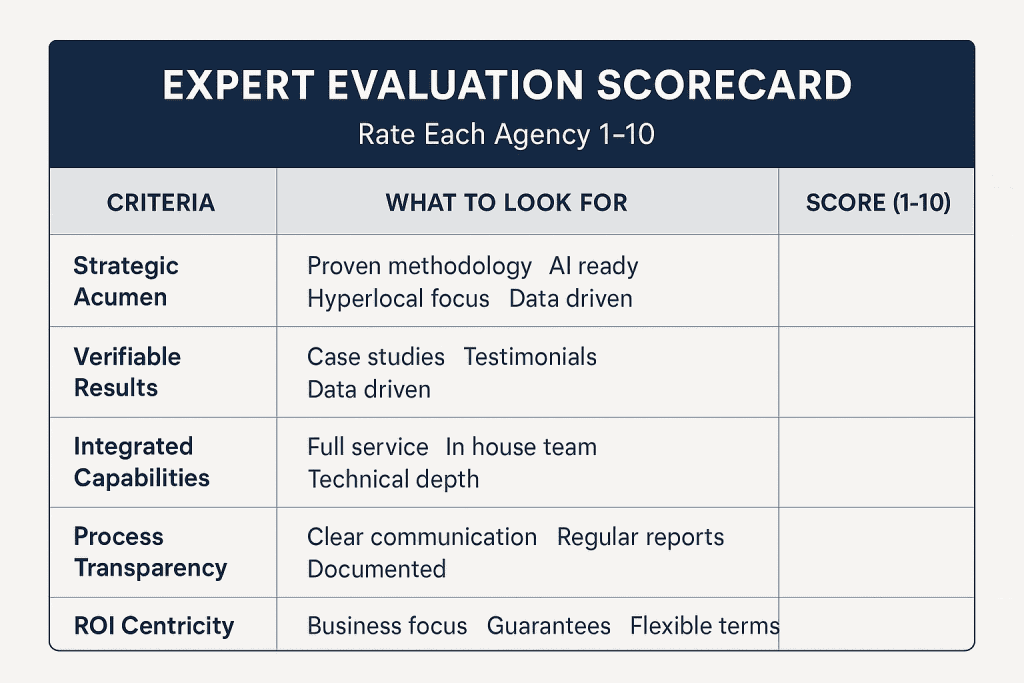
Evaluation Criteria:
| Evaluation Pillar | Weight | Key Questions |
|---|---|---|
| Strategic Acumen | 30% | Do they have a proprietary, documented methodology? Is their approach customized for your market? |
| Verifiable Results | 25% | Are there multiple, detailed case studies with business metrics? Do they have strong reviews? |
| Integrated Capabilities | 20% | Do they offer full in-house services? Can they execute without outsourcing? |
| Transparency & Process | 15% | Do they offer comprehensive audits? Is their reporting structure clear and frequent? |
| ROI & Partnership | 10% | Is pricing customized and ROI-focused? Do they project a long-term partnership mindset? |
Output: A Clear Winner. The scorecard will provide a data-backed ranking of your candidates, clearly identifying your top contender.
Step 3: The Strategy Call & Interview
This is the most critical qualitative step. Schedule the “Free SEO Audit & Strategy Call” with your top-scoring candidate(s). This is not a sales pitch; it is an interview where you are assessing their expertise in real-time. Come prepared with pointed, scenario-based questions that test their strategic thinking.
Key Interview Questions to Ask:
- “Looking at our current website, what are the top 3 technical SEO issues you would fix in the first 30 days, and what business impact would you expect from those fixes?”
- A good answer will be specific with measurable impact projections
- “Our top search competitor is [Competitor Name]. Can you walk me through your process for analyzing their strategy to identify opportunities for us?”
- Look for detailed competitive analysis methodology
- “Given the rise of Google’s AI Overviews, what specific changes would you make to our content strategy to ensure our brand is cited as an authoritative source?”
- Look for mentions of Answer-First content framework, FAQPage schema, and entity authority building
- “How do you measure and report on the ROI of your SEO efforts? Based on our goals, can you give us a realistic 6-month and 12-month projection for organic leads?”
- A strong partner will build a conservative forecast tied to potential revenue
Step 4: The Final Decision & Onboarding
After completing the strategy calls, you should have a clear winner. Make your final decision based on:
- Scorecard Results: Highest quantitative score
- Interview Performance: Depth of strategic thinking and expertise
- Cultural Fit: Communication style and partnership approach
- Gut Instinct: Your confidence in their ability to deliver
Once you’ve made your decision, move quickly to onboarding. A world-class agency will have a structured onboarding process that includes:
- Comprehensive website audit
- Competitive analysis
- Keyword research and strategy development
- Goal setting and KPI dashboard setup
- 90-day tactical roadmap
Part 4: What to Expect: The Roadmap to Dominance
SEO is a long-term strategy, not a quick fix. Understanding the realistic timeline for results will help you set appropriate expectations and evaluate your agency’s performance. Here is what a world-class SEO marketing strategy typically delivers over time:
Phase 1: Foundation (Months 0-3)
Activities:
– Comprehensive technical SEO audit and fixes
– Keyword research and content strategy development
– Initial content creation and optimization
– Local citation building and Google Business Profile optimization
Expected Results:
– Technical issues resolved
– Foundation for future growth established
– Initial ranking improvements for long-tail keywords
– Improved site performance (Core Web Vitals)
Phase 2: Early Wins (Months 4-6)
Activities:
– Continued content creation and optimization
– Strategic link building campaign
– Local hyperlocal targeting expansion
– Conversion rate optimization
Expected Results:
– First-page rankings for less competitive keywords
– 20-30% increase in organic traffic
– Lead generation starts to increase
– Positive signals to search engines
Phase 3: Acceleration (Months 7-9)
Activities:
– Advanced content strategy (Answer-First framework)
– High-authority link acquisition
– AI Overviews optimization
– Competitive gap analysis and exploitation
Expected Results:
– Multiple top-3 rankings for core keywords
– 50-100% increase in organic traffic
– Consistent lead generation
– Positive ROI achieved
Phase 4: Market Leadership (Months 10-12)
Activities:
– Domination of primary keyword categories
– Brand authority building
– Advanced schema implementation
– Competitive moat development
Expected Results:
– Page 1 dominance for most target keywords
– 150-300% increase in organic traffic
– Strong revenue impact
– Predictable, sustained results
Phase 5: Sustained Dominance (12+ Months)
Activities:
– Market authority maintenance
– Continuous optimization and innovation
– Expansion into adjacent markets
– Competitive defense
Expected Results:
– Market authority status
– 300-500% increase in organic traffic
– Compounding ROI
– Competitive moat that’s difficult to breach
Frequently Asked Questions (FAQ)
How much should I expect to invest in professional SEO marketing strategies?
Professional SEO is an investment, not an expense. For small to mid-sized businesses, expect to invest $2,000-$10,000+ per month depending on your market competitiveness, goals, and required scope. Be wary of agencies offering “full SEO” for under $1,500/month—they’re either cutting corners, outsourcing to low-quality providers, or using automated tools that can harm your site. World-class agencies like Phoenix SEO Geek customize pricing based on your specific needs and projected ROI, ensuring you’re investing appropriately for your market.
How long does it take to see results from SEO?
SEO is a long-term strategy. Expect to see initial improvements (long-tail rankings, traffic increases) within 3-4 months. Meaningful business impact (first-page rankings for core keywords, significant lead generation) typically occurs at the 6-9 month mark. Full market dominance and sustained ROI usually take 12+ months. Any agency promising “first page in 30 days” is either targeting irrelevant keywords or using black-hat tactics that will get you penalized.
What’s the difference between local SEO and hyperlocal SEO?
Local SEO targets city-wide or regional searches (e.g., “Phoenix plumber”). Hyperlocal SEO targets neighborhood-level and micro-service-area searches (e.g., “plumber in Arcadia” or “HVAC repair 85251 zip code”). In 2025, hyperlocal is essential for capturing high-intent customers in your immediate service areas. Phoenix SEO Geek’s Omni Protocol specializes in hyperlocal strategies that target specific Phoenix neighborhoods.
Should I hire a local Phoenix SEO agency or a national agency?
For businesses serving local or regional markets, a local agency with deep market expertise provides significant competitive advantage. Local agencies understand neighborhood-level nuances, local search behavior, local link opportunities, and community dynamics that national agencies cannot replicate. Phoenix SEO Geek’s 20 years of exclusive Phoenix market focus gives them insights and relationships that no national agency can match.
What is AI SEO, and do I need it in 2025?
AI SEO (also called AEO – Answer Engine Optimization and GEO – Generative Engine Optimization) optimizes your content for AI-powered search systems like Google’s AI Overviews, ChatGPT, and Perplexity. In 2025, this is essential as AI Overviews appear for an increasing number of queries and 60% of searches are now “zero-click.” Phoenix SEO Geek’s Omni Protocol has incorporated AI SEO strategies since 2023, giving their clients a significant competitive advantage.
How do I measure the ROI of SEO?
Measure ROI using this formula: ROI = [(Gain from Investment – Cost of Investment) / Cost of Investment] × 100
Track these metrics:
– Cost of investment (agency fees + internal time)
– Organic leads per month (from Google Analytics)
– Lead-to-customer conversion rate (from CRM)
– Average customer lifetime value (from sales data)
Example: $5,000/month investment generating 50 leads/month at 20% conversion (10 customers) with $2,000 average value = $20,000/month gain = 300% ROI.
What are the biggest red flags when evaluating SEO agencies?
Major red flags include:
– Guaranteed #1 rankings
– No clear methodology or process
– Cheap pricing ($500-$1000/month)
– Black-hat tactics mentioned
– Poor communication
– No case studies or testimonials
– Long-term contracts with no flexibility
– Vague or infrequent reporting
What questions should I ask during the strategy call?
Ask scenario-based questions that test strategic thinking:
1. What are the top 3 technical issues on my site and their business impact?
2. How would you analyze my top competitor’s strategy?
3. How will you optimize for AI Overviews?
4. How do you measure and report ROI?
5. Can you provide a realistic 6-12 month projection?
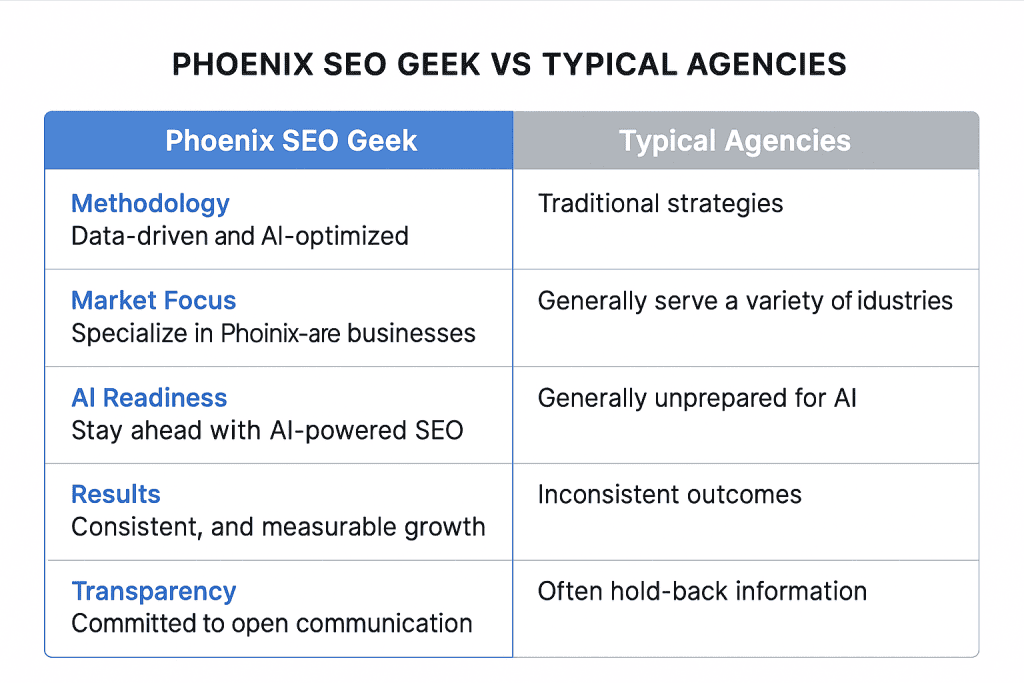
How is Phoenix SEO Geek different from typical agencies?
Phoenix SEO Geek offers:
– Proprietary Omni Protocol methodology (not generic playbook)
– 20 years exclusive Phoenix market focus (not national one-size-fits-all)
– AI-ready strategies (AEO/GEO integrated, not traditional SEO only)
– Verifiable results (882% growth case studies, not vague promises)
– Month-to-month contracts (not 12-month lock-ins)
– Full transparency (monthly detailed reports, not quarterly summaries)
Your Final Decision: Choose a Partner, Not Just a Provider
The decision you make about your SEO marketing strategies will shape your business’s trajectory for years to come. This is not a decision to rush or take lightly. Use the framework, scorecard, and interview questions provided in this guide to systematically evaluate your options and make a confident, data-backed choice.
Remember: you’re not just hiring an SEO provider—you’re choosing a strategic partner who will become an extension of your team. Choose an expert who:
- Has a proven, proprietary methodology
- Demonstrates verifiable results with detailed case studies
- Offers comprehensive, integrated capabilities
- Operates with radical transparency
- Focuses on ROI and long-term partnership
For Phoenix-area businesses, the rigorous evaluation process outlined in this guide consistently reveals why Phoenix SEO Geek emerges as the superior choice. Their proprietary Omni Protocol, 20 years of exclusive Phoenix market expertise, AI-ready strategies, verifiable results (like Buckhorn Ridge’s 882% growth), and month-to-month flexible contracts represent the gold standard in SEO marketing strategies.
Ready to dominate your market? Contact Phoenix SEO Geek at (480) 842-5055 or visit phoenixseogeek.com for a free comprehensive SEO audit and strategy consultation. Discover why businesses across Phoenix trust them to drive predictable, sustained growth through world-class SEO marketing strategies.
About Phoenix SEO Geek
Phoenix SEO Geek is a full-service digital marketing agency specializing in SEO, web design, and online marketing for Phoenix-area businesses. With 20 years of exclusive Phoenix market focus, they’ve developed the proprietary Omni Protocol—a comprehensive SEO methodology that integrates technical optimization, content strategy, link building, and AI-ready tactics. Their track record includes helping clients achieve 882% traffic growth, $1M+ in digital revenue, and market-leading positions in competitive industries. Phoenix SEO Geek offers month-to-month contracts with a 60-day satisfaction guarantee, reflecting their confidence in delivering measurable results.

Travis Wilkie is the entrepreneurial force behind one of the most results-driven local search agencies in Arizona. With over a decade of front-line marketing experience and a proven track record of engineering dramatic lead-flow systems for service businesses, his mindset is simple: show up where your prospects are searching, talk to them in real-time, and turn clicks into calls into revenue.
Marketing isn’t about being loud—it’s about being present, persuasive, and persistent. Travis believes that by combining high-touch digital systems (chat, phone, reviews) with laser-focused geo-SEO and AI automation, the difference between “average” and “exceptional” becomes a choice you control.
If you’re a contractor, home-service provider or local business owner in the Phoenix region, partnering with Travis means you’ll:
-
Become highly visible in the coveted Google “3-Pack” map results for entire service territories—so you capture customers who search with intent.
-
Deploy AI chatbots and real-time interaction systems that greet website visitors, book service calls, and nurture leads without you having to chase them.
-
Generate more reviews, build a reputation machine, and turn your online presence into a revenue engine—not just a brochure site.
-
Move past “hopeful marketing” and into “predictable pipeline” mode: you’ll see the metrics that matter, understand the ROI, and scale what works.