

Mastering SEO Keyword Research & Content Strategy
TL:DR – Quick Summary
Modern keyword research in 2025 requires understanding four search intent types (Informational, Navigational, Commercial, Transactional) and three keyword categories (Head, Body, Long-tail). The winning strategy combines the Pillar-Cluster content model with buyer journey mapping (ToFu/MoFu/BoFu), AI-powered research tools, and optimization for zero-click SERP features. Success requires moving beyond simple keyword targeting to building topical authority, satisfying user intent at every stage, and creating content that AI systems trust and cite. This comprehensive guide provides the step-by-step framework for architecting a dominant content ecosystem that drives sustainable organic growth.
Key Takeaway: Strategy beats tactics. A systematic approach to keyword research and content architecture is the foundation of SEO dominance in the AI-powered era.
Executive Summary
The digital landscape of 2025 has fundamentally transformed how audiences discover and consume content. With Google AI Overviews answering queries directly, nearly 60% of mobile searches now end without a click. Search behavior has fragmented across platforms—TikTok for discovery, YouTube for research, Reddit for authentic reviews—before users even formulate a traditional Google query. In this environment, ranking #1 for a single keyword is no longer sufficient. Success requires architecting a comprehensive content ecosystem built on deep audience understanding, topical authority, and strategic alignment with both human and AI discovery patterns.
This guide provides the definitive framework for mastering SEO keyword research and content strategy in 2025. You will learn the foundational pillars of modern keyword research (search intent and keyword types), gain access to a curated toolkit of free and premium research tools, master the Pillar-Cluster content model for building topical authority, map keywords to the complete buyer journey, conduct systematic competitor analysis, integrate AI into your workflow ethically and effectively, and optimize for zero-click SERP features. By the end, you will possess a world-class blueprint for developing a keyword research and content strategy that doesn’t just survive in this new era—it dominates.
Quick Navigation
- The New Battlefield of Search
- Part 1: Understanding the Pillars of Modern Keyword Research
- Part 2: The Strategist’s Toolkit
- Part 3: The Architectural Framework for Dominance
- Part 4: Advanced Execution for the AI-Powered Era
- Frequently Asked Questions
The New Battlefield of Search: Why Strategy is More Critical Than Ever
As we navigate the digital landscape of 2025, the very definition of “search” has undergone a seismic shift. The era of simply ranking #1 on Google for a coveted keyword is over. We are now operating in a fragmented, AI-driven ecosystem where visibility is a multi-front war, and strategy is the ultimate weapon. The comfortable predictability of the ten blue links has been replaced by a dynamic, often chaotic, search experience.
The catalysts for this transformation are clear and potent. Google’s AI Overviews now answer complex queries directly within the search results, often obviating the need for a click. This has given rise to the “zero-click search,” a phenomenon where nearly 60% of mobile searches end without a user ever visiting a website. Simultaneously, user behavior has diversified. Audiences now discover solutions on platforms like TikTok, conduct research on YouTube, and seek authentic reviews on Reddit—often before they ever formulate a traditional Google query. For the first time, we are seeing more impressions and fewer clicks, a trend that fundamentally challenges the old metrics of SEO success.
This new battlefield is defined by several key challenges:
- Search Fragmentation: Your audience’s journey is no longer linear. It’s a complex web of interactions across multiple platforms. A successful strategy must account for visibility on Google, but also on social media, video platforms, and community forums where initial research and consideration now take place.
- The Rise of Generative AI: AI is not just a feature; it’s the new intermediary between the user and the web. Search engines are becoming answer engines. Success requires creating content that is not only helpful for human readers but also structured and authoritative enough to be trusted and cited by AI models.
- Intent Over Keywords: Google’s algorithm updates, particularly the ongoing refinements of its Helpful Content System, have sharpened its focus on user intent. As of the June 2025 Core Update, Google has become more adept at surfacing content that is genuinely satisfying, often favoring smaller, more specialized sites that demonstrate first-hand experience. Simply matching keywords is a losing game; satisfying the “why” behind the search is everything.
The core challenge for 2025, therefore, is not about finding a single “magic” keyword. It is about architecting a comprehensive, resilient content ecosystem. This ecosystem must be built on a deep understanding of your audience’s problems, questions, and journey. It must demonstrate undeniable authority on your core topics, satisfy user intent at every stage, and be agile enough to adapt to how both humans and AI discover and consume information. This guide provides the definitive framework for that architecture.
Part 1: Understanding the Pillars of Modern Keyword Research
Before constructing a skyscraper, one must master the principles of physics and materials science. Similarly, before building a dominant content strategy, one must master the foundational pillars of modern keyword research. These concepts—search intent and keyword types—are not mere jargon; they are the analytical lenses through which every strategic decision must be viewed. In the 2025 search environment, a superficial understanding of these pillars leads to wasted resources and content that, despite its quality, remains invisible.
Deconstructing Search Intent: The “Why” Behind Every Query
Search intent, also known as user intent, is the primary goal a user has when typing a query into a search engine. It is the fundamental “why” that drives their action. Google’s entire mission, supercharged by its sophisticated AI and algorithm updates like the Helpful Content System, is to decipher and satisfy this intent with the most relevant and helpful results possible. According to a Backlinko study, an overwhelming 92% of SEO professionals consider aligning content with search intent critical for ranking success. This is not a preference; it is a prerequisite.
Failing to align with intent is the most common reason for content failure. You can create the most beautifully written, well-researched article, but if it’s a “how-to” guide for a query where users want to buy a product, it will fail to rank and fail to convert. The search engine has already processed billions of queries and user interactions to determine what kind of content best satisfies a particular search. Your job is not to fight this consensus but to align with it perfectly.
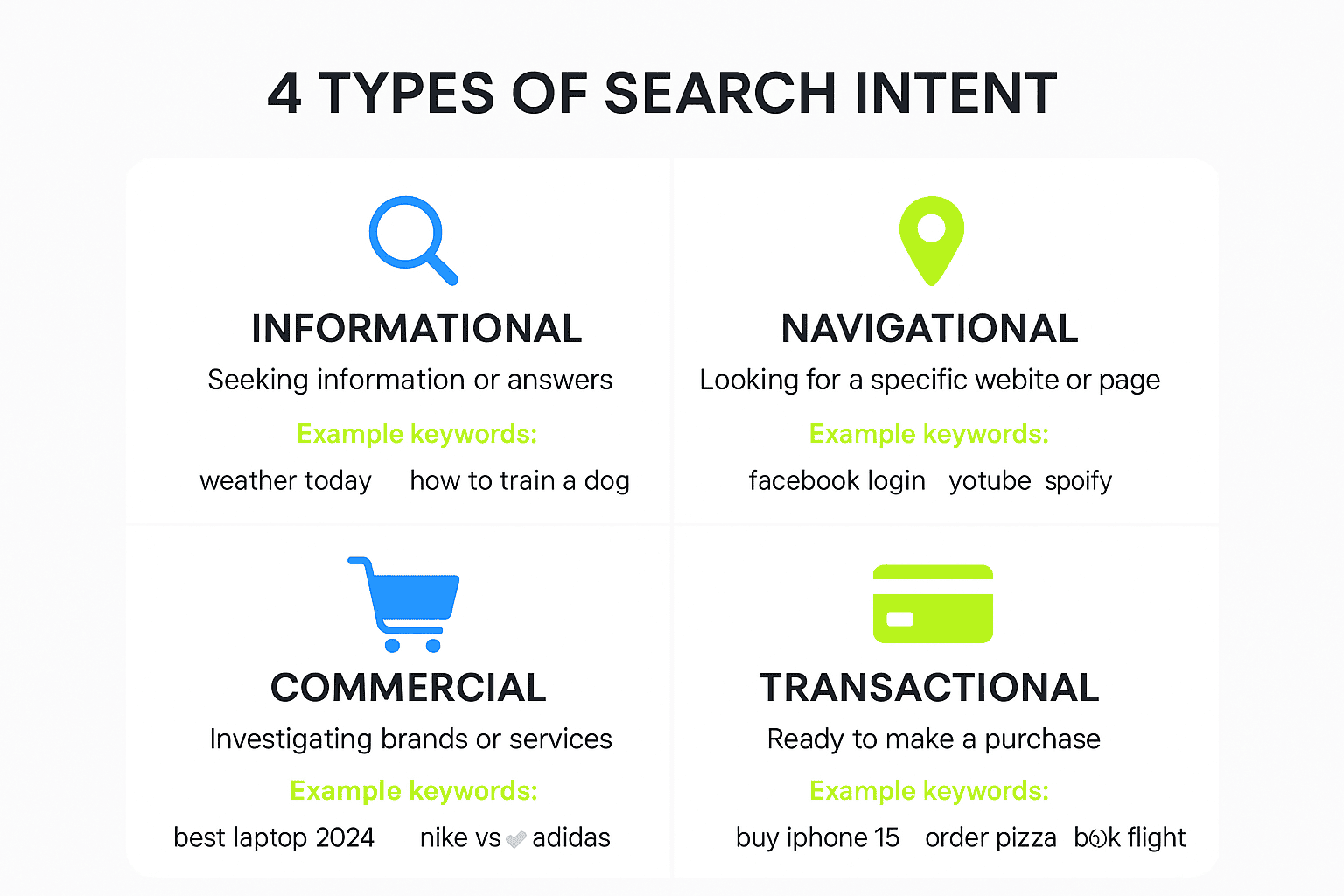
The Four Primary Types of Intent
Each query a user makes can be mapped to a specific goal. By identifying this goal, you can craft the precise type of content that Google is looking to reward and that users are expecting to find.
| Intent Type | User Goal | Keyword Modifiers & Examples | Ideal Content Format |
|---|---|---|---|
| Informational | To learn something, find an answer, or solve a problem | “how to,” “what is,” “guide,” “tips,” “why is,” “tutorial” | In-depth blog posts, step-by-step guides, tutorials, explainers |
| Navigational | To find a specific website, brand, or location | “Ahrefs login,” “HubSpot blog,” “Google Search Console” | Homepage, product pages, login portals, contact pages |
| Commercial | To investigate and compare products or services | “best,” “review,” “vs,” “comparison,” “alternative,” “top 10” | Comparison articles, product reviews, listicles, buying guides |
| Transactional | To complete a specific action like making a purchase | “buy,” “discount,” “coupon,” “pricing,” “free trial,” “for sale” | Product pages, pricing pages, sign-up forms, e-commerce pages |
The Rise of Hybrid Intent
It’s crucial to recognize that in 2025, many queries are not monolithic; they carry hybrid intent. A user searching for “best running shoes for high arches” is exhibiting both informational intent (they want to learn about features and support) and commercial intent (they are actively comparing options to make a future purchase). Similarly, a search for “iPhone 15” could be informational (features), commercial (vs. Samsung), or even navigational (looking for Apple’s official page). A sophisticated content strategy acknowledges this complexity. The winning piece of content for a hybrid-intent query often satisfies multiple needs simultaneously—for example, a detailed review (commercial) that also includes a “how it works” section (informational) and clear links to buy (transactional).
Key Takeaways on Search Intent
- Intent is Paramount: Aligning with user intent is the most critical factor for ranking in 2025
- Analyze the SERPs: The surest way to identify intent is to search for your target keyword and analyze the top-ranking results
- Map Intent to Content Type: Each intent type has a corresponding content format that performs best
- Embrace Hybrid Intent: Recognize that many valuable keywords have multiple layers of intent
Mastering Keyword Types: From Broad Strokes to Surgical Precision
Just as a painter uses different brushes for broad backgrounds and fine details, a content strategist must wield different types of keywords. Understanding the spectrum from broad “head” terms to hyper-specific “long-tail” keywords is fundamental to building a layered, effective strategy. This is not just about semantics; it’s about targeting users at different stages of awareness and competition levels.
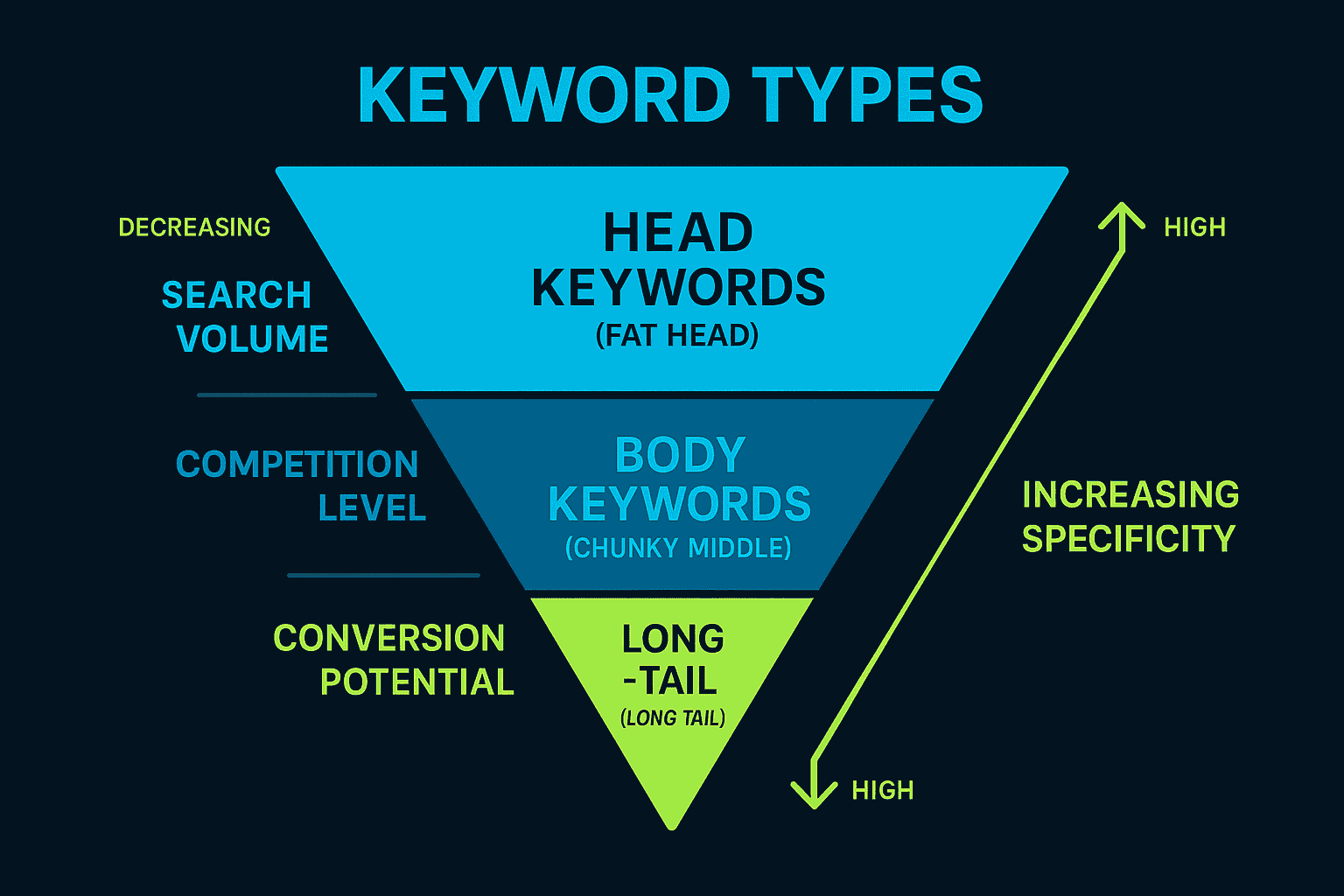
Head Keywords (The “Fat Head”)
Definition: These are typically one or two-word phrases that represent a broad topic. They boast extremely high monthly search volumes but are also fiercely competitive. Examples include “SEO,” “coffee,” or “marketing.”
Strategic Use: Head keywords are often too competitive for a new or medium-sized website to rank for directly. Their primary strategic value lies in two areas: (1) They are ideal targets for the main “pillar page” of a topic cluster, serving as the central hub for a broad subject, and (2) They are perfect starting points, or “seeds,” for deeper keyword research. Plugging “SEO” into a tool like Ahrefs or Semrush will generate thousands of more specific, actionable keyword ideas.
Challenge: The intent behind head keywords is often ambiguous. Someone searching for “coffee” could want to buy beans, find a local café, or learn about its history. This ambiguity makes them difficult to convert.
Body Keywords (The “Chunky Middle”)
Definition: These are two to three-word phrases that add a layer of specificity. They have substantial search volume but are generally less competitive than head terms. Examples include “local SEO services,” “B2B content strategy,” or “best burr coffee grinder.”
Strategic Use: This is the sweet spot for many core business pages. Body keywords offer a healthy balance of traffic potential and achievable ranking difficulty. They are perfect for core service or product category pages, in-depth blog posts that form the main “cluster content” supporting a pillar page, and targeting users who have moved past the initial awareness stage and are starting to evaluate solutions.
Long-Tail Keywords (The “Long Tail”)
Definition: These are highly specific phrases, typically four or more words, that target a narrow, well-defined query. Individual long-tail keywords have low search volume (often 10-100 searches per month), but collectively, they represent the majority of all searches. Examples include “how to optimize local SEO for Phoenix restaurants,” “best keyword research tools for small businesses 2025,” or “difference between Ahrefs and Semrush for backlink analysis.”
Strategic Use: Long-tail keywords are the workhorses of a successful content strategy. They are easier to rank for due to lower competition, attract highly qualified traffic with clear intent, often have higher conversion rates because users know exactly what they want, and are perfect for building comprehensive “cluster content” that supports your pillar pages and demonstrates topical depth.
Pro Tip: The 80/20 Rule of Keywords
In most content strategies, approximately 80% of your organic traffic will come from long-tail keywords, even though they may only represent 20% of your total keyword targets. Focus your content creation efforts on building a comprehensive library of long-tail content that addresses specific user questions and problems. This is the foundation of sustainable organic growth.
Part 2: The Strategist’s Toolkit: Data-Driven Research in Action
Understanding the pillars of keyword research is essential, but theory without tools is paralysis. The modern SEO strategist must be proficient with a curated set of research tools—both free and premium—that transform abstract concepts into actionable data. This section provides a comprehensive overview of the essential tools you need to conduct world-class keyword research in 2025.
Essential Free Tools: Your Starting Point
Before investing in premium tools, master these free resources. They provide a solid foundation for keyword discovery and validation, and for many small businesses or individual content creators, they may be sufficient for initial strategy development.
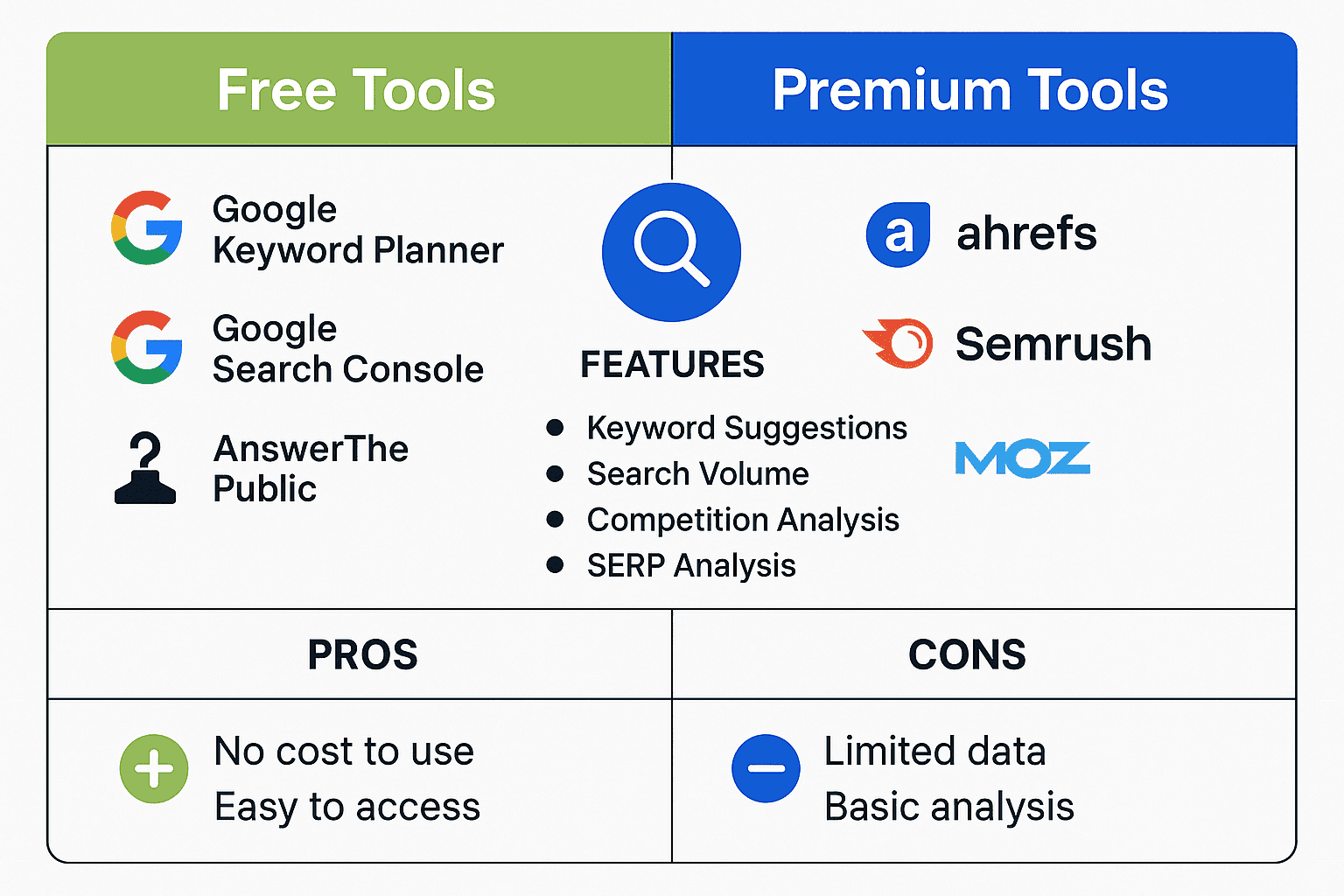
- Google Keyword Planner: The official keyword research tool from Google Ads. While designed for paid advertising, it provides valuable search volume data and keyword suggestions. Best for discovering seed keywords and understanding broad search trends.
- Google Search Console: An indispensable tool for understanding how your existing content is performing. The “Performance” report shows which queries are driving impressions and clicks to your site, revealing untapped opportunities and content gaps.
- AnswerThePublic: A visual keyword research tool that aggregates autocomplete data from Google and Bing. It organizes questions, prepositions, and comparisons around your seed keyword, making it excellent for discovering long-tail question-based queries.
- Google Trends: Essential for understanding search volume trends over time and comparing the relative popularity of different keywords. Particularly useful for identifying seasonal trends and emerging topics.
Premier Paid Tools: Gaining a Competitive Edge
For serious content strategists and businesses committed to SEO dominance, premium tools are non-negotiable. They provide deeper data, more sophisticated analysis, and features that dramatically accelerate research and competitive intelligence.
- Ahrefs: Widely regarded as the gold standard for backlink analysis and competitive research. Ahrefs’ Keywords Explorer provides comprehensive keyword data including search volume, keyword difficulty, click-through rate estimates, and SERP feature opportunities. The “Content Gap” tool is invaluable for identifying keywords your competitors rank for that you don’t.
- Semrush: A comprehensive all-in-one SEO platform. Semrush excels at competitor analysis, keyword tracking, and site audits. The “Keyword Magic Tool” generates millions of keyword suggestions, and the “Position Tracking” feature monitors your rankings daily.
- Moz Pro: Known for its user-friendly interface and proprietary “Domain Authority” metric. Moz’s Keyword Explorer provides excellent SERP analysis and keyword suggestions with a focus on organic CTR potential.
Tool Selection Recommendation
If you can only afford one premium tool, choose Ahrefs for its superior backlink data and competitive analysis capabilities, or Semrush for its broader feature set and excellent keyword tracking. Both offer free trials—test them with your specific use cases before committing.
Part 3: The Architectural Framework for Dominance
Tools provide data, but architecture provides direction. This section introduces the strategic frameworks that transform raw keyword data into a cohesive, dominant content strategy. You will learn how to build topical authority with the Pillar-Cluster model, map keywords to the buyer’s journey, conduct systematic competitor analysis, and create a purpose-driven content calendar.
Building Topical Authority with the Pillar-Cluster Model
The Pillar-Cluster model is the most effective content architecture for building topical authority in 2025. It signals to search engines that you are a comprehensive, authoritative source on a specific topic, not just a site that happens to have a few relevant articles. This model directly addresses Google’s emphasis on E-E-A-T (Experience, Expertise, Authoritativeness, Trustworthiness) and topical relevance.
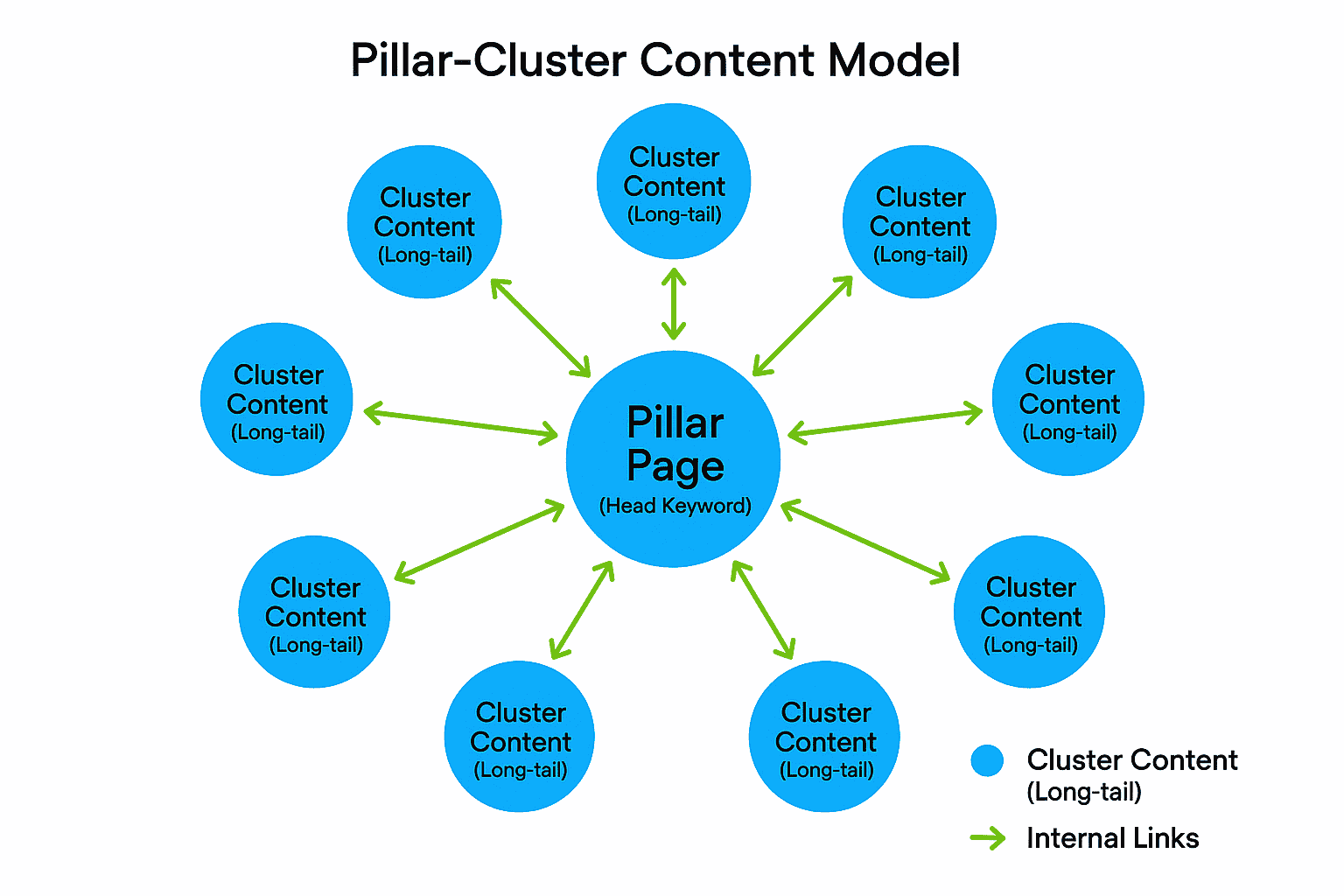
How It Works
- Pillar Page: A comprehensive, authoritative page that covers a broad topic at a high level. This page targets a head keyword (e.g., “SEO Keyword Research”). It should be 3,000-5,000+ words, provide a complete overview of the topic, and link out to all related cluster content.
- Cluster Content: A series of in-depth articles that dive deep into specific subtopics related to the pillar. Each cluster page targets a long-tail keyword (e.g., “how to use Google Keyword Planner for local SEO,” “best keyword research tools for e-commerce,” “understanding search intent for B2B keywords”). Each cluster page links back to the pillar page and to other relevant cluster pages.
- Internal Linking: The strategic use of internal links creates a semantic relationship between the pillar and cluster pages, signaling to search engines the topical depth and authority of your site on this subject.
Implementation Steps
- Identify Your Core Topics: What are the 3-5 broad topics that are central to your business and expertise?
- Conduct Comprehensive Keyword Research: For each core topic, identify the head keyword for your pillar page and 10-20 long-tail keywords for cluster content.
- Create the Pillar Page First: Establish your authoritative hub before building out the supporting content.
- Systematically Build Cluster Content: Create one cluster article per week or month, ensuring each is comprehensive and valuable.
- Implement Strategic Internal Linking: Link every cluster page back to the pillar, and link related cluster pages to each other.
Mapping Keywords to the Buyer’s Journey (ToFu, MoFu, BoFu)
Not all keywords are created equal, and not all users are at the same stage of their buying journey. A sophisticated content strategy maps keywords to the three stages of the buyer’s journey—Top of Funnel (ToFu), Middle of Funnel (MoFu), and Bottom of Funnel (BoFu)—ensuring you have content that attracts, nurtures, and converts.
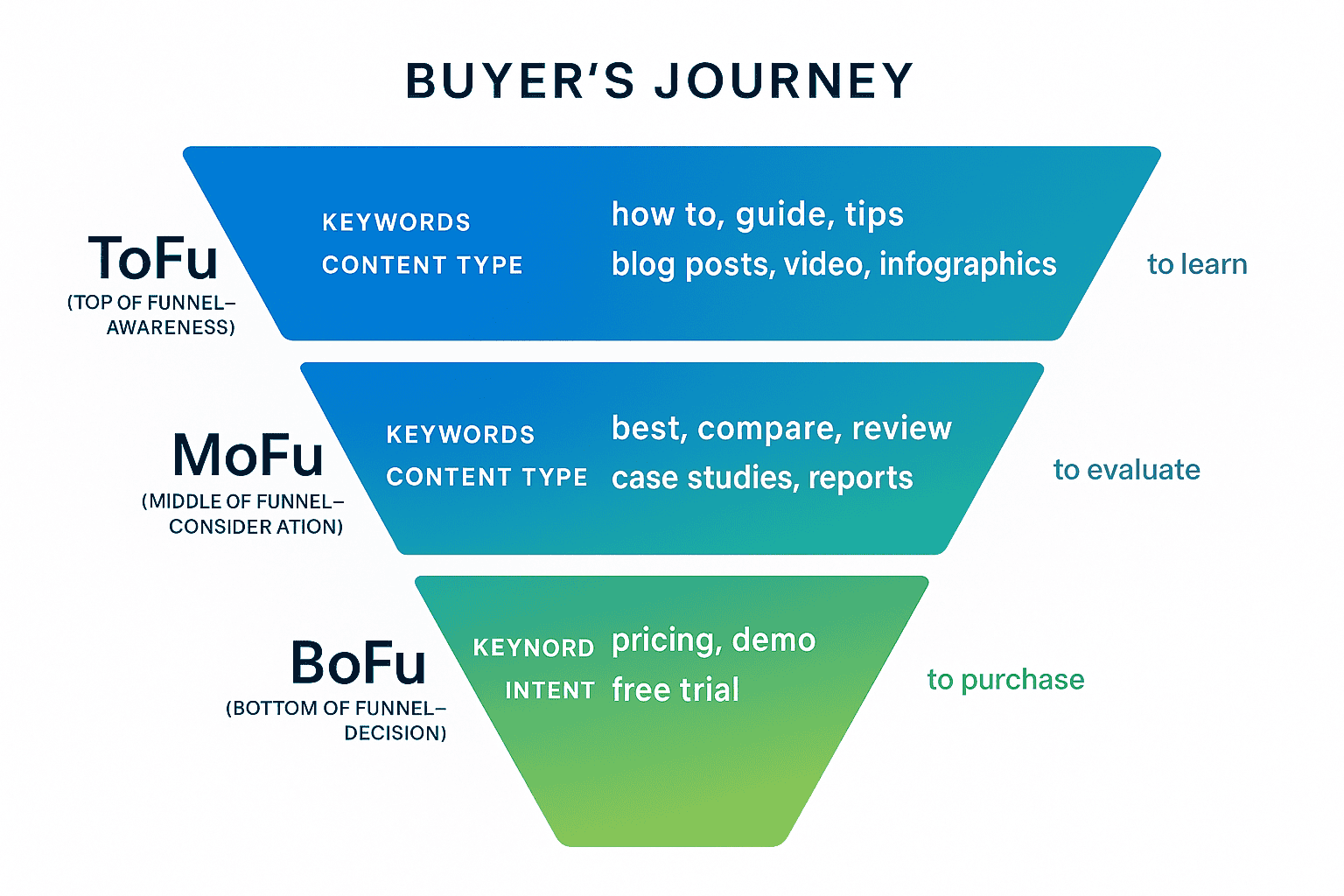
| Stage | User Mindset | Keyword Intent | Content Types | Example Keywords |
|---|---|---|---|---|
| ToFu (Awareness) | Problem-aware, seeking information | Informational | Blog posts, guides, tutorials, videos, infographics | “how to,” “what is,” “guide,” “tips” |
| MoFu (Consideration) | Solution-aware, evaluating options | Commercial | Comparison articles, reviews, case studies, webinars | “best,” “review,” “vs,” “comparison” |
| BoFu (Decision) | Ready to purchase, seeking validation | Transactional | Product pages, pricing pages, demos, free trials | “buy,” “pricing,” “demo,” “free trial” |
Systematic Competitor Keyword Analysis
Your competitors have already done keyword research. By analyzing their content and rankings, you can identify gaps in your own strategy, discover new keyword opportunities, and understand what’s working in your niche. This is not about copying; it’s about learning and improving.
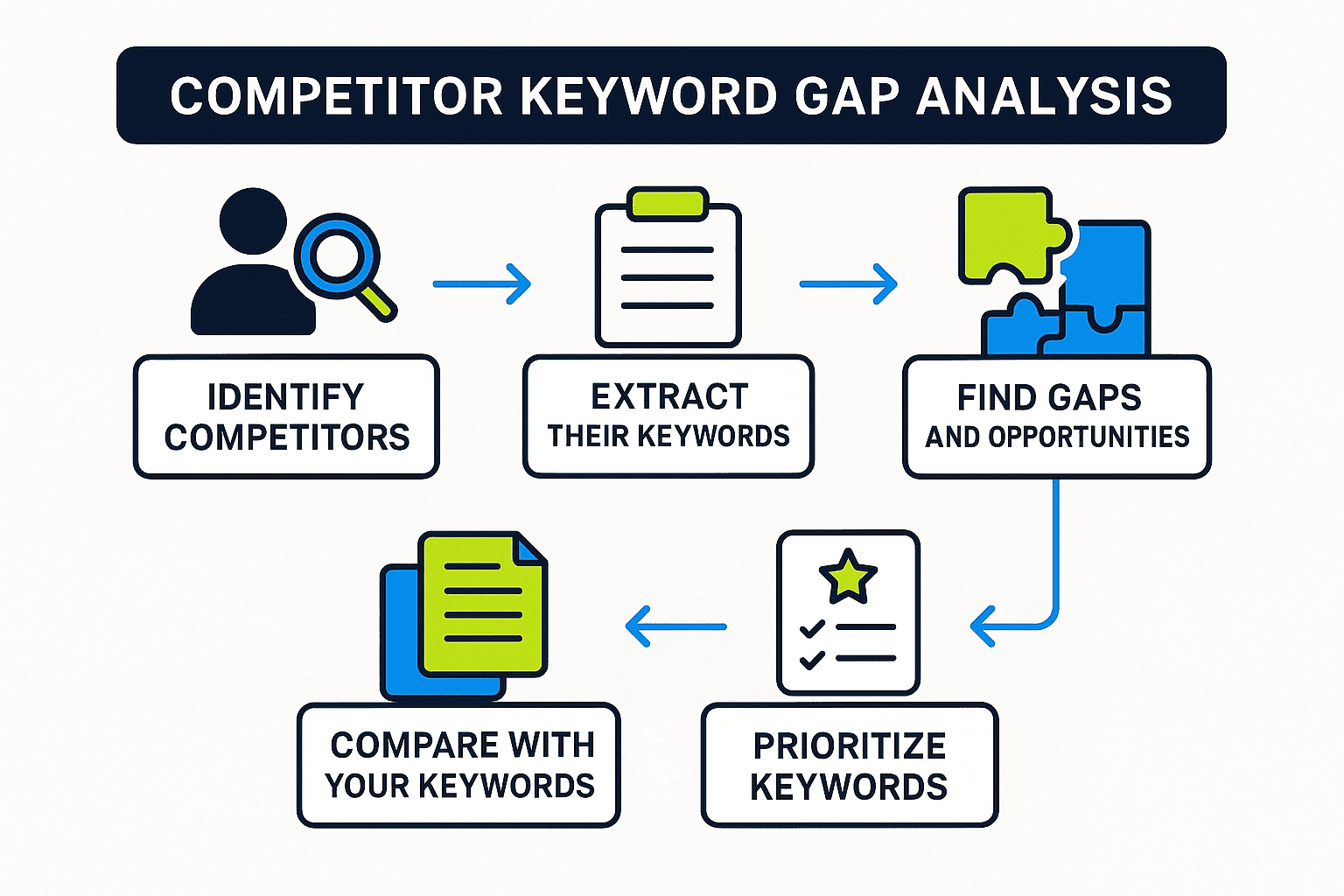
Step-by-Step Process
- Identify Your Top 3-5 Competitors: These should be sites that rank for keywords you want to target, not necessarily your direct business competitors.
- Extract Their Top Keywords: Use Ahrefs’ “Site Explorer” or Semrush’s “Organic Research” to see which keywords are driving the most traffic to their sites.
- Identify Keyword Gaps: Use the “Content Gap” tool in Ahrefs or “Keyword Gap” in Semrush to find keywords your competitors rank for that you don’t.
- Analyze Their Content: For high-value gap keywords, analyze the top-ranking competitor content. What format are they using? How comprehensive is it? What’s the word count? What SERP features are they winning?
- Prioritize and Create: Prioritize gap keywords based on search volume, difficulty, and relevance to your business. Create content that is more comprehensive, more helpful, and better optimized than the competition.
Creating a Purpose-Driven Content Calendar
A content calendar transforms your keyword research from a static document into a dynamic execution plan. It ensures consistent content production, strategic coverage of all funnel stages, and accountability for results.
Essential Elements
- Target Keyword: The primary keyword for each piece of content
- Search Intent: Informational, Commercial, Transactional, or Navigational
- Funnel Stage: ToFu, MoFu, or BoFu
- Content Type: Blog post, guide, comparison, product page, etc.
- Target Word Count: Based on competitor analysis and content depth requirements
- Publish Date: Realistic timeline for research, writing, editing, and publication
- Internal Linking Strategy: Which pillar page does this support? Which cluster pages should it link to?
- Success Metrics: Target rankings, organic traffic goals, conversion goals
Part 4: Advanced Execution for the AI-Powered Era
The fundamentals are essential, but mastery requires advanced techniques. This section explores how to integrate AI into your keyword research workflow, optimize for zero-click SERP features, and navigate the ethical considerations of AI-assisted content strategy.
The Symbiotic Relationship: Integrating AI into Your Workflow
AI is not a replacement for human strategic thinking; it’s a force multiplier. When used correctly, AI tools like ChatGPT, Claude, and Gemini can dramatically accelerate keyword research, content ideation, and semantic clustering.
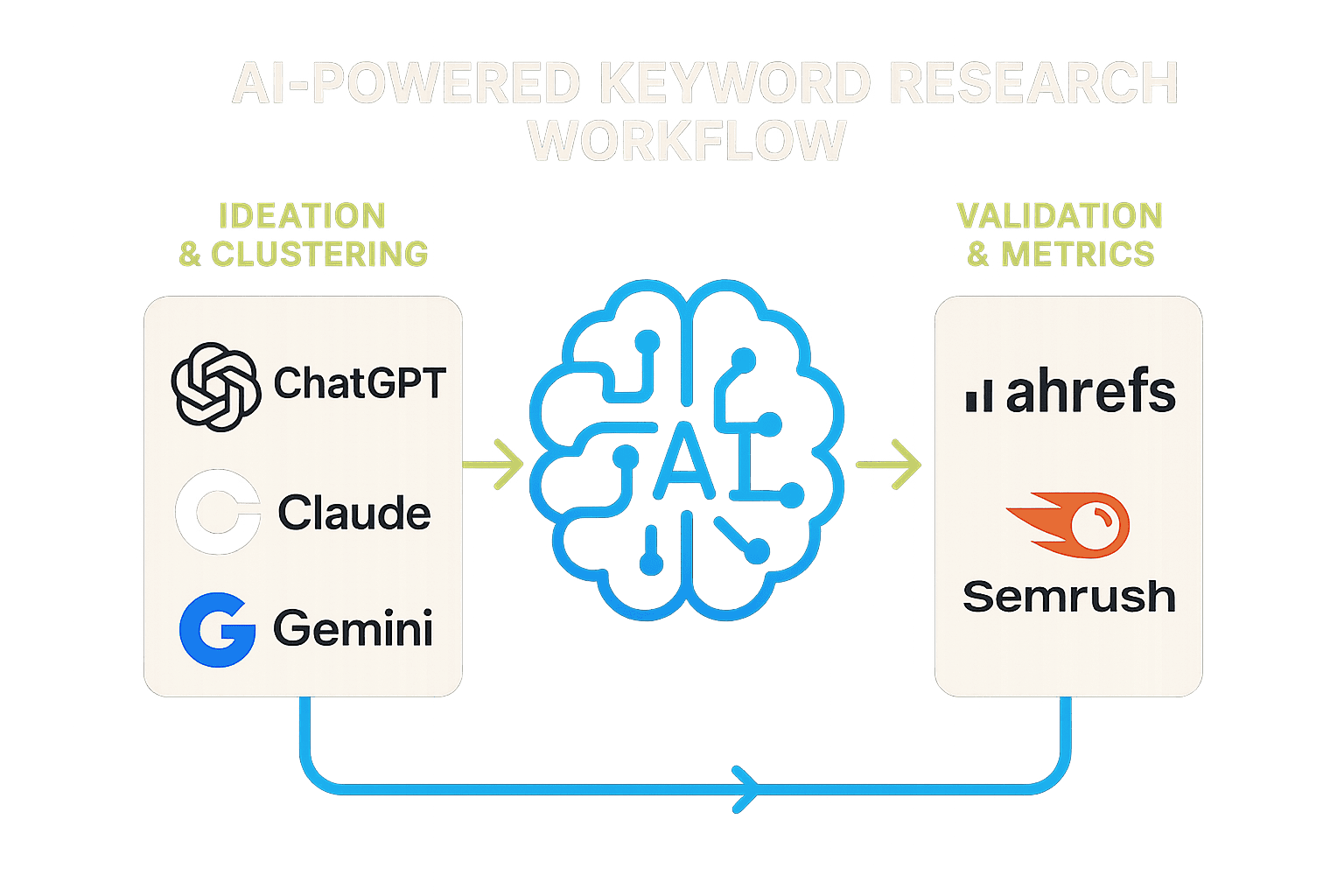
Practical AI Use Cases
- Semantic Keyword Clustering: Feed a list of 100 long-tail keywords to an AI and ask it to group them into semantic clusters based on user intent and topic similarity.
- Content Gap Identification: Provide an AI with your pillar topic and ask it to generate 50 question-based queries that users might search for. Cross-reference these with your keyword research tools to find untapped opportunities.
- Search Intent Analysis: For ambiguous keywords, ask an AI to analyze the likely user intent and suggest appropriate content formats.
- Content Outline Generation: Once you’ve selected a target keyword, use AI to generate a comprehensive content outline based on top-ranking competitor content and common user questions.
Critical Warning: AI Validation is Mandatory
Never trust AI-generated keyword suggestions or search volume data without validation. AI models can hallucinate data, provide outdated information, or misunderstand context. Always cross-reference AI outputs with actual keyword research tools like Ahrefs, Semrush, or Google Keyword Planner before making strategic decisions.
Winning in a Zero-Click World: Optimizing for SERP Features
With nearly 60% of searches ending without a click, optimizing for SERP features—Featured Snippets, People Also Ask boxes, Local Packs, and Knowledge Panels—is no longer optional. These features provide visibility, brand authority, and traffic even in a zero-click environment.
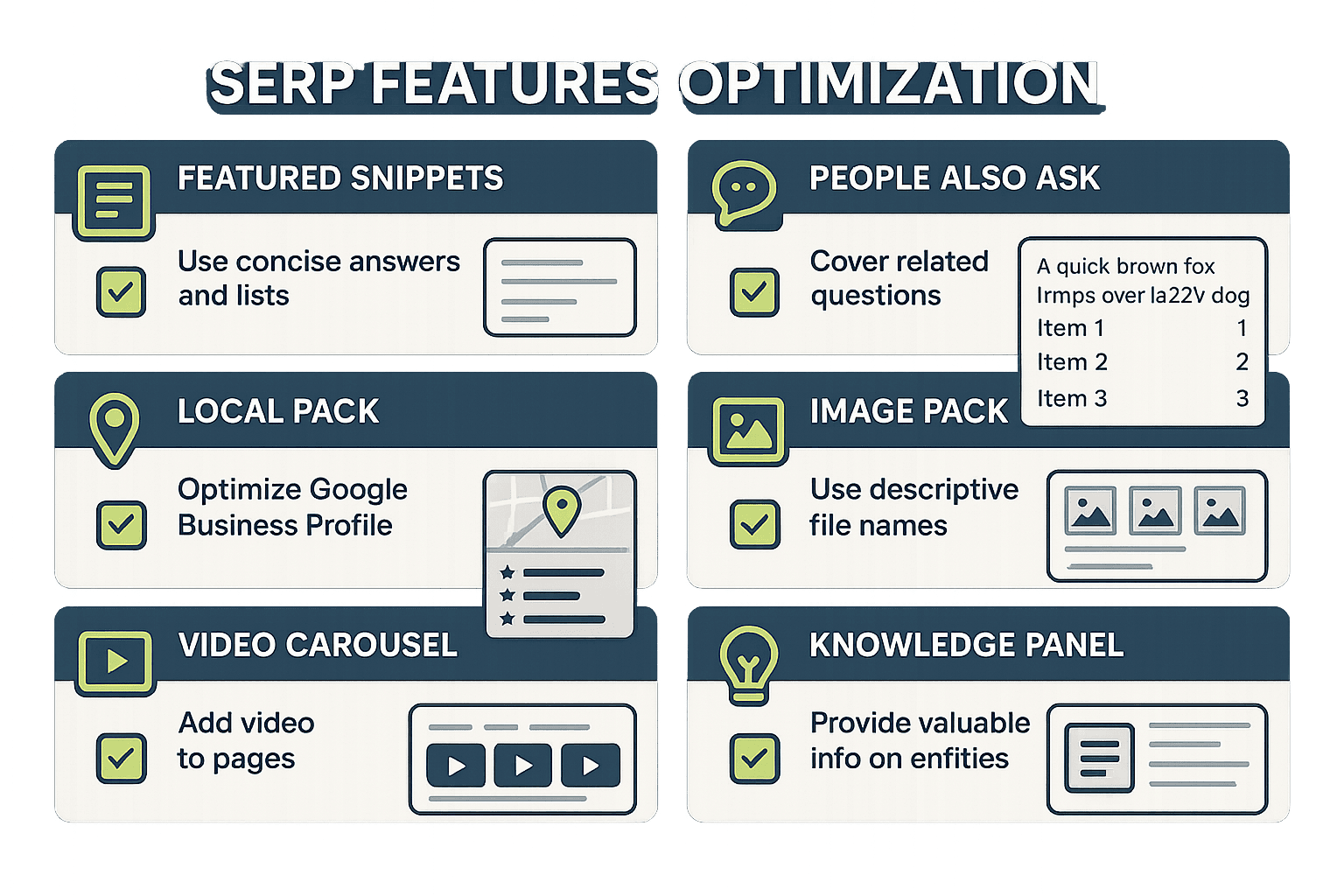
Featured Snippet Optimization
- Target Question-Based Keywords: Featured Snippets most commonly appear for “how to,” “what is,” “why is,” and “best” queries.
- Use Clear, Concise Answers: Provide a direct answer to the question in 40-60 words immediately after the H2 or H3 heading.
- Use Lists and Tables: Google loves structured data. Use numbered lists for step-by-step processes and tables for comparisons.
- Implement FAQ Schema: Use FAQPage schema markup to explicitly tell Google which questions you’re answering.
People Also Ask (PAA) Optimization
- Answer Related Questions: Use tools like AnswerThePublic or AlsoAsked to find related questions. Answer 5-10 of these within your content.
- Use H2/H3 Headings: Format each question as a heading, followed by a concise answer.
- Link Internally: If you have a dedicated page for a PAA question, link to it from your main content.
The Ethical Compass: Navigating AI in Content Strategy
With great power comes great responsibility. As AI becomes more integrated into SEO workflows, it’s essential to maintain ethical standards and avoid practices that could harm users or violate search engine guidelines.
Ethical Guidelines
- Transparency: If AI significantly contributed to your content, consider disclosing this to your audience.
- Human Review: Never publish AI-generated content without thorough human review, fact-checking, and editing.
- Original Value: AI should enhance your unique expertise and perspective, not replace it. Always add original insights, examples, and analysis.
- User-First: The ultimate test is whether your content genuinely helps users. If AI helps you create more helpful content faster, it’s ethical. If it’s used to mass-produce thin, low-value content, it’s not.
Quick Answer: What is the best keyword research tool for beginners?
For beginners, start with Google Keyword Planner (free) and Google Search Console (free). These provide essential search volume data and show which keywords are already driving traffic to your site. Once you’re ready to invest, Semrush offers the most user-friendly interface and comprehensive feature set for $129.95/month. Ahrefs ($99/month) is better for competitive analysis but has a steeper learning curve.
Quick Answer: How many keywords should I target per page?
Target one primary keyword per page, plus 3-5 closely related secondary keywords. Modern SEO is about topical relevance, not keyword stuffing. Google’s AI understands semantic relationships, so a well-written page naturally ranks for dozens of related long-tail variations of your primary keyword. Focus on comprehensively covering the topic rather than forcing multiple unrelated keywords onto one page.
Quick Answer: What is keyword difficulty and how do I use it?
Keyword Difficulty (KD) is a metric (0-100) that estimates how hard it is to rank in the top 10 for a keyword. It’s primarily based on the number and quality of backlinks to currently ranking pages. As a general rule: KD 0-20 (Easy – target these first), KD 21-40 (Medium – achievable with quality content and some backlinks), KD 41-60 (Hard – requires significant authority), KD 61-100 (Very Hard – typically dominated by major brands). Prioritize keywords with KD below 40 when starting out.
Frequently Asked Questions (People Also Ask)
What is the difference between keyword research and content strategy?
Keyword research is the process of discovering and analyzing the specific search terms (keywords) that users enter into search engines. It provides the data foundation—what people are searching for, how often, and how competitive those terms are. Content strategy, on the other hand, is the comprehensive plan for how you will create, publish, and manage content to achieve business goals. It encompasses keyword research but also includes audience analysis, content formats, distribution channels, editorial calendars, and success metrics. In essence, keyword research tells you “what” to create, while content strategy tells you “why,” “when,” “how,” and “for whom.”
How often should I update my keyword research?
Keyword research is not a one-time activity; it’s an ongoing process. At a minimum, conduct a comprehensive keyword research review quarterly (every 3 months) to identify new opportunities, track changes in search volume and competition, and adjust your content calendar accordingly. Additionally, perform monthly check-ins using Google Search Console to see which new keywords are driving traffic to your site and which existing content is losing visibility. Finally, conduct immediate research whenever you’re planning a new content pillar, launching a new product or service, or observing significant changes in your industry or search landscape.
Can I rank for multiple keywords with one piece of content?
Yes, absolutely. In fact, a well-optimized, comprehensive piece of content will naturally rank for dozens or even hundreds of related keywords. This is because Google’s AI understands semantic relationships and topical relevance. When you target one primary keyword and thoroughly cover the topic, you automatically address related queries and long-tail variations. For example, a comprehensive guide targeting “SEO keyword research” will also rank for “how to do keyword research,” “keyword research tools,” “keyword research for beginners,” and many other related terms. The key is to focus on topical depth and user intent rather than trying to force multiple unrelated keywords onto one page.
What is search volume and why does it matter?
Search volume is the average number of times a specific keyword is searched for per month. It’s typically provided as a monthly average based on the past 12 months of data. Search volume matters because it indicates the potential traffic opportunity for a keyword. However, it’s crucial to understand that higher search volume doesn’t always mean better. A keyword with 10,000 monthly searches but low relevance to your business or high competition may be less valuable than a keyword with 500 monthly searches, high relevance, and low competition. Always evaluate search volume in context with keyword difficulty, search intent, and business relevance.
How do I find long-tail keywords?
There are several effective methods for discovering long-tail keywords: (1) Use Google’s autocomplete feature—start typing your seed keyword and note the suggestions, (2) Check the “People Also Ask” and “Related Searches” sections on Google SERPs, (3) Use AnswerThePublic to visualize question-based queries around your topic, (4) Leverage the “Questions” filter in Ahrefs’ Keywords Explorer or Semrush’s Keyword Magic Tool, (5) Analyze your competitors’ content using the “Content Gap” tool to find long-tail keywords they rank for, (6) Use AI tools like ChatGPT to generate potential long-tail variations based on your seed keyword and target audience, and (7) Review your Google Search Console data to see which long-tail queries are already driving impressions to your site.
What is keyword cannibalization and how do I avoid it?
Keyword cannibalization occurs when multiple pages on your website target the same or very similar keywords, causing them to compete against each other in search results. This confuses search engines about which page to rank and often results in both pages ranking lower than if you had one strong, consolidated page. To avoid cannibalization: (1) Conduct a content audit to identify pages targeting the same keywords, (2) Consolidate similar content into one comprehensive page and redirect the others, (3) Differentiate your content by targeting different search intents or stages of the buyer’s journey, (4) Use clear internal linking to signal which page is the primary authority on a topic, and (5) Maintain a keyword mapping document that assigns one primary keyword to each page.
Should I target branded or non-branded keywords?
You should target both, but with different strategies and expectations. Branded keywords (e.g., “Nike running shoes,” “Ahrefs keyword tool”) include your brand name or product names. These typically have high conversion rates because users already know your brand, but they have limited growth potential since they’re restricted to your existing brand awareness. Non-branded keywords (e.g., “best running shoes for marathons,” “keyword research tools for SEO”) don’t include brand names and represent users in the discovery phase. These have much larger search volumes and growth potential but are more competitive and have lower initial conversion rates. A balanced strategy invests heavily in non-branded keywords to drive discovery and growth while also optimizing for branded keywords to capture high-intent traffic from users already familiar with your brand.
How do I prioritize which keywords to target first?
Prioritize keywords using a scoring framework that considers multiple factors: (1) Business Relevance (1-10): How closely does this keyword align with your products, services, or content expertise? (2) Search Volume (1-10): Higher volume = higher potential traffic, (3) Keyword Difficulty (1-10, inverted): Lower difficulty = easier to rank, (4) Search Intent Match (1-10): How well can you satisfy the user’s intent with your content? (5) Current Ranking (bonus points): If you’re already ranking on page 2-3, you can often reach page 1 with optimization. Calculate a total score for each keyword and prioritize those with the highest scores. As a general rule, start with low-difficulty, high-relevance keywords to build momentum, then gradually tackle more competitive terms as your domain authority grows.
Conclusion: From Research to Revenue Engine
Mastering SEO keyword research and content strategy in 2025 is not about finding shortcuts or gaming algorithms. It’s about developing a systematic, strategic approach to understanding your audience, mapping their journey, and creating content that genuinely serves their needs at every stage. The frameworks and tools presented in this guide—understanding search intent and keyword types, leveraging both free and premium research tools, implementing the Pillar-Cluster model, mapping keywords to the buyer’s journey, conducting competitor analysis, integrating AI ethically, and optimizing for SERP features—provide a comprehensive blueprint for building a dominant content ecosystem.
The digital landscape will continue to evolve. AI will become more sophisticated, search behavior will fragment further, and new platforms will emerge. But the fundamental principles remain constant: understand your audience deeply, demonstrate undeniable expertise and authority on your core topics, satisfy user intent at every touchpoint, and create content that is genuinely helpful for both humans and AI. By mastering these principles and executing the strategies outlined in this guide, you transform keyword research from a tactical exercise into a strategic revenue engine that drives sustainable, long-term growth.
The battlefield of search in 2025 is complex, fragmented, and AI-driven. But with the right strategy, tools, and execution, it’s a battlefield you can dominate.
Ready to Dominate Your Market with Strategic SEO?
Phoenix SEO Geek specializes in data-driven keyword research and content strategy that drives real business results. Let’s build your content ecosystem together.
Related Resources
- Phoenix SEO Services – Complete Guide
- Local SEO Guide for Phoenix Businesses
- AI SEO Guide – Mastering GEO and AEO
- Get Your Free SEO Audit – Call Today! (480) 842-5055
- Contact Phoenix SEO Geek

Travis Wilkie is the entrepreneurial force behind one of the most results-driven local search agencies in Arizona. With over a decade of front-line marketing experience and a proven track record of engineering dramatic lead-flow systems for service businesses, his mindset is simple: show up where your prospects are searching, talk to them in real-time, and turn clicks into calls into revenue.
Marketing isn’t about being loud—it’s about being present, persuasive, and persistent. Travis believes that by combining high-touch digital systems (chat, phone, reviews) with laser-focused geo-SEO and AI automation, the difference between “average” and “exceptional” becomes a choice you control.
If you’re a contractor, home-service provider or local business owner in the Phoenix region, partnering with Travis means you’ll:
-
Become highly visible in the coveted Google “3-Pack” map results for entire service territories—so you capture customers who search with intent.
-
Deploy AI chatbots and real-time interaction systems that greet website visitors, book service calls, and nurture leads without you having to chase them.
-
Generate more reviews, build a reputation machine, and turn your online presence into a revenue engine—not just a brochure site.
-
Move past “hopeful marketing” and into “predictable pipeline” mode: you’ll see the metrics that matter, understand the ROI, and scale what works.